This guide explains the main visa options available to UK entrepreneurs, what each requires, how to apply, and the most common mistakes that lead to delays or denials.
Key Takeaways
- UK founders choose between the E-2, L-1A, O-1A, or EB-5 visa depending on their situation
- E-2 Treaty Investor is the most practical route for UK entrepreneurs — investment amount isn't fixed, but must be "substantial" relative to the business
- Seeking a green card? The EB-5 requires a minimum $800,000–$1,050,000 capital investment
- Poor documentation and incorrect visa structuring are the leading causes of application rejection
- Consult an immigration attorney before forming a US entity
Why UK Entrepreneurs Are Expanding to the US
The US remains the top destination for UK founders seeking access to the world's largest consumer market and deepest venture capital networks. US-UK goods and services trade totalled $340.1 billion in 2024, up 7.9% from 2023, while Silicon Valley retains its #1 global startup ecosystem ranking. US-based startups received $170.6 billion in funding in 2023, confirming the US as the world's deepest capital market for scaling ventures.
UK entrepreneurs can legally own a US LLC or corporation without a visa. A visa is only required when physically working and operating the business from within the US — a misconception that leads many founders to apply for the wrong visa category entirely.
Understanding visa eligibility is straightforward for UK nationals — Brexit changed very little here. The UK's bilateral treaty with the US remains fully intact, and UK founders hold several built-in advantages:
- E-1 and E-2 treaty access: UK passport holders retain full eligibility for both treaty visa categories, independent of EU membership
- No sponsorship required: Unlike many work-based visas, E-2 applicants self-petition through their own investment — no US employer needed
- Broad sector coverage: Treaty trader and investor visas apply across most industries, from tech startups to professional services
US Business Visa Options for UK Entrepreneurs
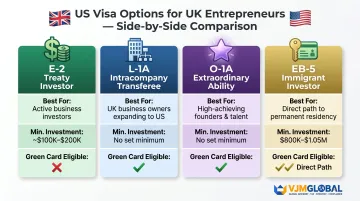
The right visa depends on four factors: investment size, whether an overseas business already exists, the entrepreneur's professional profile, and whether permanent residency is the goal. Each option below addresses a different combination of these factors.
| Visa | Best For | Investment Required | Green Card Path? |
|---|---|---|---|
| E-2 | Active investors starting/buying a US business | ~$100,000+ | No |
| L-1A | UK business owners expanding into the US | None | Yes (via EB-1C) |
| O-1A | High-achieving founders and executives | None | No (direct) |
| EB-5 | Investors seeking permanent residency | $800K–$1.05M | Yes |
E-2 Treaty Investor Visa
The E-2 is the most commonly used visa for UK entrepreneurs. It requires a "substantial" capital investment in a US business the applicant will actively direct. There is no fixed minimum amount, but investments below $100,000 rarely qualify. The E-2 is renewable indefinitely with no annual cap but does not provide a direct path to permanent residency.
Key requirements:
- Substantial investment proportional to total business cost
- At least 50% ownership or operational control
- Investment funds must be "at risk" and from lawful sources
- Enterprise cannot be marginal (must support more than just the investor's living)
L-1A Intracompany Transferee Visa
Already running a UK business and looking to expand into the US? The L-1A is built for that scenario. It requires at least one year of managerial or executive employment with the overseas entity within the last three years. The initial stay is one year for new US offices, extendable up to seven years total — and it can serve as a stepping stone to the EB-1C green card.
Key requirements:
- Qualifying relationship between UK and US entities (parent, branch, subsidiary, or affiliate)
- Executive or managerial role in both entities
- Continuous employment abroad for one year within the preceding three years
O-1A Extraordinary Ability Visa
High-profile UK founders, researchers, or executives with a demonstrable record of exceptional achievement may qualify for the O-1A. There is no nationality restriction, no annual lottery, and no minimum investment.
That said, it requires strong documented evidence of acclaim — awards, published work, or significant media coverage. Many applicants underestimate how difficult self-qualifying can be without thorough preparation.
Key requirements:
- Receipt of a major internationally recognised award (e.g., Nobel Prize), OR
- At least three of eight evidentiary criteria, including nationally recognised prizes, membership in distinguished associations, published media coverage, or evidence of original contributions of major significance
EB-5 Immigrant Investor Visa
For UK entrepreneurs whose end goal is permanent US residency, the EB-5 is the primary investment-based route. The minimum investment is $800,000 in a Targeted Employment Area or $1,050,000 in standard areas.
The business must create or preserve 10 full-time jobs for US workers within two years. Investors receive a conditional 2-year green card, upgradeable to permanent residency after filing Form I-829.
Key requirements:
- Minimum capital investment at specified thresholds
- Creation of 10 full-time jobs within two years
- Documented lawful origin of funds (7 years of personal tax returns)
- Evidence that funds are at risk in a commercial enterprise
How to Apply for a US Business Visa: Step-by-Step for UK Entrepreneurs
The application process differs depending on the visa type, but most UK entrepreneurs applying from outside the US follow a general sequence: structure the business entity first, then apply for the visa at the US Embassy in London.
Step 1: Confirm Treaty Eligibility and Choose the Right Visa
The first step is confirming which visa category fits your profile:
- Nationality check for E-2: UK nationals qualify under the 1815 UK-US Treaty of Commerce and Navigation
- Prior overseas employment for L-1A: At least one year in a managerial or executive role with the foreign entity
- Investment capacity for EB-5: Minimum $800,000–$1,050,000 in lawful, traceable funds
Choosing incorrectly at this stage causes the most downstream problems. Consult an immigration attorney before proceeding.
Step 2: Form the US Business Entity and Prepare Documentation
For E-2 and EB-5, a US entity (typically an LLC or C-Corp) must be formed and investment funds committed before filing. Required documentation typically includes:
- Detailed business plan with market analysis, financial projections, job creation timeline, and management structure
- Proof of investment origin (bank statements, tax returns, property sales records)
- Evidence of ownership structure
The business plan is the most heavily scrutinised element of any E-2 application. USCIS treats it as evidence that the enterprise is viable, scalable, and not marginal. A qualifying plan must demonstrate the business will generate sufficient income to support the investor and their family — and ideally create jobs for US workers.
Getting the financial records and business structure right at this stage is critical. Firms with cross-border accounting and compliance experience — such as those specialising in international business structuring — can help ensure your documentation meets USCIS standards before submission.
Step 3: File the Application and Attend the Visa Interview
For E-2:
- Complete Form DS-160 (Online Nonimmigrant Visa Application) and DS-156E (Nonimmigrant Treaty Trader/Investor Application)
- Schedule an interview at the US Embassy in London
- Current processing times for petition-based temporary workers show wait times of less than 0.5 months, though E-2 visas are processed separately
For EB-5:
- File Form I-526 or I-526E with USCIS before consular processing
- Processing times range from 11.5 to 61 months depending on project category (rural projects process fastest)
Premium processing (15 business days via Form I-907) is available for E-2, L-1A, and O-1A petitions but not for EB-5.
Step 4: Maintain Compliance After Approval
Approval doesn't end your obligations. UK entrepreneurs must:
- Maintain the business activity that justified the visa
- Track renewal deadlines (E-2 renewals every two years; L-1A extensions every two years up to seven years total)
- Adjust status if business circumstances change (for example, expanding headcount or bringing in co-founders)
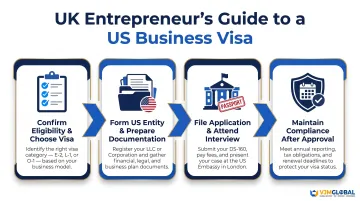
Failure to maintain compliance is a common cause of visa revocation.
Key Eligibility Factors That Affect a UK Entrepreneur's Application
USCIS evaluates E-2 and EB-5 applications against four core eligibility tests. Understanding each one helps you structure your application — and your investment — to meet the standard.
The Substantiality Test for E-2
The investment must be proportional to the total cost of establishing or acquiring the business. USCIS uses an "inverted sliding scale": lower-cost businesses require a higher percentage of investment, while highly expensive businesses may qualify with a lower percentage.
Key principles:
- An investment of 100% of the business cost is always considered substantial
- A $10 million investment in a $100 million business (10%) may qualify based on sheer magnitude
- There are no "bright line" percentages—each case is evaluated individually
- Investments below $100,000 rarely qualify in practice
The Marginality Test
A marginal enterprise is one that only generates enough income to support the investor's household — with no surplus capacity. An enterprise escapes this classification by demonstrating a "significant economic contribution," typically through hiring US workers.
Five-year rule: A new enterprise that currently lacks this capacity must demonstrate the capacity to generate such income within five years from the date the investor's E-2 classification begins.
Investment Funds Must Be "At Risk"
Funds must be subject to partial or total loss in the commercial sense, with the objective of generating profit. USCIS requires a clear paper trail showing funds came from legitimate sources:
- Bank statements covering the full investment amount
- Personal tax returns (7 years for EB-5)
- Evidence of property sales, business proceeds, or inheritance
- Documentation of fund transfers into the US entity
Undocumented fund origins are a common basis for denial.
The Business Plan Requirement
USCIS and the US Embassy treat the business plan as evidence that the enterprise is viable, scalable, and not marginal. A qualifying business plan must include:
- Market analysis demonstrating demand and competitive positioning
- Detailed financial projections (typically 5 years)
- Job creation timeline showing when and how US workers will be hired
- Management structure and operational plan
- Evidence that the business will generate sufficient revenue beyond the investor's living expenses
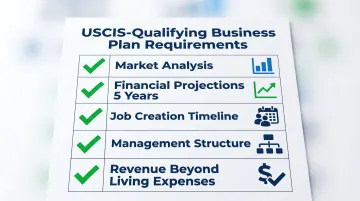
Generic or template plans without specific financial backing are frequently rejected. VJM Global works with UK clients on the financial projections and cross-border documentation that underpin a credible business plan submission.
Common Mistakes UK Entrepreneurs Make
Forming the US Entity Before Confirming Visa Eligibility
The most frequent error is forming the US business entity or committing investment capital before confirming visa eligibility. This can create a situation where funds are locked in a structure that doesn't satisfy visa requirements, or worse, where the business has already begun operations without work authorisation.
Solution: Consult an immigration attorney before incorporation.
Assuming Ownership Equals Work Authorisation
Many UK entrepreneurs assume that owning a US company automatically grants the right to work in the US. This is incorrect. Physical business activity in the US requires work authorisation through an approved visa, regardless of ownership structure.
Solution: Obtain the appropriate visa status before engaging in day-to-day business operations on US soil.
Submitting Weak or Generic Documentation
Under-evidenced investment origins, weak or generic business plans, and inconsistent company ownership structures across filings are the leading causes of E-2 and EB-5 denials or Requests for Evidence (RFE) from USCIS.
Common documentation gaps:
- Incomplete fund traceability (missing bank statements or tax returns)
- Business plans that read like templates without specific financial projections
- Inconsistent ownership percentages across formation documents and visa applications
- Failure to demonstrate job creation potential
Solution: Prepare comprehensive, specific documentation with professional support. VJM Global's cross-border accounting expertise — including fund traceability records, audited financials, and detailed financial projections — directly addresses the documentation gaps that most commonly trigger RFEs or denials. With over 250 UK businesses served, the firm understands exactly what reviewers expect to see.
Frequently Asked Questions
What visa can I use to start a business in the USA?
There is no single startup visa. The most common routes for UK entrepreneurs are the E-2 Treaty Investor visa (for those making a substantial investment) and the L-1A (for those transferring from an existing UK business). Other options include O-1A and EB-5 depending on your profile and goals.
Can UK citizens apply for an E-2 visa?
Yes. UK passport holders are fully eligible for the E-2 Treaty Investor visa because the UK and US maintain a qualifying Treaty of Commerce and Navigation in place since 1815. This eligibility was unaffected by Brexit.
Is an O-1 visa difficult to get?
The O-1A requires substantial documented evidence of extraordinary ability — published work, awards, industry recognition, or significant media coverage. Qualification demands a strong, well-structured evidence file, and most applicants work with an experienced immigration attorney to build a compelling case.
What investment is required for an EB-5 investor green card?
Any foreign national, including UK citizens, can apply for the EB-5. The minimum investment is $800,000 in a Targeted Employment Area or $1,050,000 elsewhere. The business must also create at least 10 full-time US jobs within two years.
Do I need a visa to own a US business as a UK entrepreneur?
No visa is required to own a US LLC or corporation. A visa is only required if you intend to physically work and operate the business from within the United States.
How long does an E-2 visa take to process for UK applicants?
E-2 visas are handled through a dedicated treaty visa unit at the US Embassy in London, with current wait times under 0.5 months. Check the US Embassy London website for up-to-date appointment availability. Premium processing (15 business days) is available for petitions filed directly with USCIS.