Introduction
Where you incorporate your business in the US isn't just paperwork — it's a tax decision that compounds over years. According to COST/EY's FY2024 analysis, total effective business tax rates vary from 3.2% to 10.6% of private-sector GDP depending on the state. That gap is real money.
Most founders default to their home state without running the numbers. Others hear "Delaware" or "Wyoming" and incorporate there without understanding what that actually means for their tax bill once they start operating.
We'll cover the five states that consistently offer the strongest tax advantages, then help you identify which one fits your business type, operating model, and growth stage.
Key Takeaways
- Wyoming and Nevada impose no corporate or personal income tax — the lowest overall tax burden for most small businesses and LLCs
- Delaware is the incorporation choice for investor-backed companies, not a tax minimization play
- Texas and North Carolina offer competitive corporate tax rates for businesses that need a physical presence
- Registering in a tax-friendly state does not erase tax obligations in the state where your business actually operates
- Entity type (LLC vs. C-Corp) carries the same weight as state selection — get both decisions right together
Why State Tax Laws Matter More Than You Think
Federal taxes apply the same rules to every business in the country. State taxes are a different story — and the gap between states can cost or save a business tens of thousands of dollars annually.
Businesses pay state-level taxes across several categories: corporate income tax, personal income tax (for pass-through entities), sales tax, franchise taxes, and gross receipts taxes. Each state structures these differently, and Tax Foundation's 2026 data shows the range runs from 0% to 11.5% on corporate income alone.
Entity Type Changes the Calculation Entirely
The "right" state depends heavily on how your business is taxed:
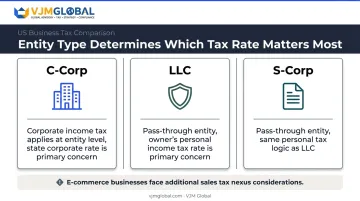
- C-Corps pay state corporate income tax as a separate entity — so the corporate rate is what matters most
- LLCs and S-Corps are pass-through entities, meaning income flows to owners' personal returns — so the personal income tax rate in the owner's state is the primary concern
- E-commerce businesses face a different set of concerns entirely, centered on sales tax nexus rules across states
There is no universally "best state." The right answer depends on your entity type, where your owners live, and how you generate revenue. The five states below cover the strongest options for different business profiles.
Best States to Start a Business for Tax Purposes
These states were selected based on low or zero income tax, minimal franchise or gross receipts taxes, reasonable formation costs, and consistent pro-business tax policy over time.
Wyoming
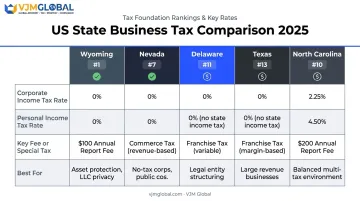
Wyoming ranks #1 on the Tax Foundation's 2025 State Tax Competitiveness Index, driven by one of the simplest tax structures in the country.
What Wyoming offers:
- No corporate income tax
- No personal income tax
- No gross receipts tax (one of only two states with neither)
- LLC annual report fee of just $60 or 0.0002 of Wyoming-based assets, whichever is greater
- No public disclosure of LLC member names at formation
| Tax Type | Rate |
|---|---|
| Corporate Income Tax | None |
| Personal Income Tax | None |
| State Sales Tax | 4% statewide (counties may add up to 3%) |
| Annual LLC Fee | $60 minimum |
Wyoming works especially well for holding companies, single-member LLCs, and founders who prioritize tax efficiency and privacy. One caveat: if your business has no actual Wyoming presence, you'll still owe taxes where you operate.
Nevada
Nevada takes a similar approach to Wyoming: no corporate income tax, no personal income tax, but with a slightly different structure for larger businesses.
Nevada's Commerce Tax applies only when Nevada gross revenue exceeds $4 million in a taxable year, with rates varying by industry (retail: 0.111%; manufacturing: 0.091%). For early-stage businesses nowhere near that threshold, it's effectively irrelevant.
What Nevada offers:
- No corporate or personal income tax
- Commerce Tax kicks in only above $4M in Nevada gross revenue
- Growing startup ecosystem, particularly in Las Vegas and Reno
- Geographic advantage for businesses serving California without California's tax burden
| Tax Type | Rate |
|---|---|
| Corporate Income Tax | None |
| Personal Income Tax | None |
| Commerce Tax | Applies above $4M Nevada gross revenue |
| State Sales Tax | 6.85% base (local additions apply) |
Nevada does require public filing of officers/directors for corporations and managers/managing members for LLCs. It's not fully anonymous at the entity management level, despite some marketing to the contrary.
Nevada ranks #17 on the Tax Foundation's 2025 index. Wyoming's simpler structure edges it out for pure tax minimization, but Nevada holds its own for businesses with a genuine western US presence.
Delaware
Delaware is the incorporation capital of the US. 66.7% of Fortune 500 companies are incorporated there, and it dominates VC-backed company formation. The reason isn't income tax savings.
Delaware's appeal is its legal infrastructure: the Court of Chancery (a specialized business court with 200+ years of precedent), investor-familiar governance structures, and straightforward share class customization for fundraising.
The key tax nuance: A Delaware-incorporated company that doesn't actually conduct business in Delaware is generally not required to file a Delaware corporate income tax return.
Only the annual franchise tax applies, running from a $175 minimum up to $200,000 depending on method and share structure.
| Tax Type | Rate |
|---|---|
| Corporate Income Tax | 8.7% — but only on income sourced within Delaware |
| Personal Income Tax | 2.2% to 6.6% (for Delaware residents) |
| Sales Tax | None |
| Annual Franchise Tax | $175–$200,000 depending on method |
Delaware isn't a tax minimization strategy. It's an investor-readiness strategy. If you're raising venture capital, Delaware is close to mandatory. If you're not, Wyoming or Nevada will serve you better on pure tax grounds.
Texas
Texas has no corporate income tax and no personal income tax, backed by a constitutional prohibition on individual income taxes. For businesses that need a real physical presence (employees, offices, operations), Texas offers the rare combination of tax efficiency and a large domestic market.
The franchise (margin) tax applies above a revenue threshold of $2.47M for 2024–2025 reports, rising to $2.65M for 2026–2027.
Above that threshold, rates are 0.375% for retail/wholesale and 0.75% for other businesses, calculated under margin rules rather than straight gross revenue.
| Tax Type | Rate |
|---|---|
| Corporate Income Tax | None |
| Personal Income Tax | None |
| Franchise (Margin) Tax | No tax due below $2.47M threshold; 0.375%–0.75% above |
| State Sales Tax | 6.25% + up to 2% local |
Texas has attracted 314 announced headquarters relocations between 2015 and 2024, with companies citing tax structure, cost of operations, and market access as primary drivers.
Texas ranks #7 on the Tax Foundation's 2025 index, the strongest ranking of any large state with significant economic infrastructure.
North Carolina
North Carolina is the standout choice for businesses that need a physical operating presence but don't want to sacrifice tax competitiveness. It carries the lowest corporate income tax rate among states that levy one: currently 2.5% for 2024, declining to 2.25% in 2025, 2% in 2026, and scheduled to reach 0% after 2029.
The personal income tax is a flat 4.5% for 2024, dropping to 4.25% in 2025 and 3.99% after 2025, with further reductions tied to revenue triggers.
| Tax Type | Rate |
|---|---|
| Corporate Income Tax | 2.5% (2024); declining to 0% after 2029 |
| Personal Income Tax | 4.5% flat (2024); declining schedule |
| State + Local Sales Tax | ~6.99% combined average |
Beyond taxes, North Carolina's Research Triangle (anchored by Duke, UNC Chapel Hill, and NC State) produces roughly 42,000 bachelor's degrees annually and holds the country's fourth-highest PhD concentration. For businesses where talent access matters as much as tax rates, no other state on this list comes close.
North Carolina ranked #2 overall in CNBC's 2024 Top States for Business, and #12 on the Tax Foundation's 2025 index.
How to Choose the Best State for Tax Purposes
The most common mistake is treating state selection as purely an incorporation decision. It's not — it's a nexus decision.
The fundamental rule: If your business has a physical presence in a state — employees, an office, a warehouse — you owe that state's taxes regardless of where you incorporated. California's Franchise Tax Board, for example, applies the $800 minimum franchise tax to any entity doing business in California, even if it was formed in Wyoming.
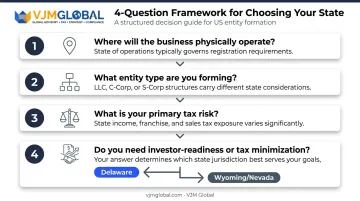
The 4-Question Framework
Work through these before choosing a state:
- Where will the business physically operate? This determines where you'll owe taxes regardless of incorporation state.
- What entity type are you forming? C-Corp? State corporate rate matters. LLC or S-Corp? Your personal income tax rate matters more.
- What is your primary tax risk? Income tax, sales tax, or franchise tax? Each state's profile differs.
- Do you need investor-readiness or tax minimization? Delaware serves the first; Wyoming and Nevada serve the second.
Foreign Qualification — Don't Skip This
If you incorporate in Wyoming but operate in California, you'll need to register as a foreign entity in California and comply with California tax law. Tax nexus and secretary-of-state qualification are separate processes — a tax obligation can arise even without formal qualification.
Foreign investors, NRIs, and multinational founders face an additional layer: federal withholding rules, US tax treaty positions, and state-specific rules for non-resident owners all interact in ways that vary by state and entity type.
Getting this wrong means double compliance obligations — not just extra paperwork. VJM Global works specifically with international founders on these cross-border structures, combining US-office presence with deep experience across 500+ American business engagements.
Common Mistakes to Avoid
Incorporating Out of State Without Registering as a Foreign Entity
Incorporating in Wyoming but physically running the business from California or New York triggers foreign entity registration requirements in those states. Skip that step and you're looking at back taxes, penalties, and potentially losing the ability to enforce contracts in your home state.
Counting Only the Headline Tax Rate
A state with no income tax can still be expensive to operate in. Annual report fees, mandatory registered agent costs, and franchise taxes add up fast. Always calculate the total annual cost of maintaining an entity — not just the income tax rate — before committing to a state.
Picking Entity Type and State as Separate Decisions
Many founders choose Delaware incorporation for investor optics without realizing the cost: C-Corps face double taxation, with corporate tax at the entity level and personal tax again on dividends. An LLC or S-Corp in the same state avoids that entirely. Entity type and state selection are one decision, not two.
Conclusion
There is no single best state for every business. The right answer depends on where you operate, how your entity is structured, and which tax exposures matter most.
- Wyoming and Nevada for maximum tax minimization with no physical presence requirement
- Delaware for investor-backed companies where legal infrastructure and fundraising optics matter
- Texas for businesses that need real operations in a large market with strong tax efficiency
- North Carolina for companies prioritizing talent access alongside declining tax rates
For foreign investors, NRIs, and cross-border entrepreneurs, the cost of getting entity type and state selection wrong compounds over years — restructuring mid-stream is expensive and disruptive. VJM Global's advisory team helps international founders work through these decisions: entity structuring, state-by-state tax analysis, and multi-year compliance planning from day one. Reach out at [email protected] or contact the US office at 447 Broadway, 2nd Floor, New York, NY 10013.
Frequently Asked Questions
What is the most tax-friendly state for businesses?
Wyoming and Nevada rank as the most tax-friendly states overall — both impose no corporate income tax and no personal income tax. Wyoming edges ahead on simplicity: Nevada's Commerce Tax partially applies above $4M in revenue, while Wyoming has no equivalent gross receipts tax.
What state has the lowest taxes for an LLC?
For LLCs, personal income tax in the owner's state matters most since LLCs are pass-through entities. Wyoming, Nevada, South Dakota, Texas, and Florida all have no personal income tax, making them the strongest options — provided the business operates there or the owner resides there.
Do I pay taxes where I incorporate or where I operate?
Generally, both. Businesses owe taxes in states where they have nexus — physical presence, employees, or significant economic activity. Incorporating in Wyoming doesn't exempt you from California's taxes if that's where you're actually running the business.
Can a foreign national or non-resident incorporate in any US state?
Yes. Non-US residents can incorporate in any US state, with Delaware, Wyoming, and Nevada being the most popular choices. Foreign-owned entities need an EIN, a registered agent in the state of formation, and compliance with applicable federal tax obligations.
What is the difference between a corporate income tax and a franchise tax?
Corporate income tax applies to net profits. A franchise tax is a fee for the privilege of doing business in a state, calculated on authorized shares, net worth, or revenue, and it applies even when a business reports zero profit. Delaware and California both charge franchise taxes regardless of profitability.