Introduction
Malaysia is becoming one of the easiest ASEAN entry points for Indian founders. Full foreign ownership, English-language business norms, and a two-and-a-half-hour flight from most Indian metros make it a natural first stop for outbound expansion.
This guide is written for Indian entrepreneurs, SMEs, and companies evaluating Malaysia as their next market. Many struggle with a split compliance burden. Malaysian incorporation alone is not enough; RBI outbound investment rules must be cleared before a single rupee leaves the country.
Most guides stop at the Malaysian registration steps. This one covers both tracks: the SSM incorporation process in Malaysia and the FEMA/RBI approvals required back home, including where firms like VJM Global fit into that cross-border picture.
Key Takeaways
- Own up to 100% of most Malaysian sectors through a Private Limited Company (Sdn. Bhd.)
- Run SSM/MyCoID incorporation and India’s RBI ODI/FEMA filings as two parallel tracks
- Expect low government fees—but much higher paid-up capital once you seek work visas
- Use the India-Malaysia DTAA and CECA/MICECA to cut double tax and trade friction
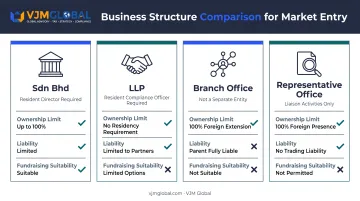
- Pick Sdn Bhd, LLP, Branch, or Representative Office by ownership and liability needs
Why Indian Entrepreneurs Are Expanding to Malaysia
Malaysia sits at the centre of an ASEAN market of over 600 million consumers, and its own economy is far from small. The IMF projects Malaysia's nominal GDP at US$516.43 billion for 2026, with real GDP growth of 4.7% — one of the stronger rates among comparable Asian economies.
Tax and Regulatory Advantages
Malaysia's standard corporate tax rate is 24%, with a preferential band of 15–17% for qualifying MSMEs on the first RM600,000 of chargeable income.
India's domestic rate is 25% below ₹400 crore turnover and 30% above it. Headline rates are close; the MSME band is where Malaysia pulls ahead for growth-stage entities.
Malaysia also charges no withholding tax on dividends paid to overseas shareholders — a meaningful advantage when repatriating profits to India.
Two bilateral frameworks support cross-border structures:
- India-Malaysia DTAA prevents the same income from being taxed twice
- CECA/MICECA reduces trade friction between the two economies
Practical Advantages for Indian Founders
A handful of operational factors keep coming up in client conversations:
- Roughly a 2.5-hour time difference with India, making daily coordination easy
- English functions as the standard language of business and government filings
- An established Indian-origin business community across Kuala Lumpur and Penang
- 15th in the 2026 IMD World Competitiveness Ranking, up eight places year on year
For SMEs testing ASEAN before committing to pricier hubs like Singapore or Hong Kong, Malaysia offers a lower-cost proving ground without sacrificing regulatory credibility.
Business Structures Available to Indian Entrepreneurs in Malaysia
Choosing the right vehicle shapes everything downstream: liability, fundraising ability, and visa eligibility included.
Private Limited Company (Sdn. Bhd.)
The Sdn. Bhd. is the default choice for most Indian founders. It permits up to 100% foreign ownership in the majority of sectors, with exceptions in regulated industries such as banking, private education, and oil and gas, where sector-specific licences may impose local participation conditions.
Key requirement: at least one director must ordinarily reside in Malaysia, with a principal place of residence there.
Limited Liability Partnership (LLP)
An LLP allows foreign partners without any residency requirement for the partners themselves. However, the compliance officer must be a Malaysian citizen or permanent resident, ordinarily resident in Malaysia. LLPs work well for professional services or joint ventures but are poorly suited to equity fundraising, since investors generally prefer a share-based structure.
Branch Office and Representative Office
These serve very different purposes:
- Branch Office — lets an Indian parent operate directly in Malaysia under its own name. The parent company remains fully liable for local debts and obligations; it isn't a separate legal entity.
- Representative Office — restricted to non-revenue activities such as market research, feasibility studies, and liaison work. It cannot sign contracts, invoice clients, or trade.
Sole Proprietorship and Partnership
These structures are legally limited to Malaysian citizens or permanent residents. Most Indian founders without PR status cannot register one, so this option is off the table for first-time entrants.
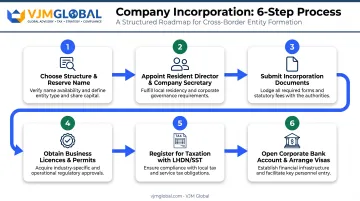
Step-by-Step Process to Register a Company in Malaysia from India
Incorporation runs through the Companies Commission of Malaysia (SSM) and a short chain of tax, licensing, and banking steps. Follow this sequence to move from name reservation to a compliant operating setup.
Step 1: Choose a Structure and Reserve a Company Name
Once you've settled on Sdn Bhd (the common choice), run a name search and reservation through the MyCoID portal, operated by the Companies Commission of Malaysia (SSM). The reservation costs RM50 and stays valid for 30 days.
Step 2: Appoint a Resident Director and Company Secretary
Two roles are non-negotiable:
- At least one resident director, someone with a principal residence in Malaysia
- A licensed company secretary, appointed within 30 days of incorporation, who must be a Malaysian citizen or PR, ordinarily resident locally
Most Indian founders satisfy this through a nominee director or a corporate services provider until they relocate or hire locally.
Step 3: Prepare and Submit Incorporation Documents
You'll need:
- Proposed company name and business activity description
- Registered Malaysian address and business address
- Full director and shareholder details, with passport copies for Indian directors
- Compliance declarations
Submit through MyCoID along with the government fee: RM1,000 for a Sdn Bhd, or RM500 for an LLP.
Step 4: Obtain Business Licences and Sector-Specific Permits
Depending on the industry, additional approvals may be required from bodies like MITI or local municipal councils. Manufacturing businesses, for instance, need a manufacturing licence once shareholders' funds hit RM2.5 million or more, or employee headcount reaches 75 full-time staff.
Step 5: Register for Malaysian Taxation
Register with the Inland Revenue Board (LHDN) through MyTax for a tax identification number. If your business crosses the relevant threshold, register for Sales and Service Tax (SST) too. The standard service tax rate is 8%, though F&B stays at 6%.
Step 6: Open a Corporate Bank Account and Arrange Visas
Malaysian banks apply strict KYC checks under Bank Negara Malaysia guidelines, and Indian directors typically need to be physically present for account opening. For relocating founders, common visa pathways include:
- Employment Pass (Category I or II) for salaried roles
- Malaysia Tech Entrepreneur Programme (MTEP) for tech founders
If you are not moving yet, appoint a local country manager or use an Employer of Record to build a compliant presence first.
FEMA, RBI Approval and Cross-Border Tax Compliance for Indian Investors
Setting up in Malaysia is only one side of the equation. Any Indian entity or resident individual investing abroad must comply with the Overseas Direct Investment (ODI) framework under FEMA, routed through an Authorised Dealer (AD) bank.
Automatic Route vs. Approval Route
Most transactions qualify for the automatic route, processed directly through the AD bank. But there are hard limits:
- Total financial commitment across all foreign entities cannot exceed 400% of the Indian entity's net worth, based on the last audited balance sheet
- Any single-year commitment exceeding USD 1 billion requires prior RBI approval, even if it's within the 400% cap
- Commitments beyond 400% need government permission, reserved for specified strategic sectors under the FEMA Overseas Investment Rules
Reporting Obligations
Two filings matter most:
- Form FC, filed at the time of investment, recording the Indian investor, the foreign entity, and the route used
- Annual Performance Report (APR), filed yearly to report the Malaysian subsidiary or JV's financial performance
Miss these, and future ODI transactions can get stuck for compliance reasons alone.
Avoiding Double Taxation
The India-Malaysia DTAA ensures profits earned through a Malaysian entity aren't taxed twice. Both countries offer foreign tax credit relief, subject to domestic limits.
Separately, Indian residents must disclose their Malaysian shareholding under Schedule FA in their Indian income tax return, regardless of whether any income was repatriated.
Coordinating SSM filings in Malaysia with FEMA and RBI compliance in India is where most Indian entrepreneurs stumble. VJM Global handles outbound investment structuring, RBI reporting, and ODI filings within its FEMA and FDI advisory work, so both sides of the border stay aligned before capital moves.
Costs, Taxation and Visa Requirements in Malaysia
Three figures shape your Malaysia setup budget from India: government fees, paid-up capital, and the salary thresholds tied to work passes.
Incorporation and Compliance Costs
Government fees are low:
- Name reservation: RM50
- Sdn Bhd incorporation: RM1,000
- LLP incorporation: RM500
Professional and company secretarial fees vary by provider, so get itemised quotes upfront.
The bigger number to plan around is capital. Share capital can start at a nominal figure, but foreign-owned entities applying for an Employment Pass typically need paid-up capital of RM500,000. That rises to RM1 million for foreign-owned companies with 51%+ equity in wholesale or retail trade.
Corporate and Personal Taxation
| Item | Malaysia | India |
|---|---|---|
| Standard corporate tax | 24% | 25-30% |
| SME preferential rate | 15-17% (first RM600,000) | 15-22% (conditional) |
| Dividend withholding tax | None | Applicable |
Individual tax residency in Malaysia hinges on the 182-day physical presence rule within a basis year. Indian directors relocating mid-year should track days carefully, since residency status changes how employment income is taxed.
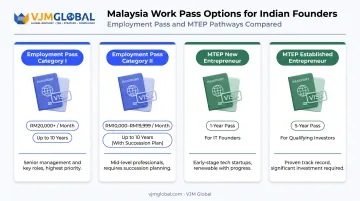
Visa and Work Pass Options
For Indian founders relocating to run operations directly:
- Employment Pass Category I — salary of RM20,000+ per month, valid up to 10 years
- Employment Pass Category II — salary between RM10,000-19,999 per month, up to 10 years with a succession plan
- Malaysia Tech Entrepreneur Programme (MTEP) New Entrepreneur — 1-year pass for IT-related founders
- MTEP Established Entrepreneur — 5-year pass for qualifying investors
Founders not ready to relocate immediately can use an Employer of Record to hire and pay a Malaysian team compliantly before applying for a pass themselves. VJM Global offers EOR coverage across 100+ countries, including Malaysia, which can bridge that gap.
Frequently Asked Questions
How much does it cost to set up a company in Malaysia?
Government fees are low: about RM1,000 for Sdn Bhd incorporation plus RM50 for name reservation. Professional fees vary by provider; foreign-owned entities needing work visas should budget RM500,000+ in paid-up capital.
How do I start a business in Malaysia from India?
It's a two-track process: incorporate through SSM/MyCoID in Malaysia while completing RBI ODI filings under FEMA in India. Both tracks should move together, so guidance on each side is recommended.
What business is profitable in Malaysia?
E-commerce, digital services, F&B, and manufacturing for export currently show strong momentum in Malaysia. Actual profitability still depends on market research, licensing requirements, and how well the business model fits local demand.
Can Indian citizens own 100% of a company in Malaysia?
Yes, most sectors allow full foreign ownership through a Sdn Bhd structure. Regulated industries like banking, private education, and oil and gas may require local participation through specific licensing conditions.
Do I need RBI approval to invest in a Malaysian company from India?
Yes, Indian residents and entities must route the investment through FEMA's ODI framework via an Authorised Dealer bank. Most transactions qualify for the automatic route, though larger commitments may need prior RBI approval.
Do I need to relocate to Malaysia to manage my company?
Not immediately. You'll need a Malaysia-resident director on record, which can be fulfilled through a nominee director or Employer of Record, until you're ready to apply for an Employment Pass yourself.