Introduction
Indian entrepreneurs are increasingly looking past Singapore and Dubai toward a quieter option: Malaysia. Freelancers, export-import traders, IT firms, and SMEs want ASEAN access without the higher setup costs those hubs often bring—and Malaysia’s established Indian diaspora makes entry easier.
Malaysia allows 100% foreign ownership for most private companies, registration through SSM is relatively straightforward, and corporate tax rates stay competitive. It also sits as a gateway to over 660 million people across ASEAN.
This guide walks Indian founders through the structures, costs, legal requirements, and exact registration process—so you can judge fit and know what to do first.
Key Takeaways
- Indian nationals can own 100% of a Sdn. Bhd. but must appoint a Malaysia-resident director
- SSM registration can be completed within days once documents and governance are ready
- Budget past filing fees—nominee directors, bank KYC, and work passes drive real setup cost
- Corporate tax is 24% standard, with a reduced rate for qualifying SMEs
- Resident director, bank account, and work-pass timing are the usual bottlenecks for Indian founders
What Does Starting a Business in Malaysia from India Actually Involve?
It means an Indian resident or company registering a legal business entity in Malaysia—not just opening a bank account or hiring a remote contractor there.
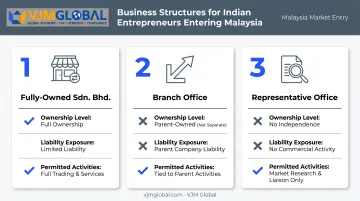
You're looking at a real operating entity: a private limited company (Sdn. Bhd.), a branch office, or a representative office. Each has different implications for liability and ongoing compliance.
Common formats Indian founders use include:
- Fully-owned Sdn. Bhd. for trading or services businesses
- Branch office for an existing Indian company expanding operations
- Representative office for testing Malaysian market demand before committing capital
Why Malaysia Makes Sense for Indian Entrepreneurs (When It Does)
Malaysia offers favourable conditions for market entry, though it's not a guaranteed win for every business model. The fit depends on your sector, target customers, and capital.
What works in Malaysia's favour:
- Trade agreements: India-Malaysia CECA and ASEAN Free Trade Area terms help import/export businesses—still verify tariff lines and rules of origin case by case
- Location: Malaysia connects India to Southeast Asian and Middle Eastern trade routes by air and sea
- Workforce: A multilingual, English-speaking talent pool eases communication for Indian founders
- Costs: Operating costs run lower than Singapore or Hong Kong for comparable services
- Ownership: 100% foreign ownership is permitted for most sectors under the Sdn. Bhd. structure
Bilateral trade between Malaysia and India hit RM79.49 billion (US$18.59 billion) in 2025, a historic high. That volume points to real commercial demand between the two markets beyond tourism or diaspora ties.
Business Structures and Legal Requirements for Indian Entrepreneurs
Your entity choice determines liability exposure, ownership limits, and how much compliance work you'll carry.
Private Limited Company (Sdn. Bhd.)
This is the most common choice for Indian founders building a standalone Malaysian business. Key features include:
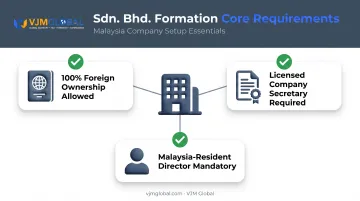
- 100% foreign ownership allowed
- Limited liability for shareholders
- Only one Malaysia-resident director required
Branch Office and Representative Office
A branch office suits an existing Indian company extending operations into Malaysia, but the parent company stays liable for all branch debts.
A representative office works well for testing market demand first. It cannot generate revenue or sign commercial contracts, so it is exploration only, not operations.
Structures That Won't Work for You
Sole proprietorships and partnerships are generally restricted to Malaysian residents or citizens. Without residency, most Indian founders simply can't use these routes.
The real early bottleneck is local people. Every Sdn. Bhd. needs a licensed company secretary and at least one director who ordinarily resides in Malaysia. Finding a qualified, trustworthy Malaysia-resident director while you are still based in India is often what slows founders down. Firms offering cross-border entity formation support, such as VJM Global, can help navigate this requirement alongside documentation and SSM registration.
Early Decisions That Matter When Starting a Business in Malaysia from India
Most delays here aren't caused by lack of effort. They come from underestimating requirements that are specific to Malaysia and don't map neatly onto Indian business norms.
Areas Indian founders commonly overlook:
- Real paid-up capital needs: The legal minimum is low, but banks, licences, and Employment Pass applications expect far more in practice
- Visa timelines: Employment Pass processing has an official five-working-day target, but that excludes company setup and document preparation time
- Sector restrictions: Agriculture, banking, and education can still require Malaysian equity or separate regulatory approval
- Cross-border banking: Currency conversion and remittance between India and Malaysia need planning, not last-minute handling
- Resident director dependency: Incorporation can't proceed without one, so this search should start early, not after documents are ready
How to Start a Small Business in Malaysia from India – Step by Step
Starting a Malaysian company from India follows a clear sequence. Each stage below reflects what an Indian applicant actually needs to do, not a generic global checklist.
Common early mistakes include:
- Assuming Indian documents alone will suffice
- Underestimating paid-up capital requirements
- Leaving the resident director search until the last minute
Step 1 – Validate Your Business Idea and Target Market in Malaysia
Research demand, competitors, and pricing specific to Malaysia. Assumptions carried over from the Indian market rarely hold.
Decide early whether you're serving the local Malaysian market, the broader ASEAN region, or using Malaysia as a trading hub back to India. This decision shapes everything downstream.
Step 2 – Choose the Right Business Structure and Name
Select Sdn. Bhd., branch, or representative office based on your ownership goals and appetite for risk. Then conduct a name search and reservation through SSM.
Step 3 – Appoint a Resident Director and Company Secretary
Malaysia requires at least one resident director and a licensed company secretary within 30 days of incorporation. Many Indian founders turn to professional service providers to source a compliant resident director rather than searching independently.
Step 4 – Prepare Documentation and Register with SSM
You'll typically need:
- Passport copies of shareholders and directors
- Proposed company constitution
- Shareholder and director details
- Registered office address in Malaysia
Submit incorporation documents online or through an agent. Registration fees for a company limited by shares start around MYR1,000, with additional name reservation fees. You'll receive a registration notice, and a formal certificate is available for an extra fee.
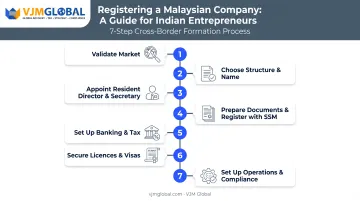
Step 5 – Set Up Banking, Capital, and Tax Registration
Open a Malaysian business bank account and remit paid-up capital from India. Under RBI's Liberalised Remittance Scheme, resident individuals can remit up to US$250,000 per financial year, subject to documentation and the Overseas Investment framework.
Register with LHDN for a tax identification number, and check whether SST registration applies based on your sector and turnover.
Step 6 – Secure Licences, Permits, and Visas
Identify industry-specific and local council licences before you start trading. If you plan to relocate and work on-site, apply for an Employment Pass — note that salary thresholds and category bands changed effective June 2026.
Step 7 – Set Up Operations, Accounting, and Compliance
Establish bookkeeping and statutory filing processes to meet SSM's annual submission deadline (30 days from your anniversary date) and LHDN's tax obligations. Treat filing and tax work as continuous obligations, not a one-time setup task.
VJM Global can handle entity formation plus ongoing accounting and compliance so you meet SSM and LHDN deadlines without hiring an in-house finance team in Malaysia.
Costs, Capital, and Compliance to Plan For
Setup and running costs vary by structure and sector. Budget for one-time registration fees and ongoing statutory obligations.
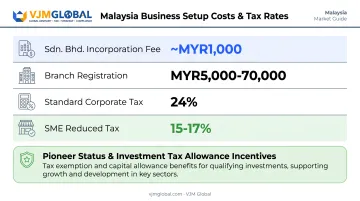
| Item | Typical Cost/Rate | Notes |
|---|---|---|
| Sdn. Bhd. incorporation fee | Around MYR 1,000 | Excludes secretary, office, and professional fees |
| Branch registration | MYR 5,000–70,000 | Scaled by parent company's capital band |
| Statutory paid-up capital | No fixed universal minimum | Real operating capital needed is much higher |
| Corporate tax (standard) | 24% | Applies to most foreign-controlled companies |
| Corporate tax (qualifying SME) | 15–17% on lower income bands | Eligibility depends on paid-up capital and income tests |
Don't assume the token legal minimum capital is workable. Banks, licensing authorities, and Employment Pass applications all expect real, substantive funding behind the company.
Beyond incorporation, plan for recurring compliance: company secretary retainers, annual returns, audit where required, and licence renewals. These often exceed the one-time registration fee within the first year.
Malaysia also offers incentives such as Pioneer Status (partial tax exemption) and Investment Tax Allowance for qualifying manufacturing. Both need MIDA approval and an eligible promoted activity. They are not automatic.
Conclusion
Starting a business in Malaysia from India is achievable when you get three things right:
- The right entity structure
- A compliant resident director
- Realistic capital planning
Legal clarity and accurate documentation matter more than speed. Rushing incorporation without a resident director in place, or underestimating capital needs, usually costs more time later than it saves upfront.
Cross-border support can shorten timelines and cut compliance risk, especially for first-time Indian entrepreneurs navigating Malaysian rules. VJM Global helps Indian companies with entity formation and ongoing compliance as they expand into overseas markets.
Frequently Asked Questions
How much money is required to start a small business in Malaysia?
The legal minimum paid-up capital can be as low as MYR 1, but foreign-owned companies usually need substantially more for banking, licensing, and early operations. Budget also for registration and professional service fees on top of capital.
Can a foreigner open a business in Malaysia?
Yes. Indian nationals can own 100% of a private limited company in Malaysia, but must appoint at least one Malaysia-resident director to meet legal requirements.
Do I need to relocate to Malaysia to run my business from India?
No. You can run the company from India if you appoint a Malaysia-resident director. You only need an Employment Pass if you plan to work on-site in Malaysia yourself.
How long does it take to register a company in Malaysia from India?
SSM registration itself can take just a few days once documents are ready. Sourcing a resident director and preparing paperwork from India often stretches the full process to several weeks.
What is the easiest business structure for an Indian entrepreneur to set up in Malaysia?
A private limited company (Sdn. Bhd.) is generally the most practical choice, thanks to 100% foreign ownership eligibility and limited liability protection.
Can I send money from India to fund my Malaysian company's paid-up capital?
Yes, outward remittance is possible under RBI's Liberalised Remittance Scheme, subject to applicable annual limits and documentation requirements.