Companies House issues this document the moment your registration is approved, under Section 15 of the Companies Act 2006. Yet many business owners still get tripped up by it. Some confuse it with a certificate of good standing. Others lose their original and don't know how to get a replacement. And plenty of UK founders eyeing markets like India have no idea their certificate needs an apostille before anyone abroad will accept it.
This guide walks through what the certificate actually is, three ways to get one, how to replace a lost copy, and what to do when you need it recognised overseas. If you're a UK company expanding into India, that last part matters more than you'd think, and it's an area where firms like VJM Global regularly support businesses through the local compliance maze.
Key Takeaways
- A certificate of incorporation is your legal proof of registration under Section 15 of the Companies Act 2006
- You get it automatically upon successful registration, whether you apply online, by post, or through a formation agent
- Free digital copies are available anytime via the Find and Update Company Information service
- Certified paper copies for legal or international use must be ordered separately from Companies House
- International use typically requires certification plus an apostille from the FCDO
What Is a Company Registration Certificate in the UK?
The certificate of incorporation is the official document Companies House issues confirming your company exists as a distinct legal entity. This document marks the legal moment your business becomes real in the eyes of UK law.
Under Section 15 of the Companies Act 2006, the certificate must include:
- Registered company name
- Company Registration Number (CRN) — a unique identifier for life
- Date of incorporation
- Company type — limited by shares, limited by guarantee, or unlimited
- Public or private status
- Jurisdiction — England and Wales, Scotland, or Northern Ireland
- Registrar's seal or signature for authentication
What's Missing From the Certificate
Several key details are deliberately left off the certificate. The certificate does not list:
- Director names
- Shareholder details
- The registered office street address
None of this is confidential — it's published separately on the Find and Update Company Information service, where filing history, officer details, and the registered address are all searchable for free.
Different Certificates for Different Company Types
Not every business gets an identical certificate. The wording and requirements shift depending on structure:
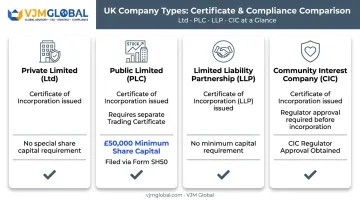
- Private limited companies (Ltd): Receive a straightforward certificate confirming private status and that the company is limited by shares.
- Public limited companies (PLC): Get the standard incorporation certificate first, but can't legally trade or borrow until they secure a separate trading certificate. This requires proving at least £50,000 in allotted share capital, submitted via Form SH50.
- LLPs: Receive a certificate of incorporation specific to limited liability partnerships, confirming the LLP's name, number, and formation date.
- Community Interest Companies (CICs): Need approval from the CIC Regulator first. Once approved, Companies House issues the certificate.
Why Your Company Registration Certificate Matters
This document does more than sit in a drawer. It's frequently the first thing third parties ask for when verifying that your business is legitimate.
Financial institutions commonly request it as part of their evidence when opening a business bank account, alongside other documentation like proof of address and director ID. Requirements vary by provider, but the certificate is standard supporting evidence in most onboarding processes.
Beyond banking, the certificate supports:
- HMRC registrations for Corporation Tax, VAT, and PAYE, where your CRN (found on the certificate) is a key reference point
- Loan and grant applications, where lenders want confirmation your company is properly registered
- Legal agreements, where counterparties may ask for proof of incorporation before signing contracts
- Investor due diligence, particularly during funding rounds
- International expansion, where foreign banks and regulators need proof your UK entity legally exists before letting you open accounts or register a local presence
That last point is where things get more complicated. A UK certificate accepted without question by a British bank might mean nothing to a regulator in Mumbai or Delhi unless it's been properly certified and apostilled first. This is a common stumbling block for UK companies entering the Indian market, and firms like VJM Global regularly help clients navigate the certification and apostille process so their UK documents hold up under Indian regulatory scrutiny.
How to Register Your Company and Get Your Certificate
Here's the good news: you don't request the certificate separately. Companies House issues it automatically and immediately once your registration application is approved. No extra form, no separate fee.
How fast that happens depends entirely on which registration route you choose.
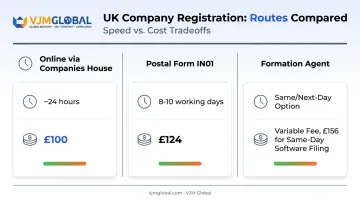
Option 1: Register Online via Companies House
This is the fastest and cheapest route for most private limited companies.
- Fee: £100
- Turnaround: Usually within 24 hours
- Delivery: Digital PDF certificate sent via email
For straightforward company structures, this is the default choice. It's quick, it's affordable, and the certificate lands in your inbox almost immediately after approval.
Option 2: Register by Post Using Form IN01
This route is mandatory for PLCs and for companies using bespoke (non-standard) articles of association that can't be filed electronically.
- Fee: £124
- Turnaround: 8 to 10 working days
It's slower and pricier, but sometimes there's no alternative, particularly if your company structure doesn't fit the standard online template.
Option 3: Use a Company Formation Agent
Formation agents handle the entire application electronically on your behalf, checking compliance details before submission. Many offer same-day or next-day incorporation, and some use software-based filing that Companies House prices at £156 for same-day service.
Agent fees themselves aren't set by Companies House, so costs vary. For most straightforward registrations, though, the online Companies House route remains cheaper and just as fast as going through an agent.
Before applying: always check the current Companies House fees page. These figures are revised periodically, and working from outdated numbers is a common, avoidable mistake.
How to Get a Copy of Your UK Company Registration Certificate
Lost the original? Need a spare for a loan application? There are two very different paths depending on what you actually need it for.
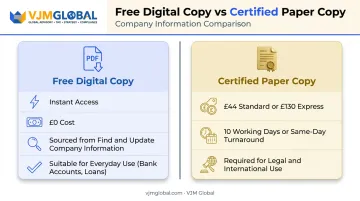
Free Digital Copy (Most Situations)
- Go to the Find and Update Company Information service
- Search your company name or CRN
- Click into Filing history
- Locate the incorporation entry and select View PDF
This copy is free, instant, and sufficient for most everyday needs: opening a bank account, applying for a business loan, or satisfying a supplier's due diligence request.
Certified Paper Copy (Legal or International Use)
For anything requiring legal weight, especially international recognition, you'll need a certified copy ordered directly from Companies House.
| Service | Cost (incorporation documents) | Turnaround |
|---|---|---|
| Standard | £44 | Within 10 working days |
| Express | £130 | Same day if ordered before 11am |
Orders can now be placed either online through Find and Update Company Information or by calling Companies House on 0303 1234 500. You'll need your CRN handy either way.
One important distinction: a "certified certificate" confirming your company's good standing is a different product from a certified copy of your original incorporation document. The certified certificate proves your company is still active and compliant; the certified copy simply reproduces the original incorporation record. Know which one the requesting party actually wants before you order. Ordering the wrong one wastes time and money — advisors handling cross-border business setup, such as VJM Global, routinely help clients pin down exactly which document a bank, investor, or regulator is asking for before submitting a request.
Using Your Certificate Abroad and Keeping It Certified
A standard digital PDF certificate won't get you far outside the UK. Foreign banks, regulators, and government bodies typically want proof that the document is genuine, and that proof comes in the form of an apostille.
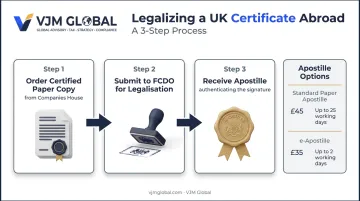
Here's how the process works:
- Order a certified paper copy from Companies House (the free digital PDF won't qualify)
- Submit it to the FCDO for legalisation
- Receive the apostille, which authenticates the signature or seal, not the content itself
| FCDO Service | Fee | Processing Time |
|---|---|---|
| Standard paper apostille | £45 per document | Up to 25 working days |
| e-Apostille | £35 per document | Up to 2 working days |
Only paper-certified copies bearing an original signature from a Companies House official can go through the standard apostille route. This matters because the UK operates under the 1961 Hague Apostille Convention, which means countries that are signatories, including India, will recognise an apostilled UK document without requiring further embassy legalisation.
For UK companies expanding into India, this documentation step is rarely optional. Indian authorities generally expect an apostilled certificate of incorporation for:
- Registering an Indian subsidiary
- Opening a local corporate bank account
- Setting up a liaison or branch office
VJM Global works with UK businesses on this exact paperwork, confirming which authority needs what document before the entity registration process begins.
Certificate of Incorporation vs. Other Company Documents
It's easy to lump all your company paperwork together, but these documents serve very different purposes.
- Certificate of Incorporation: Proves your company exists. One-time issue, no expiry, no renewal.
- Articles of Association: The rulebook. Governs how your company operates internally, director powers, shareholder rights, decision-making procedures.
- Certificate of Good Standing: A periodic check confirming your company is compliant and active today, useful for tenders, contracts, or opening accounts abroad.
The certificate of incorporation works like a birth certificate: fixed and permanent. A certificate of good standing works more like a medical check-up, confirming current health rather than just a clean birth record.
Frequently Asked Questions
What is a company registration certificate in the UK?
The company registration certificate is the certificate of incorporation issued by Companies House, confirming your company is legally registered. It includes the company name, CRN, and date of incorporation.
How do I get a copy of my UK company registration certificate?
Download a free digital PDF through Companies House's Find and Update Company Information service. For legal or international use, order a certified copy directly from Companies House for a fee.
How long does it take to get a certificate of incorporation in the UK?
Online registration typically produces a certificate within 24 hours. Postal applications using Form IN01 take 8 to 10 working days.
Is a certificate of incorporation the same as a certificate of registration?
Yes. These terms are commonly used interchangeably in the UK to refer to the same Companies House document.
Can I use my UK certificate of incorporation for business overseas?
Usually, yes, but you'll need a certified paper copy legalised with an apostille from the FCDO. A standard digital PDF alone typically won't be accepted abroad.
What details are included in a company registration certificate?
Company name, CRN, date of incorporation, company type, jurisdiction, and the Registrar's seal or signature. Director and shareholder details are not included; those appear separately on the public register.