Introduction
Type "Business Registration Certificate USA" into Google and you'll hit a wall of confusion. Unlike countries with a single national registry, the US handles business registration at the state level, through 50 different Secretary of State offices, each with its own forms, fees, and terminology.
Many founders mix up three separate things: the state formation certificate, the federal EIN, and local business licenses. Confusing these can delay bank account openings, stall contracts, or complicate visa and investor paperwork.
This guide breaks down exactly which document you need and walks through the registration process step by step. It also flags state-by-state differences and highlights mistakes that trip up foreign founders and first-time owners alike.
Key Takeaways
- Your "Business Registration Certificate" is your state's Certificate of Formation, Organization, or Incorporation
- Costs, forms, and timelines vary by state and entity type: LLC, Corporation, or sole proprietorship
- An EIN from the IRS is separate from, and doesn't replace, state registration
- Foreign nationals, NRIs, and OCIs face extra steps involving ITINs and registered agents
What Is a Business Registration Certificate in the US?
Here's the thing most guides skip: the US has no single national business registration certificate. Registration happens through your state's Secretary of State (or equivalent agency), and the resulting document goes by different names depending on where and how you form your entity.
What you'll actually receive:
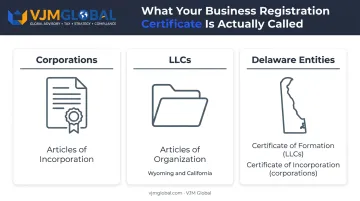
- Articles of Incorporation: for corporations
- Articles of Organization: for LLCs (used in states like Wyoming and California)
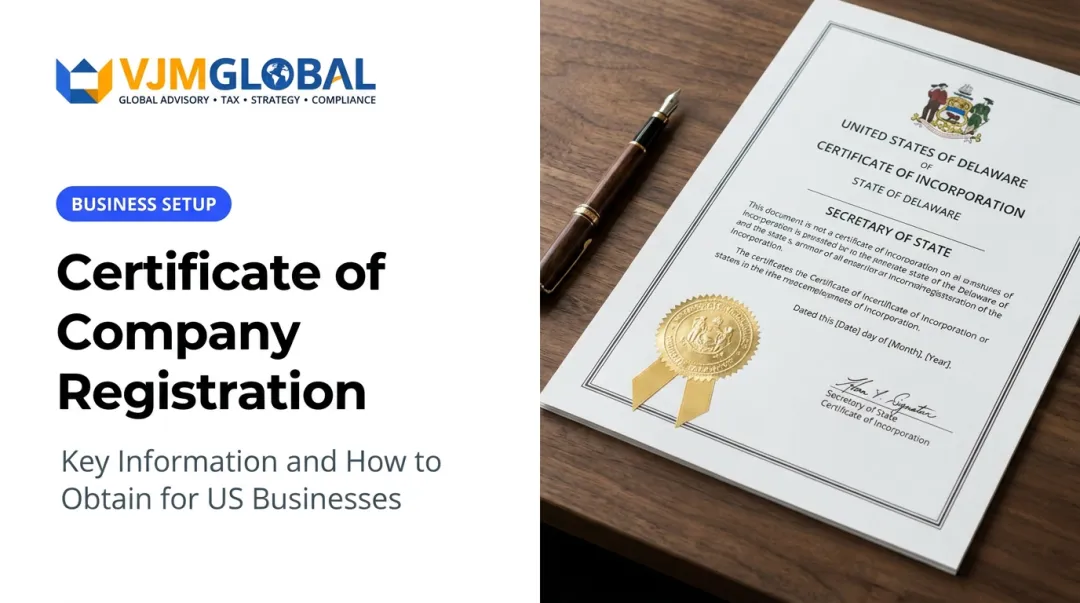
- Certificate of Formation: the term Delaware uses for LLCs, while Delaware corporations get a Certificate of Incorporation
Whatever the label, this is the core document proving your entity legally exists.
EIN vs. State Certificate: Not the Same Thing
An EIN (Employer Identification Number) is a federal tax ID issued by the IRS. It's not proof of business registration. The IRS explicitly requires an entity to form through its state before applying for an EIN, since the two serve entirely different purposes.
Where DBAs and Good Standing Certificates Fit
A DBA (Doing Business As, also called a fictitious or assumed name) lets sole proprietors or existing entities operate under a name other than their legal one. Registration requirements vary by state, county, or city, and a DBA alone doesn't provide legal name protection.
A Certificate of Good Standing comes later, once your business is already registered. It confirms your entity remains compliant, and you'll typically need one when opening a bank account, applying for a loan, or expanding into another state.
How to Obtain a Business Registration Certificate in the US
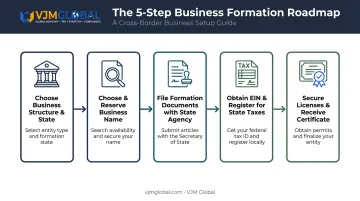
The process follows five distinct steps. Skip one, and you risk rejected filings or an entity that can't legally operate.
Step 1: Choose Your Business Structure and State of Formation
Your entity type determines which certificate you'll receive and which forms apply:
- Sole proprietorship: Simplest to start, but offers no separation between you and business liabilities
- LLC: Protects personal assets in most instances; requires state formation but less governance paperwork than a corporation
- Corporation: Strongest liability protection, but comes with heavier recordkeeping and reporting obligations
You can register in your home state or a business-friendly one like Delaware or Wyoming. Delaware offers established corporate law, but if you're physically operating elsewhere, you may need to "foreign qualify" in that state too, adding extra fees and filings.
Step 2: Choose and Reserve a Business Name
Before filing anything, search your state's business name database to confirm your desired name isn't already taken. Some states let you reserve a name in advance:
| State | Name Reservation Cost | Duration |
|---|---|---|
| Delaware | $75 | 120 days |
| California | $10 | 60 days |
| Kentucky | $15 | Optional, no fixed term specified |
Kentucky treats this step as optional for businesses not yet ready to file formation documents, while other states build it directly into the formal filing process.
Step 3: File Formation Documents with the State Agency
This is where you submit Articles of Organization or Incorporation to the Secretary of State, online or by mail, along with the filing fee. Most states also require a registered agent at this stage.
Delaware, for example, mandates that every entity maintain a registered agent with a physical street address and office in the state, open during normal business hours to accept legal documents. A P.O. box alone won't satisfy this requirement.
Step 4: Obtain Your EIN and Register for State Taxes
Once your entity is formed, apply for an EIN through the IRS. It's free, and online applicants with a valid SSN or ITIN receive their number immediately. Those without either must file Form SS-4 by fax (about 4 business days) or mail (roughly 4 weeks).
Depending on your business activity, you may also need:
- A seller's permit for retail sales (required in California when selling tangible goods)
- Sales tax vendor registration (New York requires this for applicable sellers)
- Employer withholding registration (Virginia requires an FEIN first)
Step 5: Secure Necessary Licenses and Receive Your Certificate
Once your formation documents are approved, the state issues your official Certificate of Formation or Incorporation. This is your core proof of registration. But you're not done yet.
The SBA notes that local governments determine many licensing and permitting requirements separately from entity formation. Industry-specific or city/county licenses may still be required before you can legally operate.
What You Need Before You Apply
Gathering the right information upfront prevents rejected filings and unnecessary delays.
Business & Ownership Details
- Proposed business name (checked against the state database)
- Entity type (LLC, corporation, sole proprietorship, etc.)
- Business address
- Names and details of owners, directors, or members
Registered Agent & Compliance Info
Every state formation requires a registered agent with a valid physical address within that state. If you don't have a local presence, virtual registered agent services exist specifically for this purpose, an option many foreign founders rely on.
Identification Requirements
- US citizens typically use their SSN for the EIN application
- Foreign founders, NRIs, and OCIs without an SSN can still apply. Enter "foreign" or "N/A" on line 7b of Form SS-4, then submit via fax or mail instead of online
- An ITIN (obtained via Form W-7) serves federal tax purposes only. It doesn't authorize US employment or Social Security eligibility
Key Factors That Affect Your Registration Process
Your timeline and costs depend on more than just filling out forms correctly. Three variables drive most of the variation.
Business Structure Chosen
Why it matters: Corporations, LLCs, and sole proprietorships each carry different filing forms, fees, and liability protections.
Impact on process: LLCs are generally faster and cheaper to form than corporations, which require more governance documentation, like bylaws and board resolutions. For example, forming an LLC typically costs $50 to $500 in state filing fees, while corporate formation often runs $100 to $800 once you factor in registered agent and documentation requirements.
State of Formation
Why it matters: Each state sets its own fees, processing times, and ongoing compliance obligations.
Impact on process: Consider these examples:
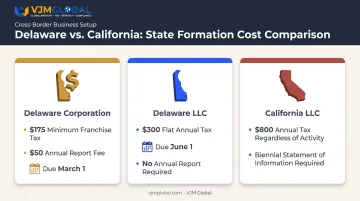
- Delaware corporations owe a minimum $175 franchise tax plus a $50 annual report fee, due March 1
- Delaware LLCs pay a flat $300 annual tax, due June 1, with no report required
- California LLCs pay an $800 annual tax regardless of activity level, plus a Statement of Information due every two years
Filing in Delaware can offer legal advantages, but it adds complexity if your actual operations sit in another state, since you may need to register there as well.
Foreign Ownership Status
Why it matters: Non-US residents lack an SSN, which complicates both EIN applications and bank account setup.
Impact on process: This is where working with a firm experienced in cross-border filings makes a real difference. VJM Global has guided more than 500 American business owners, along with numerous NRI and OCI clients, through this exact challenge. Its cross-border advisory team handles ITIN documentation, registered agent selection, and other paperwork gaps that trip up first-time foreign founders.
Common Mistakes to Avoid When Registering Your US Business
Even experienced founders stumble here. Watch for these four traps:
- Confusing the EIN confirmation letter with state registration proof. Banks and landlords often ask for your actual Certificate of Formation, not just your EIN letter.
- Picking a state based on tax perception alone. Delaware's reputation is well-earned, but operating elsewhere usually means foreign qualification too, doubling your compliance burden.
- Missing ongoing compliance filings — Delaware charges a $200 penalty plus 1.5% monthly interest on late franchise tax payments, and repeated lapses can lead to administrative dissolution
- Attempting DIY registration without local presence or an SSN. This often causes rejected EIN applications or registered agent issues for foreign founders.
A missed annual report isn't just a fee; it can mean losing your legal right to operate. Georgia, for instance, gives dissolved entities just 60 days to cure the issue before winding-up procedures kick in.
Working with a compliance partner experienced in cross-border filings, like VJM Global's advisory team, helps foreign founders avoid these pitfalls and keep filings accurate and on time.
Frequently Asked Questions
What is a business registration certificate in the US?
It's the state-issued Certificate of Formation, Organization, or Incorporation confirming your business is legally registered with the Secretary of State. The exact name depends on your state and entity type.
Is a Business Registration Certificate the same as an EIN?
No. The state certificate proves legal formation, while the EIN is a separate federal tax identification number issued by the IRS. You need both, but they serve different purposes.
How long does it take to get a business registration certificate in the US?
It varies by state. Wyoming and Oregon process eligible online filings the same or next business day, while mailed applications elsewhere can take a few weeks. Delaware offers paid expedited options too.
Do I need a registered agent to register my business in the US?
Yes, most states require a registered agent with a physical address in the state of formation to receive legal and compliance documents on your behalf.
Can foreign nationals or NRIs obtain a US business registration certificate?
Yes. Foreign nationals can register a US business without being a citizen or resident, though they'll need a registered agent and may require an ITIN for federal tax filing purposes.
How much does it cost to register a business in the US?
State filing fees alone range roughly from $40 (Kentucky) to $500 (Massachusetts). Total costs also include registered agent fees, name reservation, and any required licenses or permits.