Introduction
US entrepreneurs are increasingly choosing the LLP structure to enter India, and it's easy to see why. Compared to a Private Limited subsidiary, an LLP means less paperwork, no mandatory audit at lower turnover levels, and a faster path to operating legally in India.
But the process trips up a lot of American founders. Common challenges include:
- Documents rejected by the Ministry of Corporate Affairs (MCA) due to missing apostilles
- Mismatched names across passports and other identification documents
- Outdated proof of registered office address
This guide walks through every document required for LLP registration in India in 2024, with a specific focus on what changes when the partners are based in the United States.
Key Takeaways
- LLP documents fall into three buckets: partner KYC, registered office proof, and MCA (Ministry of Corporate Affairs) filings
- US partners need notarized, apostilled passports since the USA is a Hague Convention member
- At least one Designated Partner must be an Indian resident, often fulfilled via a local nominee
- Missing the 30-day LLP Agreement deadline is a top rejection trigger
- Submitting an outdated utility bill for office proof also triggers rejection
Why US Businesses Prefer LLP for Entering the Indian Market
An LLP gives US founders limited liability protection without the compliance load of a Private Limited company. There's no minimum capital requirement, and the ownership structure stays flexible.
The Compliance Gap Between LLP and Private Limited
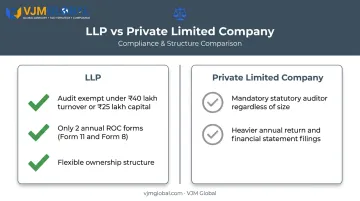
The difference in audit obligations is the biggest draw:
- LLPs are exempt from mandatory audit if turnover stays under ₹40 lakh or capital contribution stays under ₹25 lakh, per Rule 24 of the LLP Rules, 2009
- Private Limited companies must appoint a statutory auditor regardless of size, under Section 139 of the Companies Act
- LLPs file just two annual ROC forms (Form 11 and Form 8), while companies handle a heavier annual return and financial statement filing load
This structure suits US consulting firms, IT and export businesses, and professional service providers who want to test the Indian market before committing to a larger entity. Many treat the LLP as a low-risk foothold, then convert to a Private Limited company once revenue justifies it.
The broader numbers back up the trend. India recorded 58,990 new LLP incorporations in FY2023-24, up from 36,249 the year before, according to Economic Times reporting on MCA data. That's overall LLP growth across all founders, not a foreign-specific figure, but it signals a structure gaining serious momentum.
Documents Required for Designated Partners and Partners (US-Specific Requirements)
Every LLP needs at least two Designated Partners, and the documentation differs depending on whether that partner is Indian or based in the US.
Standard Identity Documents
For any Indian resident partner, you'll need:
- PAN card (mandatory for Indian residents)
- Passport-sized photograph
- Valid mobile number and email for OTP-based verification
- Address proof (Aadhaar, voter ID, or driving license)
Meeting the Indian Resident Requirement
At least one Designated Partner must reside in India. US businesses without an existing local presence typically satisfy this by appointing:
- Local nominee or consultant familiar with the compliance obligations
- Staff member from an Indian subsidiary or affiliate office
- Trusted business partner already resident in India
This is often the single most overlooked requirement in early planning conversations.
Apostille Rules for US Passports and Address Proof
Since the United States is a signatory to the Hague Apostille Convention, US partners don't need embassy attestation. Documents instead follow the apostille route, which the Ministry of External Affairs confirms applies between India and the US as fellow Convention members.
Practically, this means:
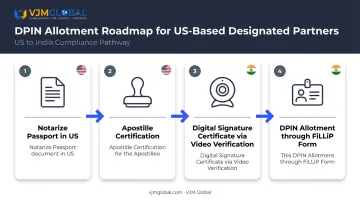
- Passport copies must be notarized in the US and then apostilled
- Overseas address proof, such as a bank statement, driving license, or utility bill, should also be notarized and kept current — most practitioners recommend nothing older than two months
- Federal document authentication can take several weeks depending on the issuing state, so this step needs early planning
Digital Signature Certificate and DPIN
Every Designated Partner needs a Digital Signature Certificate (DSC) to sign MCA filings electronically. The Controller of Certifying Authorities explicitly permits DSC issuance to foreign nationals, and current guidelines require video-based identity verification, meaning US-based partners can complete this step remotely without a flight to India.
Once the DSC is in hand, the Designated Partner Identification Number (DPIN) is obtained directly through the FiLLiP incorporation form itself, rather than as a separate filing. This integration has simplified what used to be a multi-step process.
Documents for Registered Office Address Proof in India
Every LLP needs a registered office address inside India. This is where GST notices, income tax correspondence, and MCA communication land, so getting it right matters.
If the office is rented or leased, you'll need:
- A signed rent or lease agreement
- A No Objection Certificate (NOC) from the landlord
- A utility bill (electricity, water, or similar) not older than two months
If you're using a virtual office or co-working space (a common choice for US businesses without a physical India footprint), you'll typically need:
- An allotment letter from the space provider
- The signed service agreement
- A recent utility bill
This combination must clearly establish both the address and your legal right to use it.
Don't have an India address yet? Many US founders use their nominee partner's residential address as an interim registered office while they finalize a permanent commercial space. This is a common workaround, though it should be treated as temporary rather than a long-term solution.
Documents for MCA Incorporation Filing – DSC, FiLLiP, and LLP Agreement
Once partner and office documentation is ready, the actual MCA filing sequence begins with a credential every Designated Partner must obtain first.
DSC Comes Before Anything Else
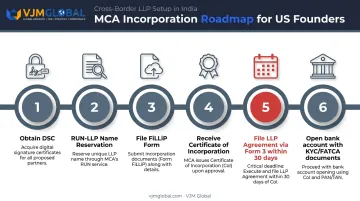
Every Designated Partner needs a Digital Signature Certificate (DSC) from a government-recognized certifying agency before any MCA form can be submitted. For US-based partners, this usually means completing video verification and submitting notarized, apostilled identity documents, since in-person Aadhaar verification isn't an option.
RUN-LLP Name Reservation
The RUN-LLP service lets you submit two proposed names along with a description of your business activity. If both names get rejected, MCA typically allows one resubmission within a defined window, so it pays to have backup names ready.
FiLLiP Consolidates the Heavy Lifting
FiLLiP is the integrated incorporation form, and it now handles most of what used to require separate filings:
- Partner details and identification documents
- DPIN allotment for Designated Partners
- Registered office address and supporting proof
- Capital contribution amount and structure
- NIC business activity code for your sector
The LLP Agreement Deadline
Once incorporated, you must file the LLP Agreement through Form 3 within 30 days. This document, executed on state-specific stamp paper, defines profit-sharing ratios and partner responsibilities. Stamp duty amounts vary by state, so there's no single nationwide figure. Check the relevant state's stamp act before finalizing.
Miss this 30-day window and penalties start accumulating, so it's worth calendaring the moment your Certificate of Incorporation arrives.
Post-Incorporation: PAN, TAN, and Bank Account
For US businesses, two things happen after incorporation. PAN and TAN are issued on a near-real-time basis as part of the integrated incorporation process, according to MCA's official announcement on the integrated system.
Opening an Indian bank account, however, typically requires additional KYC beyond the incorporation documents. Banks will ask for beneficial-owner declarations, authorized signatory proof, and FATCA/CRS information given the US connection, and firms like VJM Global can help assemble this paperwork in advance.
What Government Fees Look Like
MCA fees for LLP incorporation scale based on capital contribution, following the slabs in Annexure A of the LLP Rules. Rather than quote exact figures that shift periodically, budget for a modest government fee that rises as your contribution amount increases, and confirm the current slab on the MCA portal before filing.
Common Mistakes US Businesses Make (and How VJM Global Helps)
Most rejections at the MCA aren't about complicated legal issues. They're about small documentation errors that compound across time zones.
Frequent mistakes include:
- Submitting US documents that were notarized but never apostilled
- Overlooking name mismatches between a passport and a secondary ID (a middle name on one document but not another is enough to trigger a query)
- Letting utility bills for the registered office age past the two-month cutoff
- Underestimating how long apostille processing takes from a US state authority, which can run into several weeks
The remote nature of the process adds friction too. Coordinating notarization, apostille requests, and video-based DSC verification across a 10-to-13-hour time difference introduces its own risks. Small delays on either side can stretch a straightforward filing into a multi-week ordeal if nobody is actively managing the sequence.
This is where VJM Global comes in. With over 30 years of experience in tax, audit, and cross-border advisory, the firm has worked with 500+ American business owners navigating exactly these hurdles. Support includes:
- End-to-end LLP documentation review before submission
- DSC and DPIN coordination, including remote video verification scheduling
- Registered office guidance suited to US founders without an existing India presence
Having someone track the apostille-to-MCA-filing sequence in real time is often the difference between a clean approval and a document sent back for correction.
Frequently Asked Questions
What documents are required for LLP account opening?
Indian banks typically require the Certificate of Incorporation, LLPIN, LLP Agreement, entity PAN, and KYC documents for each designated partner. Some banks also request beneficial-owner declarations and FATCA/CRS forms for foreign-linked LLPs.
Can a US citizen be a partner in an Indian LLP without visiting India?
Yes, most steps including DSC issuance and document notarization or apostille can be completed remotely from the US. However, the LLP still needs one Indian resident as a co-Designated Partner.
Do documents need to be apostilled for US citizens registering an LLP in India?
Yes. Since the US is a Hague Convention member, an apostille is sufficient for passport and address proof documents. Embassy attestation isn't required for this route.
How long does LLP registration take for foreign nationals from the US?
There's no fixed official benchmark, but expect several weeks in total. Factor in US apostille processing, which can itself take a few weeks, plus standard MCA incorporation processing on top of that.
What is the difference between DPIN and DIN for designated partners?
DPIN identifies designated partners under the LLP Act, while DIN identifies directors of companies under the Companies Act. Both are unique MCA identification numbers, but they apply to different entity types.
Is a physical office address in India mandatory, or can a virtual/co-working office be used?
A virtual or co-working address is acceptable as long as you can provide an allotment letter, the service agreement, and a current utility bill establishing your right to use that address.