Introduction
Setting up a company in India from Singapore means satisfying two distinct documentation layers. The first covers standard requirements under India's Companies Act 2013 and Ministry of Corporate Affairs (MCA) regulations. The second — often overlooked — involves authentication and attestation protocols specific to foreign nationals and entities.
The most common bottleneck? Document preparation. Singapore-based founders, NRIs, and locally incorporated companies regularly face delays because they submit documents without proper apostille authentication, use address proofs older than two months, or miss the mandatory resident Indian director requirement.
This guide covers exactly what you need: the documents required for a Private Limited Company, LLP, Branch Office, or Liaison Office registration in India — what Singapore applicants must handle differently, and how the SPICe+ filing process works end to end.
Key Takeaways
- All Singapore-origin documents require apostille authentication through the Singapore Academy of Law (SAL) under the Hague Apostille Convention
- Required documents span four categories: personal identity/address proof, apostille and visa documents, registered office proof in India, and constitutional documents (MOA/AOA) with statutory forms
- At least one director must be resident in India for 182+ days in the preceding calendar year — no exceptions apply
- SPICe+ filing is fully online via Class 3 Digital Signature Certificate (DSC), with no physical presence required
- Typical timeline: 7–15 working days from document readiness to Certificate of Incorporation
Documents Required from Directors and Shareholders
All proposed directors and shareholders — Singapore citizens, Singapore PRs, or NRIs resident in Singapore — must submit identity and address proof as foundational documents. A Private Limited Company (the most common structure for Singapore investors) requires a minimum of two directors.
Identity Proof Requirements
- Indian nationals resident in Singapore (NRIs/OCIs): PAN Card is mandatory
- Singapore citizens and other foreign nationals: Valid passport including personal details page, photograph page, and validity page; PAN is not required at incorporation but must be applied for post-registration
Address Proof Requirements
Accepted documents include:
- Bank account statements
- Electricity or utility bills
- Mobile postpaid bills
Critical validity rule: Address proof must not be older than two months from the filing date. This strict window is the most common rejection reason for Singapore applicants who prepare documents too early.
Once physical documents are in order, directors must fulfill two digital prerequisites before any filing can proceed.
Digital Signature Certificate (DSC)
All directors and subscribers must obtain a Class 3 DSC before filing.
Foreign nationals in Singapore can obtain this through Indian authorized Certifying Authorities (such as eMudhra or Sify) via online video verification. VJM Global helps Singapore clients schedule video verification with eMudhra or Sify, handles document submission, and tracks DSC issuance to keep incorporation timelines on track.
Director Identification Number (DIN)
The SPICe+ portal issues DIN simultaneously with incorporation approval — covering up to three directors in a single filing. Existing DIN holders simply provide their number; first-time foreign directors receive theirs as part of the approval process.
Singapore-Specific Document Requirements: Apostille, Attestation, and Visas
All documents signed or issued outside India must be authenticated before the Indian ROC accepts them. Since Singapore joined the Hague Apostille Convention in September 2021, the process is significantly simpler than for non-Hague countries.
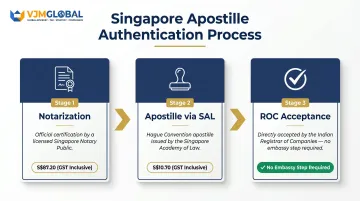
Apostille Process for Singapore Documents:
The Singapore Academy of Law (SAL) is the sole designated authority to issue apostille certificates. Documents requiring apostille include:
- Singapore NRIC copies
- ACRA business profiles (if a Singapore company is the investor)
- Utility bills and bank statements
- Corporate resolutions and constitutional documents
Apostille fee: S$10.70 per document (inclusive of GST)
Notarization Before Apostille:
Private documents must first be notarized by a Singapore Notary Public before SAL affixes the apostille. The Notary Public collects an authentication fee of S$87.20 (inclusive of GST) payable to SAL. Once apostilled, documents are accepted directly by the Indian ROC — no further authentication from the Indian Embassy is required, which cuts weeks off the typical timeline.
Visa and Immigration Requirements:
- Singapore citizens: Check current visa requirements with the Indian High Commission in Singapore before traveling for registration-related purposes
- OCI/PIO cardholders: Generally exempt from standard entry visa requirements — confirm current rules with official immigration authorities
Note: Since SPICe+ is fully online, physical presence in India is not mandatory for incorporation. Most Singapore-based founders complete the entire process remotely.
Singapore Corporate Investor Requirements:
When the investor is a Singapore-incorporated company (not an individual), additional documents are required:
- ACRA business profile (Certificate of Incorporation equivalent)
- Board resolution authorizing India investment and appointing a representative
- Company's Constitution (formerly Memorandum & Articles of Association)
- All documents must be apostilled and translated into English if applicable
VJM Global assists Singapore companies in compiling and authenticating this complete document package — from notarization coordination to ROC submission. Contact our team to review your specific document checklist before starting the process.
Registered Office, MOA, AOA, and Statutory Forms
Registered Office Requirement
Every Indian company must declare a registered office address at incorporation. Singapore-based founders without a physical office in India can use:
- Virtual office
- Co-working space
- Director's residential address
Required documents:
- Rent/lease agreement or ownership proof
- No Objection Certificate (NOC) from property owner
- Utility bill for the premises (not older than two months)
Many Singapore founders use a nominee director arrangement where the resident Indian director also provides the registered office address.
Memorandum and Articles of Association
- MOA: Defines company name, registered state, objectives, authorized capital, and subscriber details
- AOA: Governs internal operations including share transfers, board meetings, and director appointments
For most Private Limited incorporations through SPICe+, these are generated electronically (e-MOA and e-AOA). Singapore investors with specific investor rights or share class requirements should opt for a customized AOA.
Statutory Forms Required
- Form INC-9: Auto-generated declaration of compliance by all subscribers and first directors, signed digitally via DSC
- Form DIR-2: Individual director consent forms confirming willingness and eligibility
Both forms require valid DSC signatures. Missing or unsigned declarations are one of the most common reasons the MCA rejects SPICe+ applications — so Singapore founders should confirm all DSCs are active and correctly mapped before submission.
Business Structure Options for Singapore Companies in India
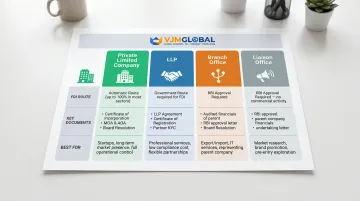
Singapore businesses have four main India entry structures:
| Structure | FDI Route | Key Documents | Best For |
|---|---|---|---|
| Private Limited Company | Automatic route in most sectors | Full documents as above | Most common; operational flexibility |
| Limited Liability Partnership | Requires government approval unless 100% FDI sector with no performance conditions | LLP agreement replaces MOA/AOA | Professional services; pass-through taxation |
| Branch Office | RBI approval required; USD 100,000 net worth; 5-year profit track record | Parent company audited financials for 5 years | Export/import; IT services |
| Liaison Office | RBI approval required; USD 50,000 net worth; 3-year profit track record | Parent company audited financials for 3 years | Representational activities only |
FDI and RBI Compliance
When a Singapore entity invests capital in India, RBI's FDI framework under FEMA governs the transaction. Most sectors permit FDI under the automatic route, meaning no prior RBI approval is needed. Post-incorporation, an FC-GPR (Foreign Currency-Gross Provisional Return) filing is mandatory within 30 days of share allotment.
At least one director must be an India-resident (182+ days in the preceding calendar year). Singapore founders without a local director can either appoint a professional nominee director or bring on a trusted resident partner. The nominee director's documents — Indian PAN, Aadhaar, address proof, DSC, and DIN — are also required for registration. VJM Global provides nominee director services for Singapore clients, handling compliance without ceding operational control to foreign investors.
Filing Via SPICe+ and Common Mistakes to Avoid
SPICe+ Filing Sequence:
Part A (Name Reservation):
- Propose up to 2 company names
- Approval in 1–2 working days
- Reservation valid for 20 days
Part B (Full Document Upload):
- All identity/address proofs
- Registered office documents
- e-MOA, e-AOA
- INC-9, DIR-2
- Linked forms for PAN, TAN, GST, ESIC, EPFO
ROC Review:
- ROC issues the Certificate of Incorporation within 3–7 working days of Part B submission
- PAN and TAN allotted alongside Certificate
Document Format Requirements:
- All PDFs, color scanned, minimum 300 DPI
- File sizes under 6 MB per attachment
- Name and address must match exactly across all documents
For Singapore applicants, ensure the name format on apostilled foreign documents exactly matches SPICe+ form entries.
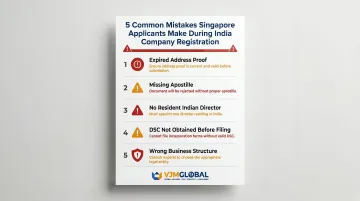
Even small formatting oversights can trigger ROC rejections. These are the errors that most commonly delay Singapore applicants:
Most Common Mistakes Singapore Applicants Make:
- Address proof older than two months — Singapore bank statements follow the same 2-month validity rule as Indian documents
- Submitting documents without apostille, or confusing apostille with simple notarization
- Overlooking the resident Indian director requirement (at least one director must have stayed 182+ days in India)
- Not obtaining DSC before filing — video verification often takes longer than applicants expect
- Choosing the wrong structure — a Branch Office when a Private Limited Company would be faster and more operationally flexible
VJM Global's team reviews every document set before submission — checking apostille validity, name consistency, DSC status, and director eligibility — so filings go through without back-and-forth with the ROC.
Frequently Asked Questions
What documents are required to register a company in India?
Documents fall into four categories: personal identity and address proof for all directors/shareholders, proof of registered office address in India, constitutional documents (MOA and AOA), and statutory forms (INC-9 and DIR-2). Singapore-based applicants must also provide apostilled versions of all foreign-origin documents.
How do I register a company in India?
The process runs through the SPICe+ portal in four steps: obtain a DSC, reserve your company name, submit all documents and forms, then receive your Certificate of Incorporation with PAN and TAN. Everything is filed online and typically takes 7–15 working days from submission.
How do I get a Certificate of Incorporation in India?
Submit your SPICe+ application with all required documents to the Registrar of Companies (ROC) via the MCA portal. Once verified, the ROC issues the certificate digitally to your registered email, bundled with PAN and TAN.
How can I verify a Certificate of Incorporation in India?
Navigate to the MCA portal (mca.gov.in) → MCA Services → View Company/LLP Master Data, then enter the company's CIN (Corporate Identification Number). The certificate itself also carries a QR code for instant on-document verification.
What is proof of company registration in India?
Your Certificate of Incorporation, issued by the ROC, serves as official proof of registration. It carries the company's CIN, incorporation date, and registered address — accepted for bank account opening, FEMA filings, and all regulatory purposes.
VJM Global works with Singapore-based entrepreneurs at every stage of India entry — from coordinating apostilles through SAL to nominee director services, SPICe+ filing, and post-incorporation FC-GPR compliance. Our team handles the paperwork so you can focus on the business.
With 30+ years of experience and 100+ professionals, we've helped 500+ American, 250+ UK, and 250+ Australian businesses establish Indian operations — and we bring the same depth of support to Singapore clients. Reach us at [email protected] or +91 9891576441 to get started.