At the center of it all sits one document: the Certificate of Incorporation (COI). Think of it as the birth certificate of your Indian company. Issued by the Registrar of Companies (RoC) under the Ministry of Corporate Affairs (MCA), it's the moment your business goes from an idea to a legal entity.
This guide walks through entity selection, the step-by-step incorporation process, the specific documents US directors and shareholders need, realistic costs, and how to verify your certificate once it lands in your inbox.
Key Takeaways
- The RoC issues the COI electronically, confirming your Indian company as a legal entity separate from its US parent
- US directors need notarized and apostilled ID documents before applying for a Digital Signature Certificate (DSC)
- Most US founders choose a Private Limited Company structure for full ownership and liability protection
- Budget 3-4 weeks total for the full process, even though MCA itself often issues the COI within days of filing
- The entire process is remote-friendly — no travel to India required
What Is a Certificate of Incorporation and Why US Businesses Need It
Under Section 7 of the Companies Act, 2013, the Registrar of Companies must issue a COI once all required documents and information have been filed and verified. The certificate confirms your company is officially incorporated. From that date, it becomes a distinct legal entity, separate from you and your US business.
This new entity can own property, sign contracts, and sue or be sued in its own name.
That separation is exactly why US businesses can't skip this step. Without it, compliance and banking simply don't work. A US company without a COI legally cannot:
- Open an Indian bank account (banks require certified copies of the COI, constitutional documents, and PAN as part of KYC)
- Sign contracts with local vendors or hire Indian employees
- Register for a GST number or apply for other business registrations
- Meet FEMA/RBI reporting obligations tied to foreign investment inflows
Operating in India without proper incorporation exposes your US business to compliance gaps and personal liability risk, undermining the very protection limited liability structures exist to provide. Firms experienced in cross-border setup, such as VJM Global, routinely help US businesses secure the COI correctly the first time, avoiding these exposure risks.
Choosing the Right Business Entity Structure as a US Company
Your entity choice shapes everything downstream: how much foreign compliance you'll carry, how easily you can repatriate profits to the US, and even how the certificate itself gets issued.
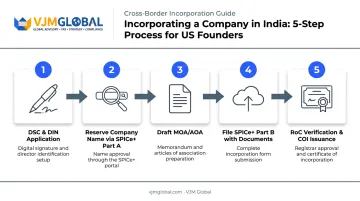
Private Limited Company (Wholly Owned Subsidiary)
This is the route most US parent companies take. It gives you:
- Full ownership of the Indian entity
- Limited liability protection
- Access to India's automatic FDI route for most sectors (no prior government approval needed)
The entity is registered through SPICe+, and the RoC issues a proper Section 7 COI with a Corporate Identity Number (CIN) attached.
Liaison, Branch, or Project Office
If you're not ready to commit to a full subsidiary, these are alternatives — but they're not incorporation in the traditional sense. Each remains legally part of your US company rather than a new Indian entity:
- Liaison Office (LO): Represents your US parent for marketing or coordination, with no revenue-generating activity permitted
- Branch Office (BO): Conducts business activities directly, subject to sector-specific RBI conditions
- Project Office (PO): Set up temporarily for executing a specific contract in India
All three require RBI or authorized-dealer bank approval. The foreign company must also file documents with the RoC within 30 days of establishing a place of business in India under Section 380.
LLP Registration
An LLP can work well for US professional services firms wanting lower compliance overhead. LLPs are registered via FiLLiP, and the Registrar issues a distinct LLP certificate — one that, unlike a company's COI, is explicitly stated as "conclusive evidence" of incorporation under the LLP Act.
The catch: foreign investment into an LLP only qualifies for the automatic route if the sector allows 100% FDI automatically with zero performance conditions attached. Many sectors don't meet both tests. DPIIT's consolidated FDI policy lays out exactly which activities qualify.
Getting the structure wrong at this stage can delay — or in some cases block — your COI application entirely. Confirm current sector caps with an India-entry advisory team, such as VJM Global, before filing.
Step-by-Step Process to Obtain the Certificate of Incorporation
The entire process runs through the MCA's online portal. It's fully digital, but foreign directors face a few extra hurdles domestic founders don't.
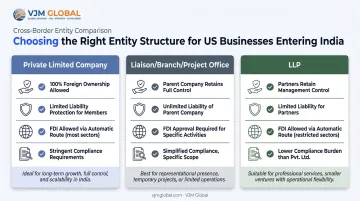
Step 1: Digital Signature Certificate (DSC) and DIN
Every proposed director needs a DSC to sign forms electronically, plus a Director Identification Number (DIN). For US-based directors, this means getting identity documents notarized by a US Notary Public first. The documents must then be apostilled (or consularized, depending on document origin) before Indian authorities will accept them. This authentication step is where most delays happen.
Step 2: Reserve the Company Name (SPICe+ Part A)
Your proposed name gets checked against the RoC database for uniqueness and compliance with MCA naming guidelines. You can reserve the name separately or combine this with your full application.
Step 3: Draft the Memorandum and Articles of Association (MOA/AOA)
These documents define what your company is legally permitted to do (its "objects") and how it will be governed internally. They need to accurately reflect the business activities your US parent intends to run in India.
Step 4: File SPICe+ Part B With Supporting Documents
This single integrated form bundles:
- Director and shareholder KYC details
- Registered office proof
- PAN and TAN applications
- AGILE-PRO-S, which links your bank account application (mandatory) and optionally lets you request a GSTIN
Step 5: RoC Verification and Certificate Issuance
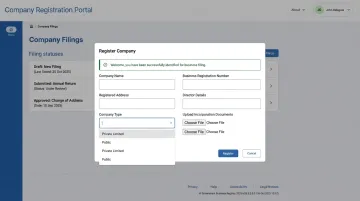
Once the RoC verifies everything, it issues the COI electronically, along with your company's CIN, PAN, and TAN (all delivered by email). There's no official average processing time published specifically for foreign-director filings, so treat any fixed-day promise with skepticism.
Firms like VJM Global typically handle this stage for US founders. They coordinate the apostille process, arrange a registered office address in India, and liaise directly with the RoC, so you're not stuck managing time-zone calls with government offices at 2 a.m. your time.
Documents Required for US Directors and Shareholders
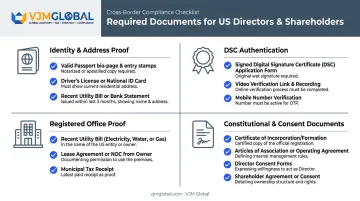
The document list looks similar to a domestic incorporation, but foreign nationals face extra authentication layers: identity verification, DSC authentication, registered office proof, and constitutional filings.
Identity and Address Proof
- Passport (mandatory for every foreign director)
- Notarized and apostilled overseas address proof, such as a recent utility bill or bank statement
DSC-Related Authentication
US applicants generally need these documents notarized by a US Notary Public, then apostilled or consularized, before Indian authorities will process the DSC application. Since the US is a Hague Apostille Convention member, apostille (rather than full consular authentication) is usually the applicable path — but confirm this with your advisor given the specific document type. Firms like VJM Global regularly coordinate this notarization-to-apostille handoff for US clients, since a single missing seal can delay DSC issuance by weeks.
Registered Office Proof in India
Since your US business won't have an existing Indian address, you'll need either:
- A virtual office arrangement, or
- A physical registered office
Either way, you need a No Objection Certificate (NOC) from the property owner, plus a utility bill no older than two months.
Constitutional and Consent Documents
- Signed MOA/AOA reflecting the company's objects
- DIR-2 consent forms from each proposed director
- INC-9 declaration from subscribers and first directors
One more requirement to flag: Indian law requires at least one director who resides in India for a minimum of 182 days during the financial year (Section 149(3)). US founders typically need to appoint a qualifying resident director alongside themselves.
Fees, Costs, and Timeline for US Businesses
MCA fees vary by authorized capital, entity type, and the specific forms filed. Rather than quoting a fixed number, use the MCA's official fee calculator at the time of filing — capital structure and state-specific stamp duty both move the total.
Cost components to budget for:
- Government filing fees (via MCA calculator, varies with capital)
- State-specific stamp duty on incorporation documents
- DSC issuance charges
- Apostille and notarization costs — this is the piece domestic incorporations skip entirely
- Professional fees for cross-border document coordination, which firms like VJM Global handle for US clients who can't be physically present in India
These costs compound into a timeline that looks nothing like a domestic incorporation.
Realistic Timeline
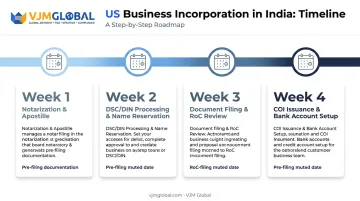
MCA can issue a Certificate of Incorporation within a few working days once a complete application is filed. That's the easy part. The real timeline for US businesses stretches longer because of:
- Document notarization and apostille turnaround in the US
- Time-zone coordination between US signatories and Indian filing teams
- Courier/shipping time for physical document exchange, where needed
Plan for 3-4 weeks total, not a few days, if you're incorporating from the US.
How to Verify and Download Your Certificate of Incorporation
Once issued, your COI lives permanently on the MCA portal — no physical certificate gets mailed.
How to check the Certificate of Incorporation in India?
- Go to the MCA portal and navigate to MCA Services
- Select View Public Documents V3 (for a quick lookup) or Get Certified Copies (for an official certified copy)
- Search using your company's CIN or exact registered name
- Download the digitally signed COI PDF
Your CIN itself is a 21-character alphanumeric code. It encodes your listing status, industry code, state code, incorporation year, ownership type, and registration number, making it useful for independently confirming a company's details before you sign any contract with it.
Keep both digital and physical copies of your COI accessible on the US side too. If you're a US officer, director, or shareholder meeting the applicable filer thresholds for a foreign corporation, you'll likely need it to support IRS Form 5471 reporting. Firms like VJM Global that work across both US and Indian compliance frameworks can help coordinate this documentation so nothing falls through the cracks at filing time.
Frequently Asked Questions
How to check the Certificate of Incorporation in India?
Log into the MCA portal and use View Public Documents or Get Certified Copies under MCA Services. Search by your company's CIN or exact registered name to pull up and download the certificate.
Who issues the Certificate of Incorporation in India?
The Registrar of Companies (RoC), operating under the Ministry of Corporate Affairs, issues the COI electronically once it verifies all filed documents and information under Section 7.
Can a US citizen be a director in an Indian company incorporated for this purpose?
Yes. US citizens can serve as directors, but Indian law requires at least one resident director who stays in India for 182+ days annually. US directors obtain their DIN and DSC using apostilled identity documents.
How long does it take for a US business to get its COI?
MCA typically issues the COI within a few working days of a complete filing. Factoring in document apostille and time-zone coordination, most US businesses should plan for 3-4 weeks total.
Do I need to travel to India to incorporate my company?
No. The entire SPICe+ process is digital and can be completed remotely. Most US founders work with a local advisory firm to handle document coordination and RoC liaison without setting foot in India.
Is the Certificate of Incorporation issued in physical form?
No. The COI is issued only in electronic form, digitally signed by the RoC. You can log into the MCA portal and redownload it anytime — there's no physical copy to lose or replace.