Foreign entrepreneurs, NRIs, and Indian founders alike run into the same roadblocks: incomplete SPICe+ filings, mismatched documents, and confusion over resident director rules. A single rejected form on the MCA portal can push your incorporation timeline back by a month or more.
This checklist covers everything you need: eligibility conditions, required documents, the step-by-step process, special considerations for foreign investors, and the post-incorporation compliance that most founders forget until it's too late.
Key Takeaways
- A Private Limited Company needs 2 shareholders, 2 directors (one resident), and no minimum capital
- Incorporation runs through the SPICe+ web form, bundling name reservation, DIN, PAN, TAN, and GST into one filing
- Foreign shareholders and directors must submit notarized or apostilled passport copies and identity documents
- Post-incorporation steps like INC-20A filing and auditor appointment carry real penalties if missed
Eligibility Checklist Before Incorporation
Before touching the SPICe+ form, confirm your company structure meets the baseline conditions under the Companies Act, 2013. Getting this wrong at the planning stage causes rejected applications later.
Minimum Shareholders and Directors
Under Section 3(1)(b), you need at least 2 shareholders — individuals or corporate entities, Indian or foreign. The Articles of Association can't exceed 200 members under Section 2(68).
For directors, Section 149(1) requires a minimum of 2 individual directors. Here's the part most guides get wrong:
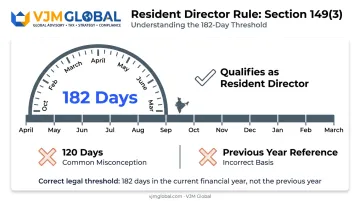
- At least one director must stay in India for 182 days during the financial year, a threshold many guides misstate as 120 days or reference to the "previous" year
- This is the resident director test under Section 149(3)
- For a newly incorporated company, this requirement applies proportionately based on that financial year's end
Foreign promoters incorporating from the US, UK, or Australia often stumble here since their existing directors rarely meet the residency test on day one. VJM Global regularly helps such founders identify a qualifying resident director or restructure board composition before filing.
Capital Requirements
There's no statutory minimum paid-up capital. The old Rs 1 lakh requirement was scrapped through the 2015 amendment to Section 2(68).
Still, setting capital too low can create practical problems. Decide your capital based on:
- Working capital needs for the first 6-12 months
- Statutory expenses (registration fees, stamp duty, professional fees)
- Investor or lender expectations, if you're planning to raise funds
Company Name Selection
Your company name must end with "Private Limited" under Section 4(1)(a). Beyond that, MCA naming rules (Rule 8, Rule 8A, Rule 8B) block:
- Names too similar to existing registered companies
- Undesirable or offensive expressions
- Trademark conflicts without consent
- Names implying government affiliation without approval
Name reservation happens through SPICe+ Part A, which you can file separately or bundled with Part B. You get two name options per application. Rejected names mean resubmission and added delay, so checking availability on the MCA portal beforehand saves a filing cycle.
Registered Office Address
You need a valid, lockable office address (owned or rented) before you can complete incorporation. Required proof includes:
- Title document or notarized lease/rent agreement
- NOC from the property owner
- Utility bill (electricity, gas, or telephone) not older than two months
Note: You can use a temporary correspondence address initially, but you must establish and verify your permanent registered office within 30 days of incorporation under Section 12. Miss this, and penalties run at ₹1,000 per day, capped at ₹1 lakh for the company and each defaulting officer.
Document Checklist for Incorporation
Documentation splits into two buckets: identity/address proofs for promoters, and company-specific legal drafts. Errors here are the number one reason applications get rejected or delayed on the MCA portal.
Identity and Address Proof Documents
For Indian directors and shareholders:
- PAN card (mandatory for DIN application)
- Aadhaar card
- Identity proof — voter ID, passport, or driving licence
- Address proof — utility bill not older than 2 months
For foreign nationals, the requirements are stricter:
- Passport is mandatory — no substitutes accepted
- Identity and address proofs must be notarized and apostilled (or consularized, depending on the country)
- Authentication route depends on where the documents are signed: Commonwealth countries need local notarization, Hague Convention countries need notarization plus apostille, and non-Hague countries need notarization plus Indian consular authentication
NRIs and OCIs often find the apostille/consularization step the most time-consuming part of the process, which is why many engage firms like VJM Global to manage document authentication across time zones.
Registered Office Documents
Once personal documents are sorted, the focus shifts to proving the company's registered address. You'll need the utility bill and NOC mentioned earlier, plus (where applicable) a notarized lease or rent agreement showing the company's right to occupy the premises.
Company Formation Documents
The Memorandum of Association (MOA) and Articles of Association (AOA) define your company's objectives, structure, and internal rules. These need to be:
- Drafted specific to your business activities
- Signed by all subscribers
- Filed electronically as eMoA (INC-33) and eAoA (INC-34) in most cases
Digital Signature and Other Requirements
A Digital Signature Certificate (DSC) is mandatory for signing the SPICe+ form electronically. MCA rules require Class II or above — Class III is the practical standard most applicants use today.
A few more requirements apply to directors specifically:
- DIN (Director Identification Number) is required for every proposed director
- Up to 3 proposed directors without an existing DIN can apply through SPICe+ Part B directly
- DIR-3 is generally for someone joining an existing company as director, not for first-time directors of a new company
Step-by-Step Incorporation Process and Timeline
Company incorporation in India runs entirely online through the MCA's SPICe+ portal (INC-32). Here's the sequence:
- Obtain DSC for at least one applicant director — this digital signature is needed to sign the entire application electronically
- Apply for DIN through Part B of SPICe+ (or DIR-3 if you're appointing a director to an existing company)
- Reserve your company name via Part A of SPICe+, submitting two name options with the applicable fee
- Draft MOA/AOA and complete Part B — enter capital structure, subscriber details, and director information. Then submit linked forms PAN, TAN, and AGILE-PRO-S, which covers GST registration, EPFO, ESIC, and Professional Tax where applicable
- Receive your Certificate of Incorporation (COI) with a Corporate Identification Number (CIN) once the Registrar of Companies (RoC) approves the application
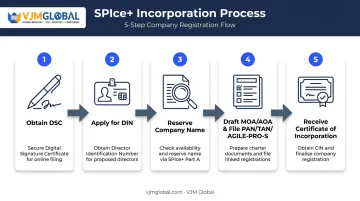
Completing these five steps doesn't guarantee a fixed timeline. Processing depends heavily on CRC workload, document quality, and whether your name or documents get flagged for resubmission.
Rather than quoting a fixed number of days, plan for potential resubmission cycles if your paperwork isn't airtight the first time. This is where experienced hands matter: firms like VJM Global that handle incorporation regularly know common rejection triggers and structure filings to minimize back-and-forth with the RoC.
Special Checklist for Foreign Investors, NRIs, and OCIs
Foreign nationals and NRIs/OCIs can hold 100% shareholding and directorship in an Indian Private Limited Company, subject to FEMA regulations and sector-specific FDI conditions.
Additional Requirements for Foreign Promoters
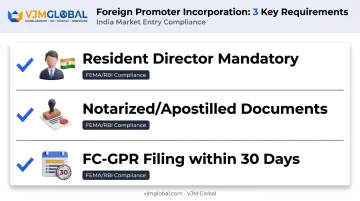
- At least one resident director is still mandatory — a foreigner cannot be the sole director, regardless of shareholding percentage
- Notarized and apostilled/consularized copies of foreign passports and address proofs
- FDI reporting via Form FC-GPR within 30 days of share allotment, filed through RBI's Single Master Form on the FIRMS portal
According to the Department for Promotion of Industry and Internal Trade's FDI policy, up to 100% FDI is permitted under the automatic route in most sectors — but not all. Sectoral caps, government-approval routes, and land-border restrictions (Press Note 3) can all apply depending on your business activity.
Navigating these sector-specific rules while also finding a compliant resident director and managing FEMA/RBI reporting is where most foreign founders get stuck without a local compliance team.
VJM Global works directly with international founders on this exact problem, having supported 500+ US, 250+ UK, and 250+ Australian businesses entering India. The team coordinates entity structuring, resident director arrangements, bank account opening, and FC-GPR filing under one process instead of multiple disconnected advisors.
Post-Incorporation Compliance Checklist
Getting your Certificate of Incorporation isn't the finish line. Several statutory actions carry hard deadlines, and missing them triggers penalties automatically.
| Compliance item | Deadline | Penalty for missing it |
|---|---|---|
| INC-20A (commencement of business) | 180 days from incorporation | ₹50,000 company fine + ₹1,000/day officer fine (up to ₹1 lakh) |
| First auditor appointment | 30 days (Board) or 90 days (members, if Board fails) | ₹25,000–₹5 lakh company fine |
| First Board meeting | 30 days from incorporation | ₹25,000 for officer breach of notice duty |
| Share certificates to subscribers | 2 months from incorporation | ₹50,000 company and officer fine |
Beyond these four time-bound deadlines, several obligations continue on an ongoing basis rather than a one-time schedule:
- Opening a bank account in the registered entity's name
- Maintaining registers for members, directors, and charges
- Registering for GST or Professional Tax, depending on your state and business activity
Most first-time founders underestimate how much ongoing compliance a Private Limited Company demands after incorporation. VJM Global's compliance outsourcing team handles auditor coordination, statutory filings, and register maintenance on an ongoing basis, which matters most for founders managing cross-border operations who can't track every Indian regulatory deadline themselves.
Frequently Asked Questions
What documents do I need to start a company?
You'll need PAN and Aadhaar for Indian promoters, or a passport plus notarized/apostilled documents for foreign nationals. Add registered office proof, a Digital Signature Certificate, and drafted MOA/AOA.
How do I check the certificate of incorporation?
Search the MCA portal's company/LLP name search or CIN lookup tool using your company's name or Corporate Identification Number. This confirms the incorporation date, status, and registered office on record.
What is a checklist in a company?
An incorporation checklist is a structured list of eligibility conditions, documents, and procedural steps required to legally register and operate a company. It ensures nothing gets missed during filing.
How long does it take to incorporate a Private Limited Company in India?
Timelines vary based on name approval speed, document accuracy, and whether the RoC requests resubmission. Clean, complete applications move faster; errors or name objections add weeks.
Can a foreigner be the sole director of an Indian Private Limited Company?
No. At least one director must be a resident Indian who stays in the country for 182 days during the financial year. A foreign national can, however, hold majority or even 100% shareholding.
What happens if I miss post-incorporation compliance deadlines?
Missing filings like INC-20A triggers company fines (up to ₹50,000) plus daily penalties for defaulting officers. Repeated non-compliance can also lead to director disqualification or RoC strike-off action.