Here's the catch: incomplete or mismatched documentation is one of the fastest ways to trigger ROC objections and resubmissions during SPICe+ filing. A missing apostille, an outdated utility bill, or a name that doesn't match across your PAN and passport can stall your application for weeks.
This guide breaks down exactly what documents you need, for directors, the registered office, the MOA/AOA, and the statutory forms, so you can prepare a complete file before you apply.
Key Takeaways
- Documents fall into four categories: ID proof, office address proof, MOA/AOA, and SPICe+ declarations
- Foreign nationals and NRIs need notarized or apostilled passports and address proof before filing
- SPICe+ Part B now issues Section 8 licenses directly; INC-12 applies only to conversions
- Address proofs (utility bills, bank statements, rent agreements) can't be older than two months
What Is a Section 8 Company and Who Should Register One
A Section 8 company is a non-profit entity registered under the Companies Act, 2013 for charitable, educational, religious, or social objectives. Unlike Trusts or Societies, which register at the state level, Section 8 companies fall under the Ministry of Corporate Affairs (MCA), giving them a more standardized, nationally recognized compliance structure.
This same compliance structure clears up a common misconception about director requirements. Many guides claim Section 8 companies need a minimum number of directors under the general rule:
| Company Structure | General Minimum Directors |
|---|---|
| Private | 2 |
| Public | 3 |
That's incorrect for Section 8 companies. A 2015 MCA notification, G.S.R. 466(E), specifically exempts them from the standard Section 149(1) director-count rule.
What does stay firm is the resident director requirement: at least one director must have stayed in India for 182+ days during the financial year. This is a residency test, not a citizenship test, so an NRI or OCI who meets the day count can serve as the resident director.
For VJM Global's client base, foreign companies, NRIs, and OCIs entering India for CSR or philanthropic ventures, this distinction matters. It means the founding team can be entirely foreign nationals, as long as one qualifying resident director is in place. That makes document readiness for non-resident applicants especially critical, since every passport, address proof, and declaration typically needs cross-border authentication.
Documents Required for Directors, Subscribers, and Members
Identity and address proof for every proposed director and subscriber forms the foundation of your incorporation file. Requirements differ meaningfully between Indian nationals and foreign applicants, so it helps to separate the two.
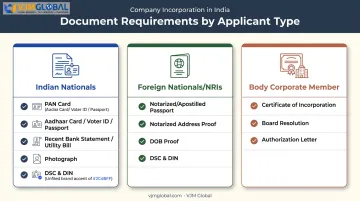
Documents for Indian Nationals
- PAN card (mandatory for all Indian subscribers and directors)
- Address proof: Aadhaar, Voter ID, Passport, or Driving License
- Recent bank statement or utility bill, not older than 2 months
- Passport-size photograph
- Digital Signature Certificate (DSC) and DIN, allotted via SPICe+ Part B
Documents for Foreign Nationals and NRIs
Foreign directors and subscribers face an extra authentication layer:
- Passport (mandatory), notarized and apostilled if the issuing country belongs to the Hague Convention; otherwise, consular authentication is required
- Address proof, such as a bank statement or government-issued document, also notarized/apostilled
- Proof of date of birth if the passport doesn't list one
- DSC and DIN, same as Indian nationals
A common pain point: foreign-language documents need an official notarized English translation before they'll be accepted by the Registrar. Firms like VJM Global, serving clients across the US, UK, and Australia, routinely coordinate this translation and authentication process directly in the applicant's home country.
When a Body Corporate Is a Member
Beyond individual directors and subscribers, corporate members bring their own layer of documentation. If another company is subscribing to shares, you'll need:
- The Certificate of Incorporation of the parent entity
- A board resolution authorizing the investment or subscription in the Section 8 company
- An authorization letter naming the representative empowered to sign incorporation documents on the entity's behalf
Registered Office Proof and MOA/AOA Requirements
Every Section 8 company needs a verifiable registered office address, and the MOA/AOA carries specific legal language that other company types don't require.
Registered Office Documents
Acceptable proofs depend on whether the premises are owned or rented:
| Ownership Type | Required Documents |
|---|---|
| Owned premises | Registered sale/title deed in the company's name |
| Rented premises | Notarized rent/lease agreement plus a rent receipt |
| Either case | Landlord NOC and a recent utility bill (electricity, gas, or telephone), not older than 2 months |
If the office isn't finalized at the time of filing, you can submit proof within 30 days of incorporation through Form INC-22.
Memorandum of Association (MOA) - Form INC-13
Section 8 companies must file their MOA in the prescribed INC-13 format. This isn't optional or flexible like it is for other company types. INC-13 must clearly state the charitable objectives and include the profit-application clause confirming that any income goes back into the stated objects, with no dividend distribution to members.
Articles of Association (AOA)
The AOA has no fixed MCA template, but it must include clauses restricting profit distribution and governing internal management. It needs to be signed by subscribers and attested by a witness.
Getting the exact clause language right matters more than it might seem. MCA reviewers expect specific charitable-object and profit-application phrasing in INC-13, and vague or generic wording is a frequent cause of resubmission. Having a Chartered Accountant or Company Secretary review the draft before filing catches these issues before the ROC does. VJM Global's team provides this review for foreign promoters as part of the incorporation process.
Statutory Declarations and SPICe+ Incorporation Forms Checklist
Section 8 incorporation now happens entirely through the SPICe+ portal, with the license itself issued as part of the same filing. Form INC-12 only comes into play when an existing company is converting into a Section 8 entity, not for fresh registrations.
Here's the current linked-form checklist, per MCA's SPICe+ guidance:
- SPICe+ Part A - Name reservation
- SPICe+ Part B - Incorporation application and Section 8 license
- INC-13 - Section 8 e-MOA
- INC-31 - Section 8 e-AOA
- INC-9 - Auto-generated subscriber and director declaration
- AGILE-PRO-S - For PAN, TAN, GST, EPFO, ESIC, and bank account setup
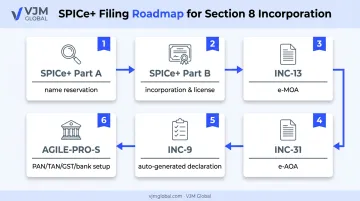
Note that INC-14 and INC-15 aren't standalone e-forms anymore in the current filing system; their declaration content is now built into INC-9. DIR-2 (director consent) is still required as a supporting document, but it isn't a separate linked e-form on the SPICe+ dashboard.
Supporting attachments you'll also need include an estimated income and expenditure statement for the next three financial years and a brief note on proposed charitable activities.
If the company plans to receive CSR funds from corporate donors down the line, factor in a separate CSR-1 registration. This isn't part of the incorporation filing itself — it's a distinct step once you're set up.
Keep both digital and physical copies of every form and declaration. ROC verification depends heavily on consistency across documents, and having a physical backup saves time if a reviewer asks for clarification.
Common Documentation Mistakes and How to Avoid Delays
Most Section 8 filing delays trace back to a handful of preventable errors:
- Name/address mismatches across PAN, Aadhaar, and utility bills
- Outdated address proofs, submitted past the 2-month window
- Missing notarization or apostille for foreign directors' passports and address documents
- Vague charitable objectives in the MOA that don't align with what Section 8 requires
None of these are complicated to fix on their own. The problem is they're easy to miss when you're managing filings across time zones, with documents arriving from three different countries in three different formats.
Getting all documents pre-verified by a practicing CA or CS before you touch SPICe+ is the single most effective way to cut down on ROC back-and-forth.
VJM Global brings 30+ years of experience to exactly this problem. Our team of CPAs, CAs, and business-setup professionals helps foreign companies, NRIs, and OCIs prepare, verify, and file complete Section 8 documentation without the guesswork.
Frequently Asked Questions
What are the documents required for Section 8?
You'll need identity and address proof for directors and subscribers, registered office proof, the MOA in INC-13 format and the AOA, plus SPICe+ linked declarations including INC-9.
What is the minimum number of directors in a Section 8 company?
Section 8 companies are exempt from the standard 2-director (private) or 3-director (public) minimum under a 2015 MCA notification. However, at least one director must be a resident of India, meeting the 182-day residency test.
What is the role of a Section 8 company?
It provides a credible, MCA-regulated corporate structure for promoting charitable, educational, or social objectives, without a profit motive, while still offering formal governance and accountability.
Is a Digital Signature Certificate (DSC) mandatory for all directors?
Yes. Every director and subscriber must have a DSC, since all SPICe+ forms and linked declarations are filed and signed digitally through the MCA portal.
Do foreign nationals or NRIs need notarized documents to become directors?
Foreign directors' passports and address proofs must be notarized and apostilled, or consularized where apostille doesn't apply, before they can be submitted with the filing.
How long does Section 8 registration take once documents are ready?
Timelines vary based on name approval, document authentication for foreign applicants, and whether the Registrar raises any queries. No fixed MCA-published average currently exists, so working with an experienced filing team helps keep the process moving.