Many foreign investors struggle with a confusing patchwork of amendments, outdated references to the old 1956 law, and unfamiliar terms like SPICe+, DIN, and FC-GPR. The Companies Act 2013 replaced the Companies Act 1956, modernizing governance and digitizing much of the registration process.
This guide walks through applicability, company types, the step-by-step registration process, and post-registration compliance, with particular attention to foreign investors, NRIs, and OCIs entering the Indian market.
Key Takeaways
- The Companies Act 2013 is India's primary corporate law, having fully replaced the Companies Act 1956
- Registration now runs through the SPICe+ portal, bundling name approval, incorporation, DIN, PAN, and TAN into a single filing
- Foreign nationals and NRIs/OCIs can register companies with notarized, apostilled documents and one India-resident director
- Missing post-registration deadlines like INC-20A or annual ROC filings triggers penalties and possible director disqualification
- Professional guidance cuts registration timelines and reduces compliance risk for founders unfamiliar with Indian corporate law
What Is the Companies Act 2013 and Who Does It Apply To?
The Companies Act 2013 is administered by the Ministry of Corporate Affairs (MCA) and enforced through Registrars of Companies (ROC) across India. It governs everything from incorporation to management and eventual winding up of Indian companies.
The Act received presidential assent on 29 August 2013 and repealed the older Companies Act 1956 under Section 465, while preserving certain prior actions and rights already in motion.
1956 vs. 2013: Clearing Up the Confusion
A lot of founders search for "Companies Act 1956 or 2013" because older references still circulate online. Here's the simple answer: the 2013 Act is the current law. The 1956 Act no longer applies to new incorporations.
Who Falls Under This Act
The Companies Act 2013 applies to:
- All companies incorporated in India, regardless of size or sector
- Private limited companies, public limited companies, One Person Companies, and Section 8 (non-profit) entities
- Certain foreign companies with a place of business in India, physical or electronic, under Section 2(42)
This last point matters most for foreign entities: if you're a US, UK, or Australian company setting up even a liaison office or branch in India, the Act's compliance requirements apply to you from day one.
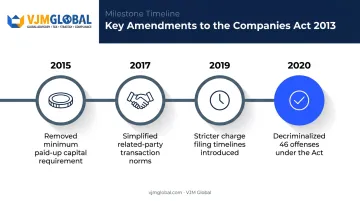
The Act has been amended several times since 2013, each time refining rather than replacing the core law. Key updates include:
- 2015: Removed minimum paid-up capital requirements for private and public companies
- 2017: Simplified provisions around related-party transactions and loans to directors
- 2019: Introduced stricter timelines for filing charges and tightened penalty provisions
- 2020: Decriminalized 46 compoundable offenses to ease compliance burdens
These amendments are why founders and foreign investors should always verify they're referencing the latest compliance requirements, something VJM Global's advisory team tracks as part of ongoing registration and compliance support for international clients.
Types of Companies You Can Register Under the Companies Act 2013
Choosing the right structure shapes your liability, compliance load, and fundraising options. Here's a quick breakdown:
| Structure | Members Required | Best For |
|---|---|---|
| Private Limited Company | 2-200 members | Startups, foreign subsidiaries |
| Public Limited Company | Minimum 7, no cap | Companies planning public capital raises |
| One Person Company (OPC) | Exactly 1 member | Solo Indian resident founders |
| Section 8 Company | Varies by chosen form | Non-profits, charitable objects |
| LLP | 2 partners minimum | Lower-compliance partnerships (governed separately) |
Private Limited Companies remain the top choice for foreign investors because they offer limited liability, straightforward fundraising through equity, and comparatively lighter compliance than public companies. Picking the right structure often depends on factors specific to your business, which is why many foreign founders work with advisors who understand both Indian corporate law and their home-country obligations.
Not every foreign business needs a full Indian subsidiary, though. If incorporating locally isn't the goal, here are the alternative structures worth considering.
Structures for Foreign Companies Not Incorporating Locally
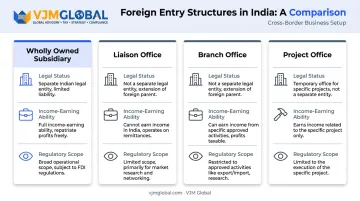
Foreign businesses that want a presence in India without setting up a full subsidiary can instead choose from:
- Wholly Owned Subsidiary (WOS) – a separate Indian company, full operating scope, subject to FEMA and Companies Act rules
- Liaison Office – representative presence only; cannot earn Indian income
- Branch Office – can earn income from RBI-permitted activities like consultancy or IT services
- Project Office – temporary, tied to a specific Indian project
The WOS is the only option among these that creates an actual Indian company. The other three remain extensions of the foreign entity.
Step-by-Step Process for Company Registration in India Under the Companies Act 2013
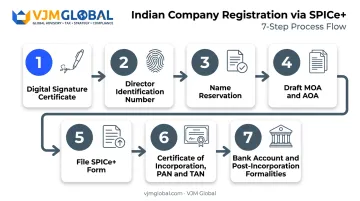
Registration today runs almost entirely through the MCA's SPICe+ (Simplified Proforma for Incorporating Company Electronically Plus) portal. This integrated system has cut both paperwork and processing time significantly compared to the pre-2020 process.
Step 1: Obtain Digital Signature Certificate (DSC)
Every proposed director and subscriber needs a DSC to sign electronic filings with the MCA. Foreign nationals must notarize and apostille their identity and address proof from their home country before this step proceeds.
Step 2: Apply for Director Identification Number (DIN)
DIN applications for up to three proposed directors are now embedded directly within the SPICe+ form itself, so there's no separate filing required for new companies.
Step 3: Reserve the Company Name
Name reservation happens through Part A of SPICe+ or the standalone RUN service. The MCA rejects names that duplicate existing companies, infringe trademarks, or violate naming guidelines, so it pays to have backup name options ready.
Step 4: Draft the MOA and AOA
- Memorandum of Association (MOA) defines your company's objectives and operational scope
- Articles of Association (AOA) sets internal governance rules and procedures
Both are typically filed electronically through INC-33 (e-MOA) and INC-34 (e-AOA) as part of the SPICe+ submission.
Step 5: File SPICe+ Form and Supporting Documents
Required documents include:
- Identity and address proof for all directors and shareholders
- Registered office proof (utility bill, rent agreement, or ownership document)
- Notarized and apostilled documents for foreign shareholders/directors, translated if not in English
Step 6: Obtain Certificate of Incorporation, PAN, and TAN
Once the ROC approves your filing, it issues a Certificate of Incorporation along with a Corporate Identification Number (CIN). PAN and TAN generate automatically through the same SPICe+ process. The AGILE-PRO-S form also triggers linked registrations, including:
- EPFO (Employees' Provident Fund Organisation)
- ESIC (Employees' State Insurance Corporation)
- GST, if opted in at this stage
Step 7: Open a Bank Account and Complete Post-Incorporation Formalities
Founders need to open a current account, deposit subscribed capital, and secure GST registration if applicable to their business activity. With incorporation complete, the natural next question is how long the entire journey takes. On timelines: in practice, the ROC's core process moves in 3-4 working days once documentation is complete. This estimate excludes prep time for foreign notarization and apostille, which typically adds the most delay for overseas founders — a step where firms like VJM Global often guide foreign clients through document authentication and post-incorporation compliance to keep the timeline on track.
Post-Registration Compliance Requirements Under the Companies Act 2013
Getting the Certificate of Incorporation is the starting line, not the finish. The Companies Act 2013 imposes strict early deadlines:
- First board meeting – within 30 days of incorporation
- First statutory auditor appointment – within 30 days by the board (or 90 days by members if the board fails to act)
- Form INC-20A (Declaration of Commencement of Business) – within 180 days, required before most companies can start operations or exercise borrowing powers
Ongoing Obligations
Companies must also maintain:
- Statutory registers and minutes of all board/shareholder meetings
- AOC-4 (financial statements) filed within 30 days of the AGM
- MGT-7 or MGT-7A (annual return) filed within 60 days of the AGM
What Non-Compliance Actually Costs
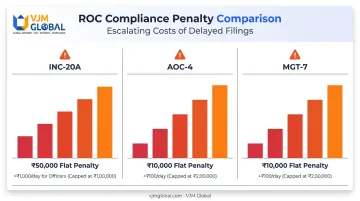
Penalties aren't symbolic. Failing to file INC-20A can cost the company ₹50,000, with defaulting officers facing ₹1,000 per day, capped at ₹1,00,000. Missing AOC-4 or MGT-7 deadlines brings penalties starting at ₹10,000 plus ₹100 per day, capped at ₹2,00,000.
Directors who fail to file financial statements or annual returns for three continuous financial years face disqualification for five years under Section 164(2). The ROC can also strike off inactive companies under Section 248.
FEMA Reporting for Foreign-Owned Companies
These domestic penalties are only part of the picture for foreign-owned entities, which face an additional layer of reporting under FEMA. Companies receiving foreign investment must file Form FC-GPR within 30 days from the date equity instruments are issued, not from the date funds are received. This distinction trips up many foreign investors who assume the clock starts at remittance.
Given how easily these overlapping deadlines are missed, most foreign-owned businesses rely on local advisors to track filings and calculate penalty exposure. VJM Global's compliance team handles these filings directly for clients entering the Indian market, coordinating board resolutions, ROC filings, and FEMA reporting so nothing slips past its deadline.
Special Considerations for Foreign Investors, NRIs, and OCIs
Foreign nationals, NRIs, and OCIs can serve as directors and shareholders in Indian companies. There's one non-negotiable condition, though: at least one director must be a resident of India, meaning someone who stays in the country for at least 182 days during the financial year under Section 149(3).
This is a physical stay test, not a citizenship test. An NRI or OCI who doesn't meet the 182-day threshold fails to satisfy this condition, no matter their citizenship or OCI status.

Additional documentation typically required for foreign applicants:
- Notarized copies of passports and address proof
- Apostille certification from the country of origin
- Certified English translations for any non-English documents
Notarization timelines, apostille processes that vary by country, and FEMA reporting requirements alongside Companies Act compliance are where most delays creep in for overseas founders.
VJM Global has guided companies from the US, UK, and Australia through this process, structuring filings correctly the first time and keeping FEMA and Companies Act compliance aligned from day one.
Frequently Asked Questions
Is the Companies Act 1956 or 2013?
India currently operates under the Companies Act 2013, which replaced the Companies Act 1956. The 2013 Act governs all companies, whether newly incorporated or existing from before 2013.
What is the Companies Act 2015?
There's no standalone "Companies Act 2015." This refers to the Companies (Amendment) Act 2015, which modified the 2013 Act by removing minimum paid-up capital requirements and making the common seal optional.
Who does the Companies Act apply to?
It applies to every company incorporated in India under current or previous company law, plus foreign companies that maintain a place of business in India, whether physical or electronic.
What is the Company Act 2019?
Again, there's no separate "Companies Act 2019." This refers to the Companies (Amendment) Act 2019, which strengthened CSR enforcement and streamlined penalty provisions under the existing 2013 Act.
Can a foreigner register a company in India?
Yes. Foreign nationals and foreign companies can register in India, subject to FDI sector norms, the resident director requirement, and additional documentation like notarized and apostilled identity proof.
How long does company registration take in India?
The core ROC process can move in 3-4 working days once all documents are ready, though foreign document notarization and apostille often extend the total timeline. VJM Global's business setup team routinely helps overseas applicants navigate these steps faster, minimizing delays from document notarization abroad.