Many UK founders assume Saudi company formation mirrors setting up a UK limited company. It doesn't. The process runs through distinct phases, and it starts with UK-specific document legalisation long before you touch a Saudi government portal. Below is the step-by-step checklist we wish more founders saw before they started.
Key Takeaways
- 100% foreign ownership is allowed in most sectors through MISA registration, with only a short restricted list
- Setup runs in three phases: entity formation, hiring authorisation, and residency/banking, spanning several months from the UK
- UK documents need FCDO apostille and Saudi Embassy legalisation before MISA accepts them
- A Saudi-resident General Manager with a valid Iqama is mandatory, with Saudization quotas from your first hire
- Capital requirements, government fees and professional costs vary by business activity
Why Saudi Arabia Is Attracting UK Businesses
The commercial relationship between the two countries is substantial, if a little uneven right now. Total UK-Saudi trade reached £13.4 billion in the 12 months to Q1 2026, according to the UK government's Saudi Arabia trade and investment factsheet. That figure breaks down into £9.6 billion in UK exports and £3.8 billion in imports. UK outward FDI stock in Saudi Arabia stood at £6.5 billion at the end of 2024.
Trade did fall year-on-year, driven mainly by a drop in exports, but the underlying opportunity hasn't disappeared. It's shifted toward sectors where the UK already has deep expertise.
Vision 2030 Sectors Match UK Strengths
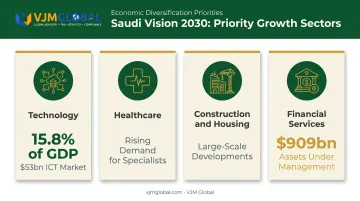
Saudi Arabia's Vision 2030 programme is actively pulling investment into areas where UK companies already compete globally:
- Technology – the digital economy now represents roughly 15.8% of GDP, with an ICT market valued at around $53 billion
- Healthcare – rising quality benchmarks and life expectancy figures are driving demand for specialist providers and health-tech
- Construction and housing – large-scale developmental housing programmes continue to expand
- Financial services – assets under management are approaching $909 billion, creating room for advisory, fintech and compliance specialists
What Makes Market Entry Easier Now
Beyond sector opportunity, regulatory reforms have made entry itself more straightforward. Several reforms directly benefit UK founders:
- Full foreign ownership in most sectors, no local sponsor or Saudi shareholder required
- No personal income tax on Saudi employment earnings
- Digital investment registration through MISA has replaced the older sponsor-based licensing model
A short negative list still restricts certain activities. Real estate development, for instance, is restricted unless each project meets a minimum value of SAR 30 million and sits outside Makkah and Medina.
Other historically sensitive sectors, including oil exploration and defence-related activity, have also faced restrictions. Because the published list changes, confirm your specific activity code against MISA's current guidance before you commit time or budget to an application.
Step-by-Step Process for UK Foreigners to Start a Business in Saudi Arabia
The process moves through three broad phases: legal entity establishment, authorisation and hiring, and residency and banking. UK applicants need to start document legalisation before Phase 1 can even begin, not alongside it.
Step 1: Legalise UK Company Documents and Choose a Business Structure
Your Certificate of Incorporation, Memorandum and Articles of Association, and board resolutions all need apostille certification from the FCDO, followed by attestation at the Saudi Embassy in London. Skip either step and MISA will reject your submission outright.
On structure: most UK SMEs opt for a Limited Liability Company (LLC), since it caps liability and suits smaller teams. Established UK exporters with an existing trading relationship sometimes prefer a branch structure instead, which avoids creating a separate legal entity.
Step 2: Obtain MISA Investment Registration
Submit your application through the Invest Saudi portal, selecting the correct ISIC4 activity code for your business. This single choice determines your capital requirements, ownership limits and any sector-specific conditions, so get it right the first time.
The official service level for MISA review is 10 working days. There's no fixed registration fee published upfront; MISA determines the amount after approval, and payment is due within 15 business days or the registration lapses. Budget for this as a variable cost, not a fixed line item.
Step 3: Reserve a Trade Name and Notarise the Articles of Association
Once registered with MISA, reserve a unique company name through the Ministry of Commerce. Reserving in Arabic costs SAR 200; English costs SAR 500, and the reservation holds for 60 days. The published turnaround is around 10 days.
Notarising your Articles of Association comes next. This fixes your entity name, activity codes, capital structure, and the scope of your General Manager's authority. Vague GM powers here cause problems later, more on that below.
Step 4: Secure Commercial Registration and Chamber of Commerce Membership
Commercial Registration (CR) is what makes your company legally operational in Saudi Arabia. The official company-establishment service carries a turnaround of up to 72 hours, with an LLC filing fee of SAR 1,200 plus a SAR 500 publication fee and 15% VAT.
Chamber of Commerce membership must follow immediately once your CR is active and complete. Fees vary depending on your business category, but the registration itself processes almost instantly once your CR is in order.
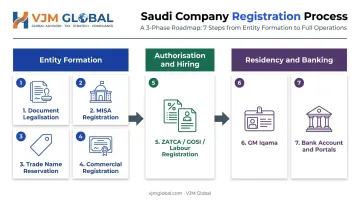
Step 5: Register with ZATCA, GOSI and the Ministry of Labour
With your CR issued, register with the Zakat, Tax and Customs Authority (ZATCA) to enable VAT and corporate tax compliance. Registration follows automatically once your Ministry of Commerce filing is complete, and there's no separate fee for the initial tax number.
You'll also need:
- GOSI registration for social insurance, which happens automatically for the facility owner after CR issuance
- Qiwa activation to manage labour contracts, work permits and visas, including for any UK staff relocating to Saudi Arabia
Step 6: Appoint a Saudi-Resident General Manager and Process the Iqama
Every Saudi entity needs a resident General Manager holding a valid Iqama (residency permit). This person can be a relocating UK national; it doesn't have to be a Saudi citizen, but they must be physically resident.
The sequence runs: the company sponsors the individual, HRSD/Qiwa issues a work permit (a flat SAR 100 fee, processed almost immediately), and that permit becomes the basis for issuing the Iqama. One recurring delay we see: AoA clauses that define GM powers too narrowly. If the GM can't sign for banking or contracts without additional sign-off, every subsequent step slows down.
Step 7: Open a Corporate Bank Account and Activate Government Portals
Banks won't open a corporate account until you have both your CR and a registered National Address, so sort your physical office lease early rather than treating it as an afterthought. Saudi banks also run standard KYC and beneficial-ownership checks before releasing funds.
Finally, activate the three portals that keep your entity compliant day-to-day:
- Qiwa – labour contracts, work permits and workforce management
- Muqeem – Iqama tracking, exit/re-entry permits, and residency alerts
- Mudad – Wage Protection System payroll submissions
Documents, Costs and Timelines for UK Applicants
What You'll Need to Prepare
Core documents for most UK applicants:
- Certificate of Incorporation
- Memorandum and Articles of Association
- Board resolution authorising the Saudi investment
- Power of Attorney for your appointed representative
- Audited financial statements (established firms)
- Passport copies of all shareholders and directors
Startups without trading history can typically substitute a detailed business plan and pitch deck in place of audited accounts.
The Legalisation Sequence UK Founders Underestimate
This is the step that catches people out most often. Your documents first need FCDO apostille, then Saudi Embassy legalisation in London. Per GOV.UK's official guidance, FCDO turnaround varies by method:
| Service | Fee | Turnaround |
|---|---|---|
| e-Apostille | £35 | Up to 2 working days |
| Standard paper apostille | £45 plus delivery | Up to 25 working days |
| Registered business next-day | £40 | Next working day |
| Urgent same-day | £100 | Same day (restricted eligibility) |
The Saudi Embassy stage has no published fee or turnaround on its official channels, so treat it as an unknown variable rather than assuming a fixed number of days.
Cost Breakdown by Business Activity
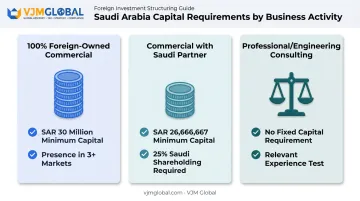
Capital requirements shift dramatically depending on your ISIC4 activity code, according to MISA's current investor guide:
- 100% foreign-owned commercial activity: SAR 30 million minimum capital, plus a presence requirement in at least three regional or global markets
- Commercial activity with a Saudi partner: SAR 26,666,667, with a minimum 25% Saudi shareholding
- Professional and engineering consulting: no fixed capital figure, but experience and multi-country presence tests apply instead
Add government fees on top: CR filing (SAR 1,200), publication (SAR 500), trade name reservation (SAR 200-500), and Chamber of Commerce subscription. Professional service fees for legal and accounting support vary by firm and scope, so request a scoped quotation rather than relying on a generic figure.
A Realistic Timeline
Component-level service standards give you a workable planning framework:
- FCDO apostille: 2 to 25 working days, depending on method
- MISA registration: 10 working days
- CR issuance: up to 72 hours
- Trade name reservation: around 10 days
GM Iqama processing and bank account opening carry no official end-to-end guarantee, so build in buffer weeks for both.
VJM Global has supported over 250 UK businesses with cross-border market entry, and its Saudi Arabia service line covers MISA investment registration, Commercial Registration, Articles of Association notarisation, and ongoing ZATCA and Nitaqat compliance. For UK founders juggling document legalisation alongside Saudi filings, having one point of contact across both ends genuinely reduces the back-and-forth.
Common Mistakes UK Investors Make and Compliance Essentials
Underestimating Legalisation Timelines
The single most frequent error: assuming FCDO and embassy attestation take days. Standard paper apostille alone can take up to 25 working days, and the Saudi Embassy stage adds further, unpublished time on top. Start this process the moment you decide to expand, not once your MISA application is drafted.
Saudization Isn't Optional
Nitaqat quota obligations apply from your very first Saudi hire. Current bands are Platinum, High Green, Mid Green, Low Green, and Red. Red-band companies cannot request new visas, use transfer visas, or renew existing work permits, effectively freezing their ability to bring in expatriate staff, including relocating UK employees.
Model your expected Saudization ratio before recruiting, not after.
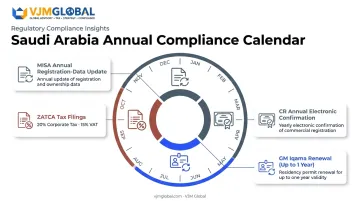
Renewals You Need to Track Annually
Three separate cycles run independently:
- MISA requires an annual registration-data update
- CR now uses annual electronic confirmation (since 3 April 2025), replacing the old renewal system
- GM Iqama is extendable, typically issued for up to one year at a time
Tax obligations round out this annual calendar. Corporate income tax sits at 20% of net adjusted profit attributable to non-Saudi ownership, and standard VAT is 15%. Both require ongoing ZATCA filings, so build these deadlines into your compliance calendar from day one. Firms like VJM Global track these Saudi filing cycles alongside UK reporting obligations, so nothing slips between jurisdictions.
Conclusion
Starting a business in Saudi Arabia from the UK is genuinely achievable, with full foreign ownership available in most sectors, provided you sequence the legal, hiring and banking phases correctly. The steps themselves aren't complicated. What trips founders up is timing.
FCDO apostille and Saudi Embassy legalisation remain the single biggest source of delay we see. They should top your task list from day one, not wait until MISA paperwork is already underway.
VJM Global works alongside UK businesses through entity formation and the compliance obligations that follow, from MISA registration through ongoing ZATCA and Nitaqat requirements. This support keeps your Saudi market entry on schedule, sidestepping the delays that catch most founders by surprise.
Frequently Asked Questions
Can a foreigner start a business in Saudi Arabia?
Yes. MISA investment registration permits 100% foreign ownership in most sectors, subject to a short negative list of restricted activities. UK nationals and companies qualify under the same framework.
How much money do I need to start a business in Saudi Arabia?
Capital requirements vary by activity: commercial businesses need SAR 30 million minimum, while many professional services have no fixed capital requirement. Add several thousand SAR for CR, trade name and professional fees in year one.
Which businesses are best for foreigners to start in Saudi Arabia?
Vision 2030 priority sectors, technology, healthcare, construction and financial services, suit UK expertise well and generally allow full foreign ownership. Professional and engineering consulting also avoid the higher capital thresholds applied to commercial trading.
Do I need to relocate to Saudi Arabia to run my business, or can I manage it from the UK?
Shareholders and directors can remain UK-based throughout. However, you must appoint a Saudi-resident General Manager holding a valid Iqama to manage the entity locally.
How long does it take to register a company in Saudi Arabia from the UK?
Once UK document legalisation and MISA approval are factored in, the full process typically spans a few months. FCDO apostille alone can take up to 25 working days depending on the service used.
Do UK citizens need a visa to travel to Saudi Arabia for business setup meetings?
Yes. UK nationals can generally use the electronic visa waiver or ETA for business travel, though formal visits sometimes require a Saudi host to submit a request through MOFA. Check requirements before booking travel.