It's not hard to see the appeal. Saudi Arabia's population crossed 32.2 million in the 2022 census, with 41.6% being non-Saudi residents — a sizeable expat and consumer base alongside the domestic market. Add government mega-projects, no personal income tax for relocating staff, and a simplified registration process under the 2025 Investment Law, and the calculus for Australian founders has changed.
This isn't just a big-corporate story either. Mining and engineering firms, tech startups, consultants, and trading companies from Australia are all exploring entry. This guide walks through what actually happens — step by step — when an Australian business decides to set up in the Kingdom, and where cross-border advisory support fits into the process.
TL;DR
- Saudi Arabia’s 2025 Investment Law swapped MISA licensing for investor registration and opened most sectors to full foreign ownership
- Australian investors still need MISA registration, a Commercial Registration (CR), plus ZATCA, GOSI, and Saudization compliance
- Full setup often takes 12–15 weeks (PwC); the MISA stage alone can clear in 5–10 working days with complete papers
- Lock legal structure and Australian document attestation early—these drive the rest of the timeline
- Dual-market sequencing support (Australia + Saudi) helps avoid rework on filings, attestation, and post-incorporation compliance
What Does Starting a Business in Saudi Arabia From Australia Involve?
An Australian company or individual establishes a legally registered presence in the Kingdom, not simply exporting goods or servicing Saudi clients remotely from Melbourne or Perth.
That presence is what separates selling into a market from operating inside it. A registered entity lets you contract directly, hire locally, and bill in Saudi riyal without a third-party distributor.
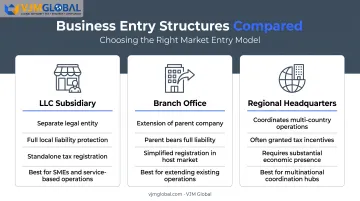
Common formats Australian businesses use:
- LLC subsidiary: the standard route for SMEs and service providers
- Branch office: for established Australian companies extending existing operations into KSA
- Regional Headquarters (RHQ): reserved for larger multinationals managing several countries from a Saudi base
What to Know Before You Start a Business in Saudi Arabia as an Australian
Many Australian founders underestimate the friction that comes purely from distance. Before you commit, set realistic expectations on documents, presence, and timelines.
Attestation and Physical Presence
Australian company documents need attestation through DFAT and the Saudi Embassy in Canberra before they're accepted in the Kingdom. DFAT charges AUD 105 per apostille or authentication, though it doesn't guarantee a fixed turnaround.
You'll also need to decide early:
- Can you manage the entity remotely at first, or do you need someone on the ground?
- Who will you appoint as General Manager, and can they obtain an Iqama (residency permit)?
- Is this a single-project entry (say, a mining services contract) or a long-term Saudi presence?
Realistic Timelines
PwC's guide estimates 12-15 weeks for the full process in some scenarios. The MISA application itself often moves in 5-10 working days once documents are complete. Attestation and banking usually stretch the timeline, not the MISA stage itself.
Why Australian Businesses Are Setting Up in Saudi Arabia
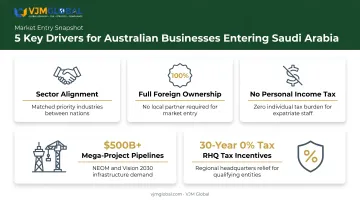
Entry makes sense under certain conditions, not automatically for every business. Here's what's driving genuine demand:
- Sector alignment: mining services, agtech, education, construction, and professional services all map well to Australian strengths
- Full foreign ownership: the 2025 Investment Law removed the old requirement for a Saudi partner in most activities
- No personal income tax: PwC confirms Saudi Arabia doesn't tax employment-only earnings, including for expatriates
- Mega-project pipelines: NEOM alone was announced with over US$500 billion in backing, and Expo 2030 Riyadh expects 42 million+ visits across 197 nations
- RHQ tax incentives: a 30-year 0% corporate tax regime for qualifying regional headquarters activities
None of this guarantees success. It just means the door is open wider than it used to be.
Early Decisions That Matter When Entering the Saudi Market From Australia
Most delays trace back to underestimating Saudi-specific complexity, not a lack of business experience. These mistakes show up again and again:
- Wrong legal structure — choosing an LLC when a branch (or vice versa) better fits the parent company's goals, or a structure that blocks full ownership later
- Underestimated first-year costs — attestation, translation, office setup, and GM visa fees stack up beyond the headline registration fee
- Saudization quotas — Nitaqat rules control how quickly you can bring in expat staff, including Australians
- Sequencing errors — signing an office lease before confirming activity codes and municipality zoning is a costly mistake
- Bank account due diligence — SAMA requires verification of ownership, directors, and capital before a foreign-owned entity can open an account, which can take weeks
First-year costs vary heavily by structure and activity. Treat any figure you're quoted as specific to your case, not a universal benchmark.
How to Start a Business in Saudi Arabia From Australia – Step by Step
This is the practical execution path once you've decided to enter. Common mistakes at this stage include rushing MISA registration before confirming activity codes, skipping Saudization planning, or assuming UAE rules carry over — they don't.
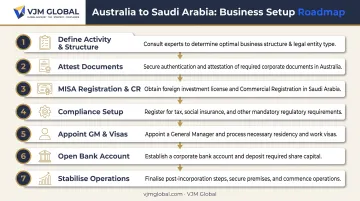
Step 1 – Define Your Activity, Structure, and Market Entry Strategy
Select the ISIC4 activity codes that match what your Australian business actually does, and check none of them sit on the Excluded Activities List under Article 8 of the Investment Law. Then choose between an LLC, branch office, or RHQ based on your company's size and ambitions.
Common miss: picking a structure that later blocks full ownership or forces a Saudi partner requirement.
Step 2 – Prepare and Attest Australian Corporate Documents
Gather your certificate of incorporation, audited financials, board resolution, and power of attorney. These need to move through DFAT, then the Saudi Embassy in Canberra, then Arabic translation.
Common miss: getting the attestation order wrong, which causes MISA application rejections and forces a restart.
Step 3 – Register With MISA and Secure Commercial Registration
Submit your investment registration application, reserve a trade name, and notarise the Articles of Association. Once approved, obtain the Commercial Registration and Chamber of Commerce membership.
Common miss: budgeting off outdated pre-2025 MISA fee structures. The process has changed materially since the new Investment Law.
Step 4 – Set Up Compliance Infrastructure
Register with ZATCA for tax and VAT, GOSI for social insurance, and Qiwa for employment. Secure a national address and registered office.
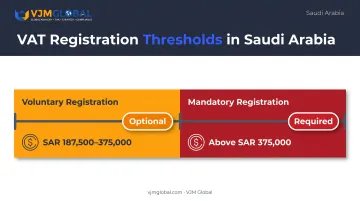
Common miss: missing the SAR 375,000 VAT registration threshold and incurring avoidable penalties. ZATCA confirms registration is mandatory above this figure and voluntary between SAR 187,500 and SAR 375,000.
Step 5 – Appoint a General Manager and Process Visas
Appoint a GM, often relocated from Australia or locally hired, and process their work visa and Iqama. Plan your headcount against Saudization (Nitaqat) quotas from day one.
Common miss: delaying the GM visa, which then blocks banking and tax registration downstream.
Step 6 – Open a Corporate Bank Account and Go Live
Approach a SAMA-licensed bank with your CR, MISA registration, and shareholder KYC file. Build in extra weeks for enhanced due diligence on foreign shareholders.
Common miss: assuming your existing Australian banking relationship will speed up Saudi onboarding. It won't. Saudi banks run independent verification on ownership, directors, and capital structure.
Step 7 – Stabilise Operations and Manage Ongoing Compliance
Once you're live, set up recurring processes for payroll reporting, tax and Zakat filings, and Saudization tracking. Treating Saudi compliance as a one-off project, rather than an ongoing function, is what starts to bite founders.
VJM Global works across both Australian and Saudi compliance environments. That includes entity formation and local obligations such as ZATCA, GOSI, Qiwa, and Nitaqat, plus parent-entity Australian accounting needs like BAS, PAYG, and Single Touch Payroll.
Common miss: treating your Saudi entity as "set and forget" once the Commercial Registration is issued.
Conclusion
Starting a business in Saudi Arabia from Australia is achievable under the 2025 reforms. The barriers that existed five years ago have largely come down. Success now hinges less on speed and more on getting the sequence right: structure, attestation, and compliance, in that order.
Getting activity classification and Saudization planning correct upfront matters more than how fast you can push through MISA registration. Once you're operational, ongoing compliance across two jurisdictions needs the same attention as the initial setup, not a one-off checkbox.
For Australian founders who want that sequence handled end to end, VJM Global supports entity formation, tax, and ongoing compliance in Saudi Arabia.
Frequently Asked Questions
Which business is best in Saudi Arabia for foreigners?
Sectors with strong 100% foreign ownership access and clear demand suit Australian expertise well. Professional services, IT, construction, and specialised consulting align especially well with mega-project pipelines.
What are the steps involved in setting up a business in Saudi Arabia?
The main steps are: MISA investor registration, Commercial Registration issuance, tax and labour registrations (ZATCA, GOSI, Qiwa), appointing a General Manager with a visa, and opening a corporate bank account.
How much does a business visa cost in Saudi Arabia?
Costs vary by visa type and sponsor, covering work visa and Iqama fees per employee plus GM-specific processing costs. Get a current quote tied to your specific entity structure rather than relying on general estimates.
What is the maximum foreign ownership limit in Saudi Arabia?
Full foreign ownership is available in most sectors under the current Investment Law, with exceptions for activities on the Excluded Activities List and certain trading or professional licences.
How long does it take to register a company in Saudi Arabia from Australia?
Timelines vary, but PwC's guide points to a process spanning several weeks to a few months in total, with Australian document attestation often the longest single stage.
Do I need a Saudi partner to start a business as an Australian company?
Most sectors no longer require a local partner following the 2025 Investment Law, though some professional and trading activities still carry that requirement. Check your specific activity code before assuming otherwise.