Interest is coming from several directions at once. Dutch freelancers exploring self-employment across the border. EU/EFTA citizens already living in the Netherlands who want a foothold in the DACH region. Dutch SMEs eyeing Switzerland as a launchpad for wider European expansion.
This guide answers the core question directly: can a Dutch resident or citizen legally start a Swiss company, and what does that actually involve? We'll walk through the legal structures, the step-by-step process, and the realistic costs and timelines.
TL;DR
- Foreigners, including Dutch nationals, can start a business in Switzerland — EU/EFTA and non-EU/EFTA rules differ slightly
- Most use a GmbH or AG, both needing a Swiss-resident director or signatory
- Minimum share capital: CHF 20,000 (GmbH) or CHF 100,000 (AG)
- Setup: choose a canton, notarise documents, register with the Commercial Register
- Cross-border advisors help Dutch founders handle setup, compliance, and tax registration beside an existing Dutch business
Can Foreigners Start a Business in Switzerland from the Netherlands?
Yes. Nationality and residence are not decisive factors when forming a GmbH or AG in Switzerland. A Dutch citizen living anywhere, including the Netherlands, can be a shareholder or director of a Swiss company.
The practical limits sit elsewhere: local representation, permission to work on the ground, and a few sector rules such as real estate.
Under SECO's own guidance, a GmbH or AG needs just one natural or legal person to found it. There's no requirement that this person be Swiss, EU, or even Swiss-resident. What is required is at least one Swiss-resident manager or director with signing authority.
The EU/EFTA Advantage
Dutch nationals hold an edge over non-EU/EFTA founders if they plan to relocate and work in the business themselves. As EU citizens, they can apply for a B EU/EFTA residence permit by proving genuine self-employment, a process that's simpler than the route available to third-country nationals.
For short stays, there's flexibility too:
- Self-employed service provision up to 90 working days per calendar year can use a notification procedure rather than a full permit
- Notification is generally required once work exceeds eight working days annually (some sectors like construction require notification from day one)
- Notifications must typically be filed at least eight days before work begins
Staying in the Netherlands? You Can Still Incorporate
Founders who have no intention of relocating can still own a Swiss company outright. The requirement isn't that the owner lives in Switzerland; it's that the company has a registered Swiss office and at least one Swiss-resident signatory handling local representation.
One restriction worth flagging: the resulting company cannot deal in Swiss real estate without additional permits under what's now called Lex Koller (formerly Lex Friedrich). This governs property acquisition by foreign-controlled entities. It is not a blanket restriction on operating a Swiss business, just on property deals.
For context, Switzerland's Federal Statistical Office recorded 46,987 businesses created from scratch in 2022, and separate FSO data shows 19,854 enterprises within foreign multinational groups as of 2023. Neither figure isolates Dutch or EU founders specifically, but both confirm foreign involvement in Swiss company formation is substantial and growing.
Business Structures Available for Dutch Founders in Switzerland
Four structures are realistically relevant to a Dutch entrepreneur:
| Structure | Liability | Minimum Capital | Swiss Residency Requirement |
|---|---|---|---|
| Sole proprietorship | Unlimited, personal | None | Owner needs the relevant work/residence authorisation |
| GmbH (LLC) | Limited to company assets | CHF 20,000, fully paid | One Swiss-resident manager |
| AG (corporation) | Limited to company assets | CHF 100,000 (min. CHF 50,000 paid) | One Swiss-resident director |
| Branch of Dutch B.V. | Liability sits with Dutch parent | No separate statutory capital | One Swiss-resident authorised representative |
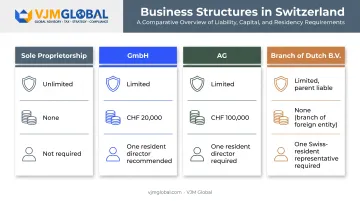
GmbH is the practical default for most Dutch-owned ventures. The lower capital threshold and more manageable compliance load make it the go-to choice for founders who want limited liability without the AG's heavier capital commitment.
A branch office suits a different situation entirely: an existing Dutch B.V. that wants Swiss presence — a local address, local contracts, local credibility — without forming a brand-new legal entity. The branch remains legally part of the Dutch parent, so liability travels back to the Netherlands rather than staying ring-fenced in Switzerland.
What to Know Before You Start a Business in Switzerland from the Netherlands
Several details catch Dutch founders off guard.
The Swiss-Resident Signatory Isn't Optional
Many assume that because they can own 100% of the shares remotely, they can also run the company entirely from the Netherlands. Not quite. Every GmbH and AG needs at least one Swiss-resident individual with signing authority (this person doesn't need to be a shareholder, but they must exist on paper and in practice).
Time and Cost Basics
- Notarisation: compulsory for both GmbH and AG constitutional documents
- Commercial Register filing: Zurich's registry typically needs about one working week of review, then publication (indicative, not a nationwide guarantee)
- Bank account: deposit and bank-confirm share capital before registration; GmbH funds stay blocked until the Commercial Register entry is published
Short-Term Services vs. Full Incorporation
If a Dutch founder only wants to deliver services in Switzerland occasionally, full incorporation may be overkill. The eight-day notification rule for EU/EFTA providers covers short cross-border assignments up to 90 working days a year. Full incorporation makes sense once activity becomes regular, substantial, or requires a permanent Swiss presence.
Ongoing Compliance Doesn't Stop at Registration
Once formed, the company faces:
- VAT registration above CHF 100,000 in relevant annual turnover
- AHV/AVS social insurance enrolment for anyone recognised as self-employed or as an employee
- Annual filings and bookkeeping obligations under Swiss commercial law
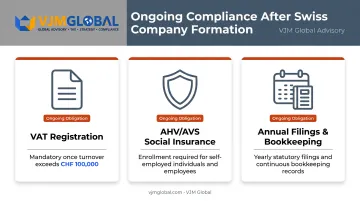
Most Dutch founders outsource this to local or cross-border accounting support rather than managing it themselves from abroad.
Why Start a Business in Switzerland as a Dutch Entrepreneur? (When It Makes Sense)
Switzerland isn't automatically the right move for every Dutch business. But three factors keep pulling founders in.
- Competitive cantonal tax rates. KPMG's 2025 comparison puts the Swiss average ordinary corporate income tax rate at 14.4%, with Zug near 11.85% and Bern around 20.54%. Canton choice changes the tax bill in a material way.
- Central European positioning. Switzerland sits between the Dutch trade corridor and the German, French, and Italian markets, so it works as a bridge for DACH expansion rather than a detour.
- Banking infrastructure and credibility. A Swiss entity often carries more weight with European partners and financiers than a purely Dutch structure, especially in finance, life sciences, and B2B services.
None of this guarantees profitability. It only means the structural conditions (tax, location, banking) are genuinely favourable for the right business model.
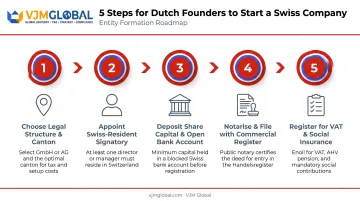
How to Start a Business in Switzerland – Step by Step (for Dutch Founders)
The process is broadly identical for any foreign founder. EU/EFTA status simplifies the personal permit side, not the corporate formation steps themselves.
Step 1 – Choose Legal Structure and Canton
Compare GmbH, AG, and branch office against your capital appetite and liability preferences. Then pick a canton based on:
- Tax rate: Zug and similar low-tax cantons attract many foreign founders
- Industry cluster: Zurich for finance, Basel for life sciences, Geneva for trade
- Proximity to Dutch/EU trade routes: border cantons may simplify logistics
Step 2 – Appoint a Swiss-Resident Director/Signatory
This is the step Dutch founders most often underestimate. You need a Swiss-resident individual authorised to sign on the company's behalf.
Firms with cross-border formation experience, including VJM Global, can arrange a resident director or nominee signatory as part of entity formation.
Step 3 – Deposit Share Capital and Open a Bank Account
- GmbH: CHF 20,000, deposited in full
- AG: CHF 100,000 subscribed, with at least 20% (minimum CHF 50,000) paid in
A recognised Swiss bank issues confirmation of the deposit. For a GmbH, these funds stay blocked until the Commercial Register publishes the formation.
Step 4 – Notarise Documents and File with the Commercial Register
Articles of association require notarisation before filing. Once submitted to the cantonal Commercial Register, expect roughly a week for document review, plus time for publication. Treat that window as indicative; exact timelines vary by canton.
Step 5 – Register for VAT and Social Insurance
Companies crossing CHF 100,000 in relevant annual turnover must register for VAT with the Federal Tax Administration. Anyone working as self-employed or employed through the entity also needs AHV/AVS enrolment, which covers old-age, disability, and income-compensation contributions.
Costs, Timelines, and Getting Cross-Border Support
Switzerland's own small-business authority lists indicative GmbH setup costs as follows (excluding the CHF 20,000 capital, bank fees, and any resident-director arrangement):
- Consulting: CHF 600–2,000
- Notary fees: CHF 700–2,000
- Commercial Register filing: CHF 600
An official Vaud cantonal guide suggests two to four weeks from document submission to legal establishment, though bank onboarding and permit processes can extend that timeline depending on the canton and the founder's circumstances.

Those longer timelines matter more when you already run a Netherlands-registered business. Swiss compliance stacks on top of Dutch VAT, corporate tax, and KvK obligations, so dual-track work gets complicated fast.
Cross-border support helps here by coordinating the Dutch side (BV filings, RSIN and VAT numbers, payroll) while Swiss formation runs in parallel. It does not replace Swiss legal counsel. VJM Global delivers each market with that market's own regulators and statutory instruments: Dutch VAT returns, corporate tax filings, and payroll stay on track at home, and the Swiss entity is formed on local footing.
Frequently Asked Questions
How much money do you need to start a business in Switzerland?
A GmbH needs CHF 20,000 in fully paid capital; an AG needs CHF 100,000 (at least CHF 50,000 paid upfront). Add notary fees, Commercial Register charges, and any advisory costs on top.
Can I start a business in Switzerland as a foreigner?
Yes. Foreign nationals, including Dutch citizens, can own 100% of a GmbH or AG. The one hard requirement is a Swiss-resident director or signatory on the company's board.
Which business is most profitable in Switzerland?
Finance, life sciences, and tech/SaaS sectors tend to perform strongly given Switzerland's infrastructure and talent pool. Actual profitability still depends heavily on execution and market fit, not sector alone.
Do Dutch citizens need a visa to start a business in Switzerland?
Owning shares doesn't require a visa. Personally working in Switzerland does. Dutch citizens can apply for a B EU/EFTA permit as EU nationals, which is simpler than the process for non-EU/EFTA founders.
Can I run a Swiss company while living in the Netherlands?
Yes, but the company still needs a Swiss-resident signatory handling local representation. The owner can remain based in the Netherlands as long as this requirement is met.
What is the difference between a GmbH and an AG for foreign founders?
A GmbH needs CHF 20,000 capital and offers less ownership privacy since members appear on the Commercial Register. An AG needs CHF 100,000 but offers stronger privacy and often carries more credibility with larger partners and investors.