Add in lower operating costs, a two-hour flight from Amsterdam to Budapest, and a long-standing Netherlands-Hungary tax treaty, and the appeal becomes obvious. This isn't just large corporates making the move, either. Dutch startups, e-commerce sellers, logistics firms, and independent consultants are all exploring Hungary as a base for EU expansion.
This guide walks through exactly what that process looks like: entity types, registration steps, taxation, and the compliance obligations that follow once your Hungarian company is live.
TL;DR
- Hungary's 9% corporate tax rate beats the EU average of 21.2%, making it attractive for Central European expansion
- The Kft. (limited liability company) is the standard structure for Dutch-owned businesses
- Incorporation can happen remotely via Power of Attorney, with no need to travel upfront
- Plan for four core steps: company registration, tax/VAT registration, bank account opening, and appointing a local accountant
- Maintain compliance (VAT filings, payroll, annual statements) even for dormant or low-turnover companies
What Is a Hungarian Kft. and Why Dutch Companies Choose It
A Kft. (Korlátolt Felelősségű Társaság) is Hungary's direct equivalent to a Dutch BV. It offers limited liability protection and requires a minimum registered capital of HUF 3 million, roughly €8,200 at current exchange rates.
Dutch founders choose the Kft. for clear structural reasons:
- Allows 100% foreign ownership with no residency requirement for directors or shareholders
- Receives an EU VAT number automatically on registration
- Enables cross-border trade across the single market from day one
Two structures are worth comparing:
- New Kft. incorporation — a standalone Hungarian legal entity, best for founders planning genuine local operations
- Branch office — an extension of an existing Dutch BV, useful if you want Hungarian presence without creating a separate legal entity
Most Dutch SMEs entering Hungary still opt for the Kft. It keeps liability cleanly separated and is the structure Hungarian banks and tax authorities know best.
What Dutch Entrepreneurs Should Know Before Starting a Business in Hungary
Before the paperwork starts, set realistic expectations. The points below cover what incorporation in Hungary actually demands of Dutch founders, not whether Hungary is the right market for you.
Physical Presence Isn't Always Required
Most of the incorporation process can be handled remotely from the Netherlands. The one exception: opening a Hungarian bank account typically requires an in-person visit, since Hungarian banks apply strict identity verification on new corporate clients.
The Language Barrier Is Real
All official filings (company registration, tax forms, articles of association) must be submitted in Hungarian. Dutch corporate documents need certified translation before they're accepted by the Company Registry or tax office.
Timeline Expectations
- Company registration: often completed in 5-10 business days
- Full operational readiness (bank account, VAT number active): typically 2-4 weeks
Tax Treaty Protection
The Netherlands-Hungary double tax treaty, in force since 1987, prevents Dutch shareholders and directors from being taxed twice on the same income. Business profits are generally taxed only where the company has a permanent establishment, which matters if you're running the Hungarian entity from Amsterdam.
Paper Entity vs. Real Activity
Hungarian tax authorities distinguish between companies with genuine local operations and shell entities set up purely for tax advantage. A "paper" Kft. with no staff, no office, and no local transactions invites more scrutiny than one with real activity.
Why Hungary Makes Sense for Dutch Business Expansion
Hungary is not the right fit for every Dutch business. When the model matches, though, the numbers are hard to ignore.
- 9% flat corporate tax versus the Netherlands' 19% on profits up to €200,000 and 25.8% above that — a clear gap if you reinvest profits
- Central European positioning puts Austria, Slovakia, and Romania within a few hours' drive, useful for logistics and distribution planning
- Immediate EU VAT number issuance means cross-border trade with the Netherlands and other member states can start without delay
- Lower payroll and operational costs compared to Western Europe make Hungary a sensible location for back-office or shared service functions
- Existing tax treaty protection reduces the risk of Dutch shareholders facing double taxation on Hungarian profits
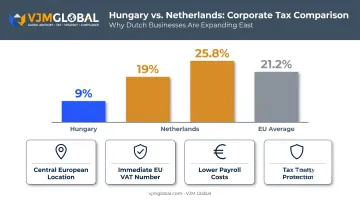
The EU-27 average top statutory corporate tax rate was 21.2% in 2023, according to the European Commission's Annual Report on Taxation. Hungary's 9% is not only lower than the Dutch rates; it undercuts the bloc average by a wide margin.
Early Decisions Dutch Founders Often Overlook
Most friction Dutch entrepreneurs hit comes after incorporation, in the administrative and banking layer that follows. Here's what tends to catch people off guard.
True costs run beyond registration fees. Legal and notary work, certified translation, and annual accounting support (often €300 or more per year) add up quickly, even for a simple structure.
Hungary's VAT rate is the EU's highest at 27%, compared to the Netherlands' 21% standard rate. That gap matters for pricing strategy, especially for e-commerce sellers comparing margins across both markets.
Banking due diligence is stricter than expected. Hungarian banks apply thorough AML checks on foreign shareholders, and documentation requirements are extensive:
- Recent company registry certificate
- Apostilled constitutional documents with certified Hungarian translation
- Full ownership chain and beneficial owner disclosure
- Identification documents for all non-resident owners
A local accountant is mandatory, even if the company is dormant or generating no revenue.
Three separate authorities require ongoing reporting, regardless of activity level:
- NAV (the tax office) for tax filings
- KSH (the statistics office) for periodic statistical returns
- The Company Registry for any changes to company data, generally within 30 days
How to Start a Business in Hungary from the Netherlands – Step by Step
Here's the process broken into practical stages. Three mistakes come up repeatedly: assuming the entire setup can be done remotely (it can't; banking requires presence), underestimating translation timelines, and delaying VAT registration until it becomes urgent.
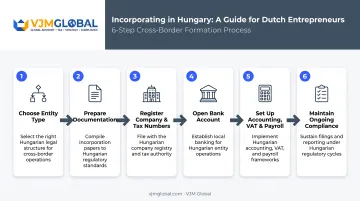
Step 1 – Choose Your Entity and Confirm Market Fit
Decide first whether you need a new Kft. or a branch of your existing Dutch BV. Then ask a harder question: does the Hungarian market genuinely require a local entity, or would registering for Hungarian VAT alone let you trade into Hungary without incorporating?
A common misstep is setting up a full Kft. when a simpler VAT registration would have covered the actual business need.
Step 2 – Prepare Documentation from the Netherlands
Before filing anything, gather:
- Passports or ID for all directors and shareholders
- Proof of Dutch registered business address
- Draft Articles of Association
Arrange certified Hungarian translation of Dutch corporate documents early. This step often causes the most delay. Then decide whether to sign incorporation documents in person or grant Power of Attorney to a local representative in Hungary.
Step 3 – Register the Company and Secure Tax Numbers
File incorporation documents with the Cégbíróság (Company Registry). Simplified registration can be completed in as little as one working day; general registration typically takes up to 15 working days.
Once approved, you'll receive:
- A company registration number
- A tax number
- An automatic EU VAT number
You'll also need to register separately with NAV and the Chamber of Commerce.
Step 4 – Open a Hungarian Bank Account
This is the step most Dutch founders underestimate. Bank account opening typically requires a physical visit to Hungary, even if the rest of the process was handled remotely.
Prepare in advance:
- Certificate of incorporation
- UBO (ultimate beneficial owner) declaration
- Business plan
- Source-of-funds evidence
Some founders use a multi-currency account as an interim solution while the Hungarian account is finalised.
Step 5 – Set Up Accounting, VAT, and Payroll Compliance
Hungarian law requires every company to appoint a local, Hungarian-speaking accountant. There's no way around this, even for very small operations.
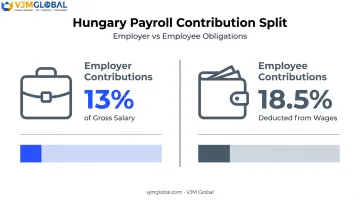
Register for a VAT filing schedule (monthly or quarterly, depending on turnover) and factor the 27% standard rate into your pricing model. If you plan to hire locally, budget for:
- Employer contributions: roughly 13% of gross salary
- Employee contributions: roughly 18.5%, deducted from wages
Step 6 – Maintain Ongoing Compliance from the Netherlands
Once the company is live, compliance doesn't stop. Track annual financial statement filings and corporate tax return deadlines carefully. Missing them creates friction with NAV.
Coordinating tax obligations across two jurisdictions is where most Dutch founders start looking for outside help.
VJM Global supports this cross-border compliance load with accounting, tax, and payroll across EU markets including the Netherlands, Germany, and Ireland. One advisory relationship that tracks both the Dutch and Hungarian compliance calendars reduces the risk of a filing deadline getting overlooked on either side.
Conclusion
Starting a business in Hungary from the Netherlands is straightforward on paper. The incorporation itself moves quickly, and the tax advantages are real. Where things get complicated is banking, translation requirements, and running compliance across two tax systems at once.
Getting the entity choice right, and understanding exactly how the Netherlands-Hungary tax treaty applies to your situation, matters more than rushing to file paperwork. Long-term success depends on staying on top of obligations in both countries. VJM Global helps Dutch founders with Hungarian entity setup, treaty-aware tax structuring, and ongoing dual-country compliance so those obligations stay manageable.
Frequently Asked Questions
Does Hungary tax foreign income?
Hungarian companies are taxed on worldwide income at the flat 9% corporate rate. The Netherlands-Hungary tax treaty helps prevent Dutch shareholders and directors from being taxed twice on the same profits.
Which business is best in Hungary?
IT services, e-commerce, logistics, and shared service/back-office operations are popular choices among foreign entrepreneurs, largely thanks to Hungary's skilled workforce and central European location.
Can a Dutch citizen own 100% of a Hungarian company?
Yes. There are no nationality or residency restrictions on shareholders or directors of a Hungarian Kft.
Do I need to travel to Hungary to register a company from the Netherlands?
Incorporation itself can be done remotely via Power of Attorney. Opening the mandatory Hungarian bank account, however, typically requires an in-person visit.
How long does it take to set up a company in Hungary from the Netherlands?
Registration alone often takes 5-10 business days. Full operational readiness, including a working bank account and active VAT number, usually takes 2-4 weeks.
What are the ongoing costs of running a Hungarian company as a Dutch owner?
Expect annual accounting fees starting around €300, plus VAT filing costs and a local business tax of 0-2%. These apply regardless of turnover, even for dormant companies.