But size and opportunity don't guarantee a smooth entry. Many companies underestimate Germany's regulatory complexity, its regional economic diversity, and how particular German consumers are about trust and quality. The result? Delayed launches, compliance fines, and products that never find traction.
This guide walks through the step-by-step process for entering the German market, the five entry modes to choose from, the legal and tax requirements you can't skip, and the mistakes that trip up even well-funded entrants.
TL;DR
- Germany is the EU’s largest industrial economy—structure and localization decide outcomes more than budget alone
- Match one of five entry modes (export, license, franchise, JV, or subsidiary) to your control, capital, and risk needs
- GmbH formation, VAT registration, and GDPR compliance are baseline requirements for most entrants
- Regional differences and weak localization cause more failures than undercapitalization
- Local formation, tax, and compliance support shortens timelines and lowers entry risk
How to Develop a Successful Germany Market Entry Strategy (Step-by-Step)
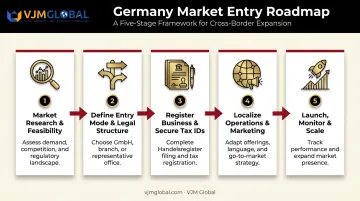
Step 1: Conduct Market Research and Feasibility Analysis
Before committing capital, assess demand, purchasing power, and how crowded your sector already is in Germany. Skipping this step is the single most common reason foreign entrants stall out within the first year.
Germany's economy isn't uniform. It's decentralized, with each state built around different industrial strengths:
- Bavaria — mechanical engineering is 18% of industrial employment, with strong automotive, electrical, and biotech clusters (Invest in Bavaria)
- North Rhine-Westphalia (NRW) — logistics hub with ~25% of Germany's logistics centers and nine of its 25 largest logistics firms (NRW Global Business)
A B2B industrial exporter targeting Bavaria will face a very different competitive and regulatory landscape than an e-commerce brand aiming for NRW's distribution networks. Map your sector to the right region before anything else.
Step 2: Define Your Market Entry Mode and Legal Structure
Once you understand the market, decide how you'll enter it. This comes down to three broad paths:
- Exporting — selling into Germany without a physical presence
- Partnering — licensing, franchising, or forming a joint venture with a local player
- Establishing a local entity — a GmbH subsidiary or branch office
The right choice depends on your available capital, how much control you need over customer experience, and your appetite for regulatory exposure. We'll break down each option in detail in the next section.
Step 3: Register the Business, Secure Tax IDs, and Ensure Compliance
If you're setting up a legal presence, this step involves:
- Registering with the local Handelsregister (Commercial Register) via the district court, or Amtsgericht
- Completing Gewerbeanmeldung, the trade office registration required before commercial activity begins
- Registering with the Finanzamt to obtain a Steuernummer (tax number) and USt-IdNr (VAT ID)
- Setting up statutory bookkeeping aligned with German accounting standards
Paperwork here is dense, and it's almost always in German. Engaging a local tax and compliance advisor at this stage prevents delays from misfiled forms or missed deadlines.
VJM Global handles this registration sequence with clients, coordinating notarization, capital deposits, and Finanzamt filings so foreign founders aren't navigating German bureaucracy solo.
Step 4: Localize Operations, Marketing, and Logistics
German consumers are unforgiving about localization gaps. A website in English, unclear pricing, or unfamiliar checkout options will cost you conversions fast.
At minimum, plan for:
- German-language websites with transparent, tax-inclusive pricing
- Trusted payment methods — SEPA transfers and invoice-based payment are standard expectations, not nice-to-haves
- Reliable, fast delivery, since German buyers compare shipping performance against domestic competitors
- Messaging built around quality, reliability, and sustainability, rather than aggressive discounting or urgency tactics
German buyers respond to substance over sales pressure. Adjust your tone accordingly.
Step 5: Launch, Monitor, and Scale
Don't launch nationwide on day one. Start with a pilot city or region, validate your assumptions, and expand once the data supports it.
Track these metrics before deciding to scale:
- Conversion rate by region
- Customer acquisition cost versus lifetime value
- On-time compliance filings (VAT returns, trade tax, payroll)
If your pilot region hits its targets and your compliance filings are clean, you have a defensible case for expansion. If not, you've limited your downside to one market instead of the whole country.
Germany Market Entry Strategies: Which Option Is Right for You?
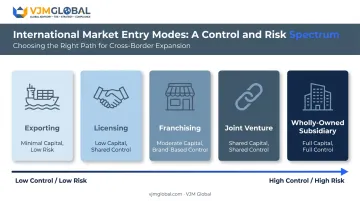
Your entry mode shapes everything downstream: cost, control, speed, and how much risk you're carrying. Here's how the five core options stack up.
| Strategy | Best For | Key Trade-Off |
|---|---|---|
| Exporting | Testing demand with minimal investment | Higher shipping costs, EORI/customs requirements, little control over local experience |
| Licensing | Fast access via a capable local partner | Reduced revenue share, dependent on partner quality |
| Franchising | Brands with a proven, replicable model | Requires strong brand controls; success tied to franchisee execution |
| Joint Venture | Local market knowledge and shared risk | Shared profits and decisions; potential culture friction |
| Wholly-Owned Subsidiary | Full control and long-term commitment | Highest capital and compliance burden |
Exporting
Exporting is the lowest-risk way to test German demand without a physical footprint. You'll need an EORI number for any customs declaration, per European Commission customs guidance.
As of July 2026, the previous customs-duty exemption for shipments under €150 no longer applies. Import VAT applies regardless of shipment value.
Licensing
Licensing works when a strong local partner can manufacture or sell under your brand. It's fast, but you're trading revenue share for speed, and your reputation now depends on someone else's compliance discipline.
Franchising
If your business model is proven and replicable, franchising lets you expand with lower capital outlay. The catch: you need robust brand-control systems, because your German reputation rides on franchisee performance you don't directly manage.
Joint Ventures
A joint venture gets you a local partner's networks and market knowledge, plus shared financial risk. The downside is shared decision-making, which can create friction if management styles or priorities don't align.
Wholly-Owned Subsidiary (GmbH or Branch)
This is the route for businesses that want full operational and financial control. A GmbH is a separate legal entity with liability limited to company assets and minimum share capital of €25,000 (€12,500 paid in at formation). A branch office has no separate legal personality, so the foreign parent remains liable, according to GTAI's Investor's Basics guide.
It carries the highest capital and compliance burden, but it also gives the deepest access to the German and broader EU market.
Match the mode to your capital, control needs, and timeline. Many firms export or partner locally first, then form a GmbH once demand is proven.
Legal, Tax & Compliance Requirements for Entering the German Market
Germany runs one of Europe's strictest regulatory environments. Planning compliance early, not after you've started selling, is what separates smooth launches from stalled ones.
Business Registration and Entity Structure
Foreign entrants typically choose between a German GmbH subsidiary, a branch office, or a cross-border EU entity structure. Each carries different documentation demands:
- GmbH: notarized articles of association, minimum share capital of €25,000 (with €12,500 sufficient at initial registration), a blocked capital account, and Handelsregister registration
- UG (haftungsbeschränkt): a lower-capital alternative requiring as little as €1 in share capital
- Branch office: no minimum capital requirement, but the parent company remains fully liable, and documentation proving the parent's legal standing is required
VJM Global's cross-border entity formation and back-office support helps foreign companies choose and set up the right structure. The team handles notarization, capital deposits, and Commercial Register filings so founders do not have to learn German bureaucracy from scratch.
Tax, VAT, and Reporting Obligations
Germany's standard VAT rate is 19%, with a reduced 7% rate on specific goods and everyday services, per GTAI's Investor's Basics on corporate taxation.
Foreign businesses must register for VAT before receiving a German VAT number. No single universal threshold covers every foreign seller, so confirm your obligation with a local tax advisor or the Finanzamt.
Other ongoing obligations include:
- Corporate income tax at 15%, plus a solidarity surcharge of 5.5% of that amount (roughly 15.8% combined)
- Trade tax (Gewerbesteuer), which varies by municipality and averages slightly above 14%
- Statutory bookkeeping and annual financial statements filed with the Bundesanzeiger
For multinationals, German filings must stay consistent with obligations in other jurisdictions, not only correct on their own. VJM Global supports ongoing tax compliance—including transfer pricing documentation and cross-border tax advisory—so multi-country filings stay aligned.
Data Protection and Consumer Compliance
Any business handling German or EU customer data falls under GDPR, whether it's based in the EU or not. The regulation applies to any organization offering goods or services to, or monitoring, individuals in the EU, per the European Commission's GDPR guidance. That means lawful data processing, clear consent mechanisms, and a 72-hour breach notification window for qualifying incidents.
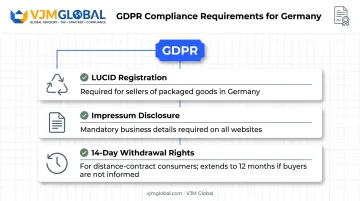
Beyond GDPR, three Germany-specific rules matter for consumer-facing businesses:
- LUCID registration under the Packaging Act, required for anyone distributing packaged goods, including online sellers
- Impressum disclosures, mandatory on commercial websites, listing your business name, address, legal form, and registration details
- 14-day withdrawal rights for consumers on distance contracts, extended to 12 months if you fail to inform the buyer of this right
Key Success Factors and Common Mistakes When Entering Germany
German market entry rewards preparation more than speed. The patterns below separate durable launches from costly resets.
Factors That Determine Success
- Regional adaptation over a national template. Bavaria's engineering buyers and North Rhine-Westphalia's (NRW) logistics-driven market expect different sales approaches entirely.
- Local, experienced representation. Domestic firms already hold buyer trust; a knowledgeable local partner closes that gap faster.
- Value for money, not the lowest price. Aggressive discounting rarely wins in Germany; quality and dependable after-sales support do.
Common Mistakes to Avoid
- Trading before legal and tax registration. Operating without completed Handelsregister and Finanzamt registration risks fines and forced shutdowns.
- Treating translation as localization. A translated website is not a localized one; German buyers notice the difference immediately.
- Choosing an entry mode your resources can't support. A wholly-owned subsidiary sounds strong, but licensing or exporting may fit better in year one if capital or timeline is tight.
Frequently Asked Questions
What are the five market entry strategies?
The five core modes are exporting, licensing, franchising, joint ventures, and wholly-owned subsidiaries. Each offers a different balance of cost, control, and risk exposure.
What is the best legal structure for foreign companies entering Germany?
A GmbH offers liability protection and stronger credibility with German partners and banks. A branch office suits companies testing the market with lower upfront commitment.
How long does it take to set up a company in Germany?
A straightforward GmbH setup often takes about 4–8 weeks once documents, notarization, and the capital deposit are in order. Delays usually come from incomplete parent-company paperwork or slow bank account and deposit steps.
Do I need to register for VAT immediately when selling into Germany?
VAT registration is required once your selling model hits the applicable threshold—rules differ for pure cross-border distance sales versus a local establishment. Registering early avoids penalties and backdated filings.
What are the biggest challenges of entering the German market?
Regulatory complexity, entrenched domestic competition, and high expectations around trust and localization top the list. Underestimating any of the three causes the biggest setbacks.
Can I hire employees in Germany without setting up a local entity?
Yes. An Employer of Record (EOR) lets you hire in Germany without a local entity. Providers such as VJM Global run the employment contracts, payroll, and social contributions on your behalf.