Introduction
UAE holding companies have become a serious talking point among US business owners heading into 2026. Part of it is timing: Henley's 2025 Private Wealth Migration Report projected a net inflow of roughly 9,800 millionaires into the UAE, bringing an estimated $63 billion in investable wealth with them.
That capital is looking for structures that protect assets and hold up across borders, especially as rising litigation risk and unpredictable tax rules make single-entity setups feel exposed. US entrepreneurs, investors, and owners of multiple business entities are drawn to the UAE for exactly this reason: asset protection, potential 0% corporate tax on qualifying income, and a launchpad into global markets.
This trend reaches far beyond large corporations. Startups scaling internationally, established US companies diversifying risk, and high-net-worth individuals relocating capital are all part of this wave. This guide walks through the structure, process, real costs, and the US tax compliance obligations that generic setup guides tend to skip.
Key Takeaways
- A UAE holding company centralizes ownership of subsidiaries, IP, or real estate while isolating risk
- DIFC, ADGM, RAK, and Meydan free zones offer 100% foreign ownership and potential 0% tax for qualifying entities
- US owners face IRS obligations (Form 5471, GILTI, FBAR) regardless of UAE tax treatment
- Setup time ranges from under an hour to several weeks, with costs varying widely by jurisdiction
- Getting cross-border tax advice early avoids costly compliance mistakes later
What Is a UAE Holding Company?
A holding company is an entity built to own shares, intellectual property, or other assets in subsidiary companies. It doesn't run day-to-day operations or trade directly.
Think of it as the parent that sits above your operating businesses. Its job is centralizing control and consolidating reporting across your group while managing risk, not selling products or delivering services itself.
US owners typically choose from three formats:
- Free Zone entities (FZE or FZ-LLC): Single or multiple shareholders, built for holding shares, IP, or investments with 100% foreign ownership
- Mainland LLCs: Broader operational flexibility and direct access to the UAE domestic market, with expanded foreign ownership allowances
- Financial-hub vehicles: DIFC Prescribed Companies and ADGM Special Purpose Vehicles (SPVs), designed as passive structures for asset-holding and risk ring-fencing
The right choice depends entirely on what the holding company needs to do, which brings us to the next question: why bother with a UAE structure at all?
Why US Businesses Are Choosing UAE Holding Companies in 2026
This section isn't a blanket endorsement. A UAE holding company benefits specific situations, not every US business.
Tax Efficiency, With Real Conditions
The UAE applies 0% corporate tax up to AED 375,000 in taxable income and 9% above that threshold. Qualifying Free Zone Persons (QFZPs) can access 0% tax on Qualifying Income, but this status isn't automatic.
To keep it, a company must maintain adequate substance in the free zone, meet transfer-pricing documentation rules, and keep audited financial statements. Non-qualifying revenue also can't exceed the lower of AED 5 million or 5% of total revenue, known as the de minimis rule. Holding shares for investment purposes generally qualifies when held for an uninterrupted 12 months.
Asset Protection in Practice
Picture a US business running three divisions under one operating company. One division gets sued. Under a single-entity structure, all three divisions' assets are exposed.
Now picture the same three divisions as separate subsidiaries under a UAE holding company. A lawsuit against one subsidiary typically doesn't touch the assets held by the others or by the parent. That separation is the entire point of a holding structure.
Riding the Wealth Migration Wave
The UAE's wealth migration trend signals something beyond tax planning: global capital is centralizing there. According to Henley & Partners' 2024 Private Wealth Migration Report, the UAE gained a net inflow of 6,700 millionaires that year, more than any other country. Additional draws for US entrepreneurs include:
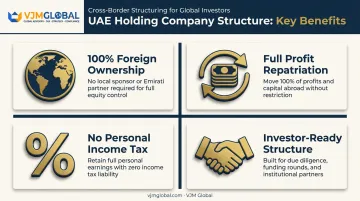
- 100% foreign ownership across most free zone and mainland structures
- Full repatriation of profits, with no restrictions on moving capital home
- No personal income tax on salary or dividends drawn from the structure
- Investor-readiness: a clean holding structure makes it far easier to raise capital or bring in partners across multiple ventures without commingling risk
Before You Start: Key Considerations for US Business Owners
Most generic guides miss this part entirely: how UAE benefits interact with US tax law. Get this wrong and the tax savings on the UAE side get eaten up by penalties on the US side.
There's no comprehensive US-UAE income tax treaty. Unlike EU or UK business owners, US owners can't lean on treaty relief for dividends, interest, or capital gains from a UAE holding structure.
The only agreements in place are a FATCA intergovernmental agreement and a narrow reciprocal exemption for shipping and aircraft income. Neither covers general holding company income.
US Reporting Obligations Don't Disappear
The US taxes worldwide income regardless of what the UAE charges. Depending on ownership percentage, US owners of a UAE holding company may need to file:
- Form 5471: Required for US persons with 10%+ ownership, majority voting control, or CFC shareholder status. Late or missing filings trigger $10,000 per foreign corporation per year in penalties, plus $10,000 every 30 days after IRS notice, up to $50,000
- GILTI and Subpart F inclusions: US shareholders of a CFC may owe current US tax on certain foreign earnings, calculated via Form 8992
- FBAR (FinCEN Form 114): Required when foreign account balances exceed $10,000 at any point in the year
- Form 8938: A separate FATCA disclosure with its own thresholds, filed alongside your tax return
Jurisdiction and Structure Trade-offs
Free zones like DIFC, ADGM, RAK, and Meydan work well for pure holding, IP, or investment activity. Mainland LLCs make more sense if the holding company needs broader access to the UAE domestic market.
Shareholder composition matters too. Whether a US LLC, an individual, or a C-corp sits as the shareholder changes both UAE registration paperwork and US tax classification, particularly around CFC status and GILTI exposure.
This is where coordinated advisory pays off. VJM Global has supported 500+ American business owners with cross-border accounting, FEMA advisory, and DTAA-related tax planning, and gets brought in specifically for the pieces that trip up US owners.
The coordination matters most when a UAE holding company sits between a US parent and Indian operating subsidiaries. In that setup, Indian FEMA rules and DTAA positions need to line up with however the UAE entity is structured.

How to Set Up a Holding Company in the UAE – Step-by-Step
The mechanics of registration are straightforward. Where US owners lose time and money is skipping jurisdiction comparison or underestimating how long US-side reporting setup takes in parallel.
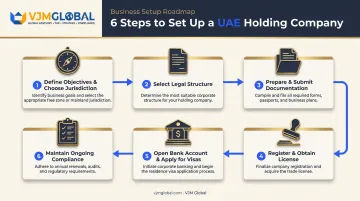
Step 1: Define Objectives and Choose Your Jurisdiction
Get specific about the primary purpose first: asset holding, IP ownership, or subsidiary management. This decision drives everything else.
- If subsidiaries operate internationally, DIFC or ADGM's passive SPV structures often fit better
- If you need broader UAE market access alongside holding functions, look at mainland or Meydan options
Step 2: Select the Legal Structure
Choose between an FZE (single shareholder), FZ-LLC (multiple shareholders), or Mainland LLC based on shareholder count and liability needs.
Each structure carries its own MOA/AOA (Memorandum and Articles of Association) requirements. DIFC provides pre-tailored constitutional documents through its digital portal, which speeds this step up considerably compared to drafting from scratch.
Step 3: Prepare and Submit Documentation
Core documents typically include:
- Passport copies for all shareholders and directors (current and prior nationality, where applicable)
- Proof of residential address, no older than three months
- A business plan outlining the holding company's purpose
- MOA/AOA or constitutional documents
- Board resolutions authorizing the formation
US shareholders should expect additional KYC and FATCA declarations from both UAE authorities and banks. Corporate shareholders will also need incumbency records and ownership charts.
Step 4: Register, Obtain a License, and Set Up a Registered Office
Digital-first free zones like Meydan advertise license issuance in as little as 60 minutes once documents and payment clear. Treat that as a marketing minimum, not a guarantee — it excludes banking setup entirely.
ADGM typically completes incorporation within a few days when submissions are accurate, while DIFC's process runs through its own digital portal without a fixed published timeline.
Office requirements vary by jurisdiction:
- Virtual or flexi-desk options for many free zone holding structures
- Shared or serviced office space where a physical presence is required
- Registered agent arrangements for passive SPVs with no operational footprint
Step 5: Open a Corporate Bank Account and Apply for Visas
Banking is often the slowest part of the process, even when licensing is fast. UAE banks require entity tax-residency details, FATCA/CRS classification (Financial Institution, Active NFE, or Passive NFE), and US shareholders will generally need to supply Form W-9 information.
Visa eligibility depends on jurisdiction and license type. Some structures qualify owners and staff for residency visas tied to the license; passive holding vehicles with no physical operations often don't.
Step 6: Maintain Ongoing Compliance
Once registered, ongoing obligations include:
- UBO registration: Beneficial owners with 25%+ ownership or control must be registered, with changes reported within 15 days
- Audited financial statements: Mandatory for QFZPs and larger taxable persons under UAE corporate tax rules
- De minimis monitoring: Track non-qualifying income against the AED 5 million or 5% threshold to keep QFZP status intact
Run this alongside your US compliance calendar. Form 5471 and FBAR deadlines don't pause because you're mid-way through a UAE audit cycle.
Costs, Timeline, and Ongoing Compliance
Published fees vary by vehicle, and none of the official sources support a single universal price tag. Here's what the official schedules actually show:
| Vehicle | Initial Fee (Official) | Annual Renewal | Timeline |
|---|---|---|---|
| DIFC Prescribed Company | ~$100 application + $1,000 license | $1,000 + AED 20 levy | Digital, no fixed SLA |
| ADGM SPV | ~$1,900 registration | $1,400 + $100 confirmation statement | A few days (if accurate submission) |
| Meydan Holding License | From ~AED 12,500 | Varies by package | As fast as 60 minutes for basic digital license |
These figures exclude office costs, company service provider (CSP) fees, audit fees, and banking charges, which vary by provider and can add substantially to the total. A commonly cited AED 30,000-40,000+ range shows up across many setup guides, but treat it as a rough planning estimate rather than a guaranteed all-in cost.
Budget for these recurring items every year:
- License renewal (jurisdiction-dependent)
- Annual audit fees (mandatory for QFZPs and larger entities)
- Registered agent or office renewal
- Ongoing compliance monitoring for both UAE and US-side deadlines
Frequently Asked Questions
How much does it cost to set up a holding company in Dubai?
Official regulatory fees range from around $100-$1,900 for DIFC or ADGM vehicles to roughly AED 12,500+ (about $3,400+) for Meydan licenses. Add office, CSP (corporate service provider), audit, and banking costs, which push most all-in setups toward AED 30,000-40,000 (roughly $8,200-$10,900) or more depending on jurisdiction.
How do I set up a holding company in the UAE?
Choose your jurisdiction based on purpose, select a legal structure (FZE, FZ-LLC, or LLC), prepare KYC documentation, register and obtain your license, then open a corporate bank account. Ongoing compliance follows once the entity is live.
What are the benefits of holding companies in the UAE?
Key benefits include asset protection through separated subsidiaries, potential 0% corporate tax on Qualifying Income for Free Zone Persons, and 100% foreign ownership across most structures. Profit repatriation is also unrestricted.
Do US citizens need to report a UAE holding company to the IRS?
Yes. US persons generally must file Form 5471 for foreign corporations they control or significantly own, and may owe GILTI or Subpart F inclusions. FBAR and Form 8938 reporting apply separately for foreign accounts.
Is there a tax treaty between the US and UAE?
No comprehensive income tax treaty exists between the two countries. There's a FATCA agreement and a narrow shipping/aircraft income exemption, but neither provides general treaty relief on dividends, interest, or capital gains.
Can a US LLC or corporation own a UAE holding company?
Yes, this is common practice. However, the shareholder's structure, whether a US LLC, C-corp, or individual, changes US tax classification and CFC status. Plan this choice before formation, not after.