
But confusion runs deep. Many US business owners can't distinguish between offshore, free zone, and mainland structures. Even fewer realize that a "tax-free" UAE entity still triggers IRS reporting obligations the moment they own shares in it.
This guide breaks down the structure types, the actual setup process, realistic costs, and the compliance considerations too many American founders learn about after incorporating instead of before.
Key Takeaways
- Offshore companies offer full foreign ownership and confidentiality but cannot trade within the UAE local market
- US owners must still file FBAR and Form 5471 regardless of UAE's tax treatment
- Setup costs range from roughly $1,500 to $3,500 for registry fees alone, plus recurring agent and renewal costs
- Choose your jurisdiction based on your goal: asset holding, international trading, or UAE market access
What Is an Offshore Company in Abu Dhabi, and How Does It Differ From Other Structures?
Here's something most guides skip: there's no such thing as an "Abu Dhabi offshore company." Abu Dhabi doesn't run its own offshore registry.
Instead, US investors based in or targeting Abu Dhabi typically incorporate through one of three UAE-wide offshore registries:
- RAK ICC (Ras Al Khaimah International Corporate Centre)
- JAFZA Offshore (Jebel Ali Free Zone, Dubai)
- Ajman Offshore
These are commonly referred to as "Abu Dhabi offshore" simply because that's where the business owner or their advisory team is based — not because the company is registered there.
What Offshore Companies Are Actually For
Offshore vehicles work well for:
- International trading and cross-border invoicing
- Holding company structures
- IP and royalty ownership
- Investment and asset holding
They are not designed for conducting business inside the UAE. JAFZA is explicit about this: offshore companies receive a certificate of incorporation, not a business license, and cannot conduct commercial activity with parties inside the UAE. RAK ICC's regulations similarly restrict UAE-based activity unless the company first secures appropriate UAE licensing.
Offshore vs. Mainland vs. Free Zone
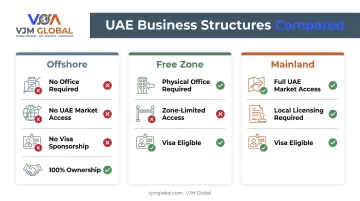
| Feature | Offshore | Free Zone | Mainland |
|---|---|---|---|
| Foreign ownership | 100% | Up to 100% | Up to 100% (activity-dependent) |
| UAE market access | No | Limited to zone/export | Full UAE market |
| Physical office | Not required | Required | Required |
| Visa sponsorship | No | Yes | Yes |
| Corporate tax exposure | Depends on classification | 0% qualifying income / 9% otherwise | 9% above AED 375,000 |
The key benefits for US businesses: no minimum capital requirement in most cases, no need for physical premises, and a straightforward incorporation path through a registered agent.
One critical caveat — offshore companies cannot sponsor UAE residency visas based on the official registry documentation reviewed. If relocation is part of your plan, this structure alone won't get you there.
Who Should Consider an Offshore Structure
Set relocation aside, and the offshore structure still fits several specific scenarios well:
- International traders invoicing clients outside the UAE
- Holding companies managing subsidiaries or investment portfolios
- IP owners licensing trademarks or royalties globally
- Investors consolidating global assets under one entity
- US businesses wanting a neutral jurisdiction for cross-border contracts
Why US Businesses Are Choosing Abu Dhabi in 2026
Abu Dhabi's economy has shifted hard away from oil dependence. Non-oil GDP hit AED 164.2 billion in Q2 2024 alone, growing 6.6% and now representing over 55% of total GDP, according to the Abu Dhabi Department of Economic Development.
That diversification is showing up in technology, renewable energy, and advanced manufacturing, sectors American investors already understand well.
Infrastructure backs it up. Khalifa Port expanded capacity 23% to 7.8 million TEUs in 2024, with Ro-Ro vehicle volume jumping 48% year over year, giving the region a real physical backbone for trade flowing between the US, Europe, and Asia.
The broader investment picture supports the trend:
- UAE foreign direct investment climbed from $30.7 billion in 2023 to $45.6 billion in 2024, according to UNCTAD's World Investment Report
- Abu Dhabi Global Market, the emirate's financial free zone, reported a 31% jump in company registrations during the first half of 2024
- Khalifa Port's Ro-Ro volume growth signals rising demand for vehicle and equipment imports tied to expanding trade routes
One detail matters for US businesses specifically: the UAE Ministry of Finance cites 137 double taxation agreements, but the US isn't on that list. There's no comprehensive US-UAE income tax treaty. What exists instead is a FATCA reporting agreement, a separate mechanism covered in more detail below.
Step-by-Step Process to Set Up an Offshore Company in Abu Dhabi
Setting up isn't complicated, but it's not instant either. Here's the realistic sequence:
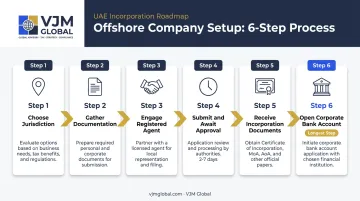
Choose your jurisdiction. RAK ICC, JAFZA, or Ajman Offshore — decide based on banking relationships, fees, and reputation with international banks, not price alone.
Gather documentation. Expect to provide notarized passport copies, proof of US residential address, a bank reference letter, and sometimes a business plan or CV.
Engage a registered agent. This isn't optional: none of these registries allow direct government filing, so you must go through a licensed agent.
Submit and wait for approval. RAK ICC states incorporation within 2 working days; JAFZA's registry process runs 5-7 working days. These are registry timelines only, not the full setup.
Receive your documents. Once approved, you'll get the Certificate of Incorporation along with the Memorandum and Articles of Association.
Open a corporate bank account. Flag this now: it's usually the slowest part of the entire process for US-owned entities.
Why Banking Takes Longer for Americans
UAE banks operate under a FATCA Model 1 intergovernmental agreement with the US, signed in 2015. That means enhanced due diligence for any account tied to a "Specified US Person."
Banks will typically request:
- IRS Form W-9 or equivalent self-certification
- Detailed beneficial ownership documentation
- Source-of-funds evidence
There's no guaranteed timeline or approval. Budget weeks, not days, for this step — and don't assume incorporation success means banking success.
Even after your account is open, compliance doesn't stop there. You'll need to maintain your registered agent relationship, pay annual renewal fees, and stay current on any economic substance filings that apply to your activity.
Cost Breakdown: What US Businesses Should Budget For
[CONTENT PENDING HUMAN REVIEW: This section's subject matter — UAE offshore registry fees (RAK ICC, JAFZA) — falls outside VJM Global's documented service scope, which centers on India entry and cross-border accounting/tax compliance for US, UK, and Australian businesses. No company information supports claims of UAE offshore formation expertise. Recommend either (a) confirming with the company whether this service exists and providing accurate details, or (b) reassigning this blog topic to a company with verified UAE offshore formation expertise.]
US Tax and Compliance Considerations for Offshore Ownership
This is where most American entrepreneurs get tripped up. A UAE offshore company doesn't exempt you from US tax obligations. The US taxes worldwide income regardless of where you incorporate.
Key IRS Filing Requirements
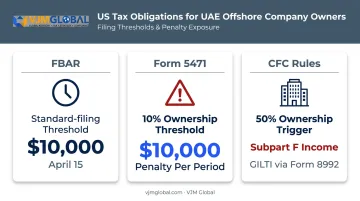
- FBAR (FinCEN Form 114): Required if the aggregate value of your foreign financial accounts exceeds $10,000 at any point during the year. Due April 15, with automatic extension to October 15.
- Form 5471: Required for US persons who are officers, directors, or shareholders owning more than 10% of vote or value in a foreign corporation.
Penalties are steep. The IRS applies an initial $10,000 penalty per accounting period for failing to file Form 5471. If you don't respond within 90 days of an IRS notice, an additional $10,000 can apply for every 30-day period, capped at $50,000 in extra penalties.
CFC Rules Still Apply
If US shareholders own more than 50% of the vote or value in your UAE entity, it likely qualifies as a Controlled Foreign Corporation (CFC). That triggers:
- Subpart F income rules requiring current inclusion of certain income
- GILTI (Global Intangible Low-Taxed Income) calculations via Form 8992
No personal income tax in the UAE doesn't erase any of this.
The Transparency Problem
The UAE joined the Common Reporting Standard framework in 2017, committing to automatic exchange of financial account information. Combined with the FATCA agreement, this means non-disclosure is riskier than ever. UAE banks are already collecting the documentation that flows straight back to US authorities.
Given this level of transparency, treating US filings as an afterthought is a costly mistake. Your tax outcome depends less on where you incorporate and more on how the entity is structured, owned, and reported back home.
That's the piece cross-border tax specialists like VJM Global focus on. Having supported over 500 American business owners with international tax compliance, VJM Global helps clients map FBAR, Form 5471, and CFC obligations against their foreign holdings early, so filings stay current instead of triggering penalty notices later.
Offshore vs Free Zone vs Mainland: Which Structure Fits Your Business?
There's no universal "best" structure. It depends entirely on what you're trying to accomplish.
| Factor | Offshore | Free Zone | Mainland |
|---|---|---|---|
| Best for | Holding, trading, IP | Physical operations, exports | Local UAE clients |
| Office required | No | Yes | Yes |
| Visa eligibility | Not established | Yes | Yes |
| Setup speed | Fastest (2-7 days) | Moderate | Moderate to slow |
If you're purely trading internationally or holding assets, offshore makes sense. If you need a UAE presence, staff, or visas, look at free zone or mainland instead.
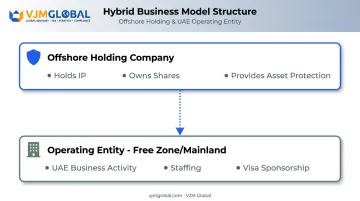
Many US businesses actually run a hybrid model, pairing an offshore holding company with a free zone or mainland operating entity below it. Each layer serves a distinct purpose:
- Offshore layer: Holds IP, owns shares in the operating entity, and provides asset protection
- Operating entity: Handles actual UAE business activity, staffing, and visa sponsorship
This structure separates risk from operations, so a lawsuit or liability at the operating level doesn't expose the assets held offshore.
Common Mistakes US Businesses Make When Setting Up Offshore
A few patterns show up again and again:
- Assuming "tax-free" means no US reporting: worldwide income taxation still applies, and the IRS expects Forms 5471, FBAR, or 8938 regardless of where profits sit.
- Picking a jurisdiction on price alone: a lower registry fee means little if the entity later struggles to open a bank account or gets flagged during compliance reviews.
- Underestimating banking timelines — enhanced FATCA due diligence can add weeks to the process, especially when the bank requests additional beneficial ownership documentation from a US-linked entity.
- Letting registered agent agreements lapse: missed renewals can trigger entity strike-off, forcing a costly reinstatement process before the business can operate again.
Working with an advisor who understands both US reporting obligations and UAE entity requirements catches most of these issues before they become costly.
Frequently Asked Questions
How much does it cost to set up an offshore company in Abu Dhabi?
Registry fees alone range from roughly AED 3,250 (RAK ICC) to AED 10,000 (JAFZA). Add registered agent and optional service fees, and total first-year setup typically falls between $2,000 and $10,000.
How do I open an offshore company in Abu Dhabi?
Choose a registry (RAK ICC, JAFZA, or Ajman Offshore), engage a mandatory registered agent, submit your documentation, and receive your Certificate of Incorporation. The registry review itself takes 2-7 working days.
Can a foreigner start a business in Abu Dhabi?
Yes. Offshore, free zone, and most mainland structures permit 100% foreign ownership for US and other international business owners.
Do US citizens need to report an offshore UAE company to the IRS?
Yes. FBAR and Form 5471 filing requirements apply regardless of the UAE's tax-free treatment, and penalties for missing them can be severe.
What is the difference between an offshore, free zone, and mainland company in Abu Dhabi?
Offshore companies can't trade in the UAE and have no office requirement. Free zone companies operate within their zone with physical premises. Mainland companies access the full UAE market but require local licensing.
Is Abu Dhabi a tax-free jurisdiction for US business owners?
The UAE imposes no personal income tax, but US citizens and residents remain fully taxable on worldwide income under US law, including any UAE-sourced earnings.