Many U.S. founders struggle to pin down what a JAFZA setup actually costs and how long it really takes. Between license fees, office requirements, and visa allocations, the numbers can feel like moving targets.
What draws Americans here isn't just tax efficiency. It's 100% foreign ownership, direct access to Jebel Ali Port, and no requirement for a local Emirati partner. Solo founders, e-commerce sellers, and established U.S. corporations are all evaluating JAFZA for different reasons, but they're asking the same questions about cost and process.
This guide breaks down JAFZA's real costs, approval requirements, and the step-by-step setup process, framed specifically for U.S. business owners.
Key Takeaways
- JAFZA remains one of the UAE's largest free zones, offering 100% foreign ownership and no local sponsor required
- Small setups (flexi-desk, one visa) typically run AED 40,000-60,000+, depending on license type and office choice
- Costs cover registration, licensing, office rental, and visas, with no upfront share capital required for most structures
- U.S. applicants should budget extra time for document attestation and annual renewal costs
- Processing takes 3-14 business days, though attestation delays often extend timelines to 2-4 weeks
What Is JAFZA Business Setup?
JAFZA business setup means registering and licensing a company within Jebel Ali Free Zone, Dubai's flagship free zone sitting adjacent to Jebel Ali Port. For U.S. businesses, it delivers a legal UAE presence with tax efficiency and global trade access, without needing an Emirati partner to hold equity.
Three Structures Dominate JAFZA Registrations
- Free Zone Establishment (FZE) - a single shareholder (individual or corporate) with limited liability and its own legal personality
- Free Zone Company (FZCO) - 2 to 50 shareholders, structured as a standalone limited-liability entity
- Branch of a Foreign/U.S. Company - a 100% owned extension of the parent company, operating under the parent's name and activities rather than as a separate subsidiary
Choosing between these depends on how many shareholders you have and whether you want a fully independent legal entity or simply an extension of your existing U.S. corporation.
JAFZA Business Setup Costs for US Businesses
Total cost depends on four variables: license type, office or facility choice, number of visas, and business activity. Treat every figure below as a range, not a fixed quote, since JAFZA's own cost calculator requires activity-specific inputs before generating a final number.
Company Registration and License Fees
Registration fees differ across FZE, FZCO, and branch setups, largely based on documentation complexity and shareholder structure. JAFZA publishes a starting license fee of AED 5,000, though this floor doesn't represent a complete setup package.
License categories break down as:
- Trading license - covers import, export, and distribution activities
- Service license - for consultancy, professional, and service-based operations
- Industrial license - runs AED 5,000 per year for one manufacturing facility, covering up to seven activities from a single group
Regulated activities, such as financial services or healthcare, typically require additional external approvals beyond the standard license, which can add processing time.
Office Space and Facility Costs
Beyond registration and licensing, a physical address is mandatory for both licensing and visa allocation. JAFZA offers three tiers:
- Co-working desks/workstations - the lowest-cost entry point; one workstation typically permits two visas
- Executive/standard offices - customizable sizes with rents set on a property-by-property basis
- Warehouses - officially advertised from AED 400 per square meter, with standard sizes ranging 313 to 1,110 sqm
Lean, remote-first US operators can start with a flexi-desk to minimize upfront investment. It's the fastest way to secure a compliant address without committing to long-term leases.
Visa and Share Capital Costs
Once office space is secured, visa costs come next, covering the entry permit, medical testing, and Emirates ID processing. JAFZA's published employment visa schedule includes:
| Item | Cost |
|---|---|
| Normal package (1-year) | AED 2,378 |
| VIP package (2-year) | AED 4,118 |
| Applicant already in UAE | +AED 780 |
| Sponsorship transfer | +AED 920 |
On share capital, JAFZA no longer prescribes a minimum for FZE or FZCO formations. Capital simply needs to be sufficient for the licensed activity. The often-cited AED 1 million FZCO minimum is outdated.
A separate AED 50,000 minimum share threshold applies only to applicants seeking a shareholder or partner visa, and it's rarely required as an upfront cash deposit.
Total Estimated Cost and Renewal Costs After Year One
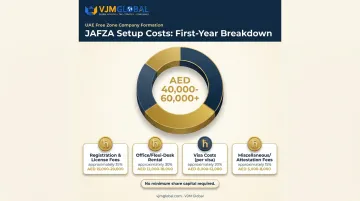
For a small JAFZA setup (flexi-desk, one visa), business setup advisors commonly estimate first-year costs at AED 40,000-60,000+, combining registration, license, facility, and visa fees. Mainland Dubai setups often run comparably or higher once local service agent and office requirements are factored in, though JAFZA has no published mainland comparison to cite directly.
Beyond year one, budget for these recurring costs:
- License renewal: AED 5,000-8,500 for trading licenses, AED 5,000 for service licenses, AED 5,000-12,000 for industrial licenses
- Office/lease renewal: property-specific, no universal published rate
- Visa renewal: AED 1,882.50 for one year, AED 2,082.50 for two years, plus medical clearance
How to Start a JAFZA Business Setup – Step by Step
The process is straightforward on paper but demands accurate documentation and precise activity classification. U.S. shareholders also carry their own compliance obligations, including FATCA foreign account reporting, which adds a layer most applicants from other countries don't face.
- Choose your business activity and legal structure. Decide between FZE, FZCO, or branch based on your ownership setup, liability preferences, and shareholder count. Match your chosen activity precisely to the correct license category. Mismatches here are the single biggest cause of processing delays.
- Reserve your trade name and submit the application. Reserve a JAFZA-compliant trade name and prepare your initial application package. A common miss: picking a name or activity description that unexpectedly triggers external regulatory approvals, adding weeks to the timeline.
- Select office space and submit your documents. Choose flexi-desk, office, or warehouse space based on your budget and visa quota needs. Submit passport copies, a one-page business plan, and board resolutions or NOCs for any corporate shareholders.
- Pay fees and receive your trade license. Pay registration and license fees to obtain your trade license and immigration establishment card. Underestimating attestation time for U.S.-issued documents is the most common misstep at this stage.
- Apply for visas and open a bank account. Apply for investor or employee visas, completing medical testing and Emirates ID formalities. When opening your UAE corporate bank account, expect added due diligence given FATCA-related beneficial ownership checks that UAE banks apply to U.S.-linked entities.
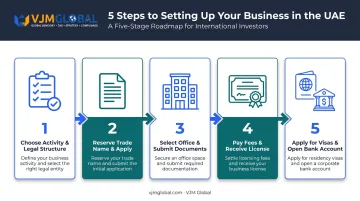
JAFZA's own formation guidance states official processing runs 3 to 14 business days once complete documents are submitted. In practice, U.S. applicants should plan for 2-4 weeks total once document attestation and bank onboarding are factored in.
Why US Businesses Are Choosing JAFZA
JAFZA makes sense for businesses that need global logistics access, tax efficiency, and full ownership without bringing on a local partner. It's not the right fit for every business model, but for trading, logistics, and e-commerce operations, the case is strong.
Key advantages include:
- Scale and reach: more than 11,000 businesses from 157 countries operate here, including 300 U.S.-owned firms and over 100 Fortune 500 companies, according to a U.S.-U.A.E. Business Council member profile
- Port and airport proximity: JAFZA sits directly alongside Jebel Ali Port and roughly 24 km from Al Maktoum International Airport
- Fast sea-air transfers: the Dubai Logistics Corridor cut transfer time between sea and air freight from four hours to under one hour
- Customs advantage: goods imported into the free zone face 0% customs duty, and re-export shipments aren't charged duty either
Beyond these free zone advantages, many U.S. businesses setting up in JAFZA also explore India as a complementary market for cost-efficient back-office support, such as accounting, tax filing, or shared services. Running both jurisdictions well requires an advisor familiar with U.S. compliance and cross-border structuring.
VJM Global supports American businesses on the India side of this setup, handling FEMA compliance, cross-border tax structuring, and outsourced accounting for companies managing dual UAE-India operations.
Getting Approved: Requirements and Common Pitfalls for US Applicants
Core approval requirements include valid passport copies (six-month minimum validity), a clear business activity description, and attested incorporation documents for any corporate U.S. shareholders. Corporate applicants also need:
- Certificate of Incorporation or Good Standing
- Memorandum and Articles of Association (MOA/AOA)
- Board resolution appointing signatories
- Applicable chamber or share certificates
Beyond assembling these documents, approval largely hinges on one thing: matching your activity classification to the correct license category. This is the top cause of processing delays across JAFZA formations.
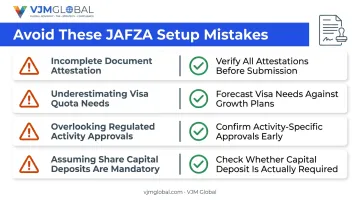
Common pitfalls for U.S. applicants:
- Incomplete document attestation - U.S. corporate documents must be notarized and authenticated through the relevant Secretary of State before UAE Embassy attestation
- Underestimating visa quota needs - facility size directly caps how many visas you can allocate, so choosing too small a workstation limits growth
- Overlooking regulated activity approvals - certain business activities need sign-off from external UAE authorities beyond JAFZA itself
- Assuming share capital deposits are mandatory - most license types don't require this upfront, but applicants sometimes budget for it unnecessarily
Conclusion
JAFZA remains a competitive, well-established free zone for U.S. businesses seeking a genuine UAE presence, provided costs and documentation are planned before you commit. Clarity on license type, realistic budgeting, and accurate paperwork matter more than moving fast.
This same planning discipline applies when comparing jurisdictions. For U.S. companies weighing JAFZA against other expansion routes, India often emerges as a parallel base for accounting, tax compliance, or back-office operations. Working with an experienced global advisor helps avoid costly missteps in either market. VJM Global supports American businesses through FEMA advisory, cross-border tax structuring, and outsourced accounting services for companies building operations that span multiple jurisdictions.
Frequently Asked Questions
How much does it cost to register a free zone company in UAE?
License fees start at AED 5,000, varying by license type and activity group. Total first-year cost for a small setup, including office and one visa, typically falls between AED 40,000-60,000+.
How do I get approved for JAFZA Dubai?
You'll need passport copies, a clear activity description, and attested incorporation documents for corporate shareholders. Approval speed depends heavily on matching your activity to the correct license category, with official processing running 3-14 business days.
Can a US citizen or company own 100% of a JAFZA business?
Yes. JAFZA permits full 100% foreign ownership with no requirement for a local Emirati sponsor or partner, for both individual and corporate U.S. shareholders.
How long does it take to set up a company in JAFZA?
JAFZA's official timeline is 3-14 business days once complete documentation is submitted. U.S. applicants should factor in additional time, often bringing the total closer to 2-4 weeks, due to document attestation requirements.
What is the minimum share capital required for a JAFZA company?
JAFZA no longer prescribes a fixed minimum share capital for FZE or FZCO formations. Capital simply needs to be sufficient for the licensed activity, and it's typically not required as an upfront deposit.
Can a JAFZA free zone company trade directly with mainland UAE or the US?
Selling into mainland UAE requires an import declaration, applicable customs duty, or a licensed mainland distributor. International trade, including with the U.S., is generally unrestricted aside from controlled-goods permits.