Introduction
"Set up your Dubai company in 24 hours." You've probably seen that claim in a dozen ads. It's misleading, even when technically true.
License issuance can happen fast, sometimes within days. Getting to a functioning business is a longer story: it means stamped visas and Emirates IDs, plus a corporate bank account that actually accepts deposits.
This guide is for US founders and established companies evaluating Dubai as a 2026 expansion base. Getting the timeline wrong affects cash flow, staffing decisions, and lease commitments made before the business can legally operate.
We'll walk through the real 2026 timeline stage by stage, including the friction points specific to US applicants that most generic setup guides skip entirely.
Key Takeaways
- Full registration typically takes 4-10 weeks, including visa processing and bank account approval
- Free zone licensing beats mainland speed, but a fast license doesn't mean you're ready to operate
- Corporate bank account approval is usually the single biggest bottleneck for US-linked shareholders
- 100% foreign ownership is now standard, removing the local-sponsor requirement for most applicants
- FTA corporate tax registration is a separate mandatory deadline with its own penalty structure
What Is the Dubai Company Registration Timeline?
The Dubai company registration timeline is the full sequence of legal, administrative, and banking milestones a foreign business clears between choosing a structure and becoming genuinely operational in the UAE.
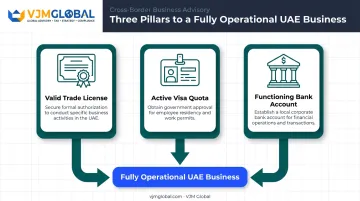
Completion means three things happening together, not merely an approved trade name:
- A valid trade license covering your actual business activity
- An active visa quota so you and your team can legally reside and work
- A functioning corporate bank account that can send and receive payments
This differs from a cost or requirements discussion, which only asks what you need. The timeline asks how long each dependent step takes, and which steps can run in parallel versus which ones strictly wait on each other.
That distinction matters more than most guides admit: document attestation and trade name approval, for instance, can happen simultaneously, while visa processing cannot start until the license exists. Banking often can't start in earnest until visas are underway. Sequencing determines your real launch date, not any single step's advertised speed.
Why the Timeline Matters More for US Businesses in 2026
US applicants face extra steps that generic "how to register in Dubai" content routinely leaves out.
The Compliance Trail Is Longer
US corporate documents (certificates of incorporation, board resolutions, powers of attorney) need authentication before UAE authorities will accept them. The UAE is not a party to the Hague Apostille Convention, so a US apostille alone often isn't the end of the road. Documents may still need UAE embassy legalization or Ministry of Foreign Affairs attestation on top of it.
This adds a step (and a queue) that founders from Hague-member countries simply don't face.
The tax clock runs on a separate schedule entirely. There's no comprehensive US-UAE income tax treaty on the IRS's current list of countries with tax treaties. That means UAE's 0%/9% corporate tax rates don't exempt US owners from US tax obligations.
US shareholders and officers of a UAE entity may need to file Form 5471, depending on ownership percentage and control thresholds. That filing deadline runs on the US tax calendar, not the UAE incorporation calendar — and missing it carries its own penalties, separate from anything the UAE imposes.
The Deadlines Are Real, and So Is the Demand
US interest in Dubai isn't hypothetical. 3,690 US companies were active Dubai Chamber members as of September 30, 2025, with 787 joining in just the first nine months of that year, according to Dubai Chambers. That volume is exactly why realistic timeline planning, rather than marketing-driven expectations, matters right now.
Every UAE company formed on or after March 1, 2024, generally has three months from incorporation to register for Corporate Tax with the Federal Tax Authority. Miss it, and the FTA imposes an AED 10,000 penalty. Founders who treat "the UAE part" as finished once the license arrives frequently miss this entirely.
Step-by-Step Dubai Company Registration Timeline for 2026
Here's the realistic sequence, including where parallel processing can compress your overall schedule. Preparing and attesting US documents remotely before formally filing can shave one to two weeks off the total.
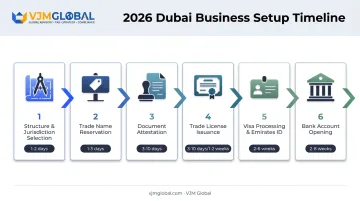
| Stage | Typical Duration |
|---|---|
| Structure, activity, jurisdiction selection | 1-2 days |
| Trade name reservation & initial approval | 1-3 days |
| Document prep & attestation | 3-10 days (longest for US applicants) |
| Trade license issuance | 3-10 days (free zone); 1-2 weeks (mainland) |
| Visa processing & Emirates ID | 2-6 weeks |
| Corporate bank account opening | 2-8 weeks |
Step 1: Choose Structure, Activity, and Jurisdiction (Days 1-2)
Free zone, mainland, or offshore: this decision locks in every deadline that follows. Free zones generally move faster and allow 100% ownership by default. Mainland companies offer access to the broader UAE market and government contracts, but route through the Department of Economy and Tourism, which typically takes longer.
Get this decision right first. Switching structures mid-application means restarting the clock.
Step 2: Trade Name Reservation and Initial Approval (Days 1-3)
Once your activity and jurisdiction are set, you reserve a trade name and get initial approval from the relevant authority. Most free zones and Invest in Dubai's portal handle this online, and turnaround is usually fast, provided the name meets naming conventions and the activity doesn't require special sign-off.
Step 3: Document Preparation and Attestation (Days 3-10, longest for US founders)
This is where US applicants lose the most time. Certificates of incorporation, good standing certificates, and powers of attorney need:
- Notarization in the US
- State-level authentication, plus US Department of State authentication if required (mail-in processing runs about five weeks from receipt, though walk-in options exist for those able to travel)
- UAE embassy or consulate legalization, since Apostille alone may not satisfy UAE requirements
Starting this process before you formally file (remotely, in parallel with structure selection) is the single biggest lever US founders have to compress the timeline.
Step 4: Trade License Issuance (Days 3-10 for free zones; 1-2 weeks for mainland)
Once documents clear, the license itself can move quickly. DMCC, for example, publishes a setup timeline of roughly 10 working days, with the e-license following in 2-3 working days after setup completes, though this depends on documentation completeness and whether your activity needs external approvals.
Mainland licensing through DET usually runs a bit longer, partly due to additional approvals for certain regulated activities.
Step 5: Visa Processing and Emirates ID (2-6 weeks)
With a license in hand, visa processing begins: entry permit, status change (if applicable), medical fitness test, Emirates ID application, and visa stamping. Dubai's immigration authority (GDRFA) states private-sector residence permits process in about 48 hours, but that figure covers just one piece of the chain.
Add in medical test scheduling, Emirates ID appointment availability, and whether applicants are inside or outside the UAE, and the realistic range stretches to several weeks per person.
Step 6: Corporate Bank Account Opening (2-8 weeks)
This is the least predictable stage, and for US-linked shareholders, often the longest. UAE banks must independently verify beneficial ownership under Central Bank AML rules, and US ownership typically triggers additional FATCA documentation, such as W-9 or W-8BEN-E forms.
No UAE bank publishes a guaranteed approval timeframe. Expect variability based on the bank, your business model, and how complete your KYC file is on first submission.
Key Factors That Affect Your Registration Speed
Several variables shift your timeline in either direction:
- Business structure chosen: free zone, mainland, or offshore each triggers different documentation loads and approval chains
- Document completeness and attestation status: incomplete or non-attested US paperwork is the top cause of delays
- Bank compliance requirements: FATCA and AML screening add scrutiny for US-linked shareholders specifically
- Number of visas requested, and whether applicants apply from inside or outside the UAE
- Free zone authority chosen: DMCC, IFZA, and JAFZA each has different processing speeds and document requirements
- Whether a formation agent manages submissions in parallel rather than waiting for each step to finish sequentially
That last point is easy to underestimate. A good agent runs attestation, licensing, and visa prep on overlapping tracks, rather than waiting for each step to finish before starting the next.
Common Delays and How US Businesses Can Avoid Them
The "24-hour" or "same-day" formation claims you'll see advertised almost always refer to license issuance only, not the visa and banking stages that determine when you're actually operational.
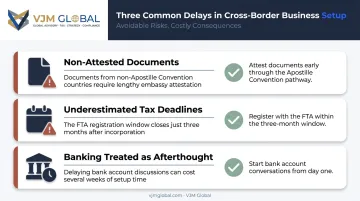
Three delay patterns show up repeatedly with US applicants:
- Non-attested documents. Since the UAE isn't part of the Apostille Convention, treating a US apostille as sufficient on its own is a common and costly mistake. Confirm the exact attestation chain your chosen free zone or DET requires before you submit anything.
- Underestimated tax deadlines. The three-month FTA corporate tax registration window catches founders off guard because it starts from incorporation, not from when the business feels "fully set up."
- Banking delays treated as an afterthought. Founders often start banking discussions only after the license arrives, adding weeks that could have run in parallel.
Coordinating the US compliance side alongside your UAE formation partner helps close these gaps before they turn into delays. VJM Global, for instance, has worked with 500+ American business owners on cross-border tax planning and compliance, including FATCA reporting and Form 5471 filings that run on their own clock alongside any UAE entity setup.
That dual-side coordination catches documentation gaps and deadline conflicts before they become expensive.
Build a 2-4 week buffer specifically for bank account approval. It's the stage most likely to run long, and the one most founders forget to plan around.
Conclusion
The realistic Dubai company registration timeline for a US business in 2026 runs 4 to 10 weeks end-to-end, well beyond the 24-48 hours often advertised.
Treat banking approval as your critical path since it typically takes the longest; licensing rarely causes delays. Map your FTA corporate tax registration and IRS reporting deadlines into the UAE setup process from the start — retrofitting compliance after incorporation wastes time you don't have. Founders who build one integrated timeline covering both jurisdictions typically avoid the last-minute scrambles that trip up everyone else.
Frequently Asked Questions
How long does it take to register a company in Dubai in 2026?
License issuance can take as little as 1-3 days in some free zones. Full operational readiness, including visa processing and bank account approval, typically takes 4-10 weeks.
How much does it cost to set up a company in the UAE in 2026?
Costs vary by structure and activity. Free zone licenses often start around AED 12,000-20,000 annually, mainland setup includes separate DET fees, and visa costs add further expense per employee.
Can you own 100% of a company in Dubai in 2026?
Yes. Since the 2021 ownership reforms, 100% foreign ownership is available in all free zones and most mainland activities, removing the local sponsor requirement for the majority of business types.
What are the new rules in Dubai in 2026?
Key 2026 developments include a phased e-invoicing rollout starting July 2026 and stricter corporate tax enforcement with a three-month post-incorporation registration deadline. Regulators are also tightening UBO and AML disclosure requirements.
Do US citizens need to pay US tax on a Dubai company?
Yes. The US taxes citizens on worldwide income regardless of UAE's 0%/9% corporate tax rates. US shareholders may also need to file Form 5471 depending on ownership and control thresholds.
Can I register a Dubai company remotely from the US?
Yes, remote formation is possible through a power of attorney and a formation agent handling submissions locally. Bank account opening, however, may still require in-person verification or video KYC depending on the bank.