Many UAE promoters exploring Bangladesh get stuck on one question early: should this be a Private Limited Company or a Public Limited Company (PLC)? If you're planning to raise capital publicly, eventually list on the Dhaka or Chittagong Stock Exchange, or simply want a structure built for scale, the PLC is worth understanding properly.
This guide breaks down what a PLC actually is, the requirements UAE investors face, the registration steps, and how to stay compliant once the company is running.
Key Takeaways
- A Bangladesh PLC needs a minimum of 7 shareholders and 3 directors, with no upper limit on shareholders.
- Most sectors allow 100% foreign ownership; reserved and controlled sectors need prior approvals.
- PLCs are governed by the Companies Act 1994 and, if listed, the Securities and Exchange Commission Act 1993.
- Formation runs through the RJSC and, depending on structure, BIDA; timelines hinge on documentation readiness.
- RJSC-fluent cross-border advisors cut filing back-and-forth for UAE promoters.
What Is a Public Limited Company in Bangladesh?
Under Section 2 of the Companies Act 1994, a public company is simply any company that isn't a private company. That sounds circular, but the practical difference matters a lot.
The practical split looks like this:
- A Private Limited Company restricts share transfers and cannot invite the public to buy shares or debentures
- A PLC can offer shares publicly, and those shares transfer more freely
- Investors typically choose a PLC when capital-raising goes beyond a small shareholder group
PLC Doesn't Automatically Mean Listed
Here's something that trips up a lot of UAE investors: incorporating as a PLC does not force you onto a stock exchange. Public company status and exchange listing are separate matters entirely. A PLC may pursue an IPO later, but plenty operate unlisted for years.
Bangladeshi banks illustrate this well. Islami Bank Bangladesh Ltd, for instance, added the "PLC" suffix to comply with the Company (Second Amendment) Act 2020, a pattern common among scheduled commercial banks. Banking and insurance businesses lean toward the PLC structure because their capital and accountability requirements demand it.
Key Requirements for UAE Investors Setting Up a PLC
Shareholding and Directorship Requirements
The Companies Act 1994 sets clear floors:
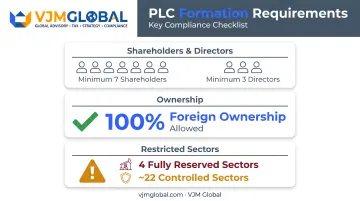
- Minimum 7 shareholders — individuals or corporate entities, no maximum cap
- Minimum 3 directors
- 100% foreign ownership permitted in most sectors
Some sectors need extra clearance:
- Fully reserved (4): arms and ammunition, nuclear energy, currency printing, and mechanized extraction in reserved forests
- Controlled (~22): banking, insurance, telecommunications, logistics, and similar fields need government permits or no-objection certificates before foreign ownership proceeds
Capital and Remittance Requirements
There's no statutory minimum paid-up capital for a Bangladesh PLC.
UAE promoters planning to hire foreign staff should know that BIDA requires an encashment certificate for at least USD 50,000 as evidence of establishment cost. That certificate supports certain work-permit and visa applications for wholly foreign-owned local companies. It is not a general capital rule; it applies only when you hire expatriates.
Your Memorandum of Association must still declare:
- Authorised capital — the maximum share capital the company can issue
- Paid-up capital — the actual amount subscribers have committed against shares taken
Each subscriber must take at least one share and state the number in the MoA.
Step-by-Step Registration Process for a PLC in Bangladesh
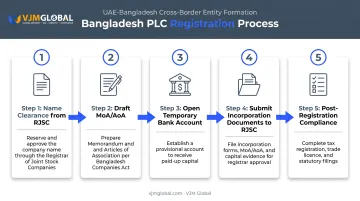
PLC registration in Bangladesh follows five sequential steps:
- Name clearance from RJSC — valid for 30 days initially, extendable to 60 or 90 days if needed.
- Draft the MoA and Articles of Association — reflecting the public company structure, share capital division, and shareholder terms.
- Open a temporary bank account in Bangladesh — remit share capital from the UAE, deposit it to match the shareholding position, and obtain the encashment certificate.
- Submit incorporation documents to RJSC — file the MoA/AoA (original plus copies), Forms I, VI, IX, X and XII, name-clearance proof, and treasury challan; pay the registration fees and collect the Certificate of Incorporation.
- Complete post-registration compliance — Trade License, e-TIN (available in about three days through BIDA's one-stop service when documentation is complete), and VAT/BIN registration.
A note on timelines: Many advisors cite 45–60 days as a rough benchmark for full PLC formation, but neither RJSC nor BIDA publishes an official end-to-end figure.
Realistic timing depends on how fast you prepare documents and clear the temporary bank account and UAE remittance steps. A compliance partner handling the file end-to-end can shorten those handoffs.
PLC vs. Private Limited Company: Which Fits Your Plans?
| Factor | PLC | Private Limited |
|---|---|---|
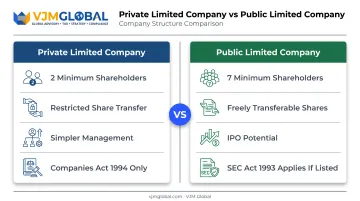
| Minimum shareholders | 7 | 2 |
| Share transfer | Freely transferable, public offer possible | Restricted, no public invitation |
| Regulatory scope | Companies Act 1994; SEC Act 1993 if listed | Companies Act 1994 only |
| Capital raising | Can issue prospectus, pursue IPO | Cannot invite public subscription |
Which structure fits:
- Private Limited — Testing the Bangladesh market with a small, controlled shareholder group; simpler to manage day to day
- PLC — Building toward public capital-raising or an eventual listing
Converting later from Private to Public is possible under Section 231 of the Companies Act. You need at least 7 members, articles amendments, and a prospectus or statement in lieu filed with RJSC within 30 days.
That adds time and legal cost. Choose the structure that matches your 3–5 year growth plan, not just your current headcount.
Ongoing Compliance Obligations for a Bangladesh PLC
Incorporation is the easy part. Staying compliant is where UAE-based promoters managing things remotely tend to lose track.
Annual obligations:
- Hold your first AGM within 18 months of incorporation; no more than 15 months between later AGMs
- File audited financial statements and the annual return (Schedule X) with RJSC within 21 days of the AGM
- Submit the balance sheet and profit and loss account within 30 days of the AGM
Recurring tax filings:
- VAT returns (Form VAT-9.1) due by the 15th of the following month
- Withholding tax (TDS) returns filed quarterly, by the 25th day after quarter-end
- Corporate income tax return by the 15th day of the ninth month after your income year ends
Foreign-ownership reporting:
- Wholly foreign-owned companies file Form FI-1 with Bangladesh Bank on a half-yearly basis (January–June and July–December)
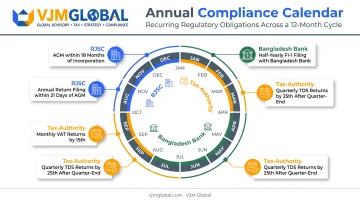
That's a lot of moving parts across RJSC, the tax authority, and Bangladesh Bank.
VJM Global handles recurring accounting, tax, and payroll compliance using each market's own filing calendar and regulators. For a UAE business that does not want an in-house finance team in Bangladesh, that support takes the ongoing compliance load off your plate.
How VJM Global Supports UAE Businesses Entering New Markets
VJM Global works with UAE companies expanding into unfamiliar regulatory environments, using each destination market's own regulators, entity types, and statutory frameworks rather than a one-size-fits-all playbook. That approach keeps cross-border entity formation manageable when you coordinate documents from Dubai or Abu Dhabi while a registrar in Bangladesh processes the local filings. The firm's team includes Chartered Accountants, a Company Secretary, and multi-jurisdiction compliance professionals. They coordinate UAE parent-company documentation with Bangladesh incorporation requirements, including:
- MoA drafting support for the local entity
- Filing coordination with the destination registrar
- Post-registration tax and statutory registrations
- Ongoing governance support after the PLC or private limited company is formed For UAE businesses not yet ready to commit to full incorporation, VJM Global's Employer of Record service offers a lower-risk entry point. You can hire local staff in 100+ countries without setting up a legal entity first, with:
- Compliant local employment contracts
- Payroll processing and statutory contributions
- Benefits administration under local rules That path lets you test talent and demand signals before formal PLC or Pvt Ltd registration in Bangladesh becomes necessary.
Frequently Asked Questions
What is a public limited company in Bangladesh?
A PLC is a company that can offer shares to the public, requiring a minimum of 7 shareholders and 3 directors. It is governed by the Companies Act 1994 and, if listed, also the Securities and Exchange Commission Act 1993.
Which companies are public limited in Bangladesh?
PLCs are typically larger corporations, banks, and insurance companies seeking capital-raising flexibility through public share offerings or stock exchange listing. Smaller businesses testing a market usually start as private companies instead.
Which banks are PLCs in Bangladesh?
Most scheduled commercial banks operate under the PLC structure since banking requires public accountability and capital-raising capacity. For a specific bank's exact status, check RJSC records directly.
How to check if a company is registered in Bangladesh?
Registration status can be verified through RJSC's online portal using the company name or registration number. The name-search tool checks name availability only, not full legal or financial standing.
Can a UAE company own 100% of a Bangladesh PLC?
Yes, in most sectors. A handful of reserved and controlled sectors require government approval, and hiring foreign staff triggers a USD 50,000 encashment certificate requirement.
How long does it take to register a PLC in Bangladesh?
Many advisors estimate 45-60 days, though this is not an officially published timeline. Actual duration depends on how quickly documentation and the temporary bank remittance are completed.