Bangladesh introduced OPC through a 2020 amendment to the Companies Act 1994, giving solo entrepreneurs a corporate structure that didn't exist before. It sits between a sole proprietorship and a full private limited company.
But here's the catch. UAE businesses and, in most practical scenarios, UAE-based individuals run into real barriers when trying to use this route. This guide breaks down what OPC actually is, where the roadblocks lie, and what UAE entrepreneurs should do instead.
Key Takeaways
- OPC allows one natural person to hold 100% ownership with limited liability protection
- A UAE company cannot form an OPC; only a natural person qualifies, not a body corporate
- NID/TIN documentation still blocks many UAE individuals, even though the law does not explicitly bar foreigners
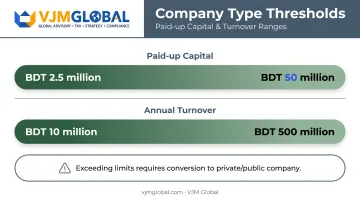
- Paid-up capital ranges from BDT 2.5 million to BDT 50 million, with turnover limits up to BDT 500 million
- Most UAE entrants should use a private limited company or branch/subsidiary structure instead
What is a One Person Company (OPC) in Bangladesh?
The Companies (Second Amendment) Act 2020 inserted OPC provisions into Bangladesh's Companies Act 1994. Before this, solo founders had two options: unlimited-liability sole proprietorship, or recruiting a second shareholder just to satisfy the private company requirement.
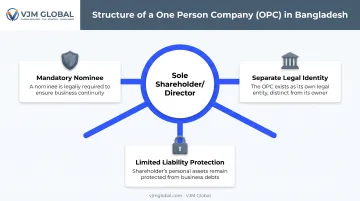
An OPC changes that. It's a company with:
- One natural person as shareholder and director simultaneously
- A mandatory nominee named in the memorandum, who steps in if the sole shareholder dies or becomes incapacitated
- A distinct legal identity, separate from the person who owns it
Why the nominee matters: Without one, the company would have no continuity plan if something happened to its sole owner. The nominee's written consent is recorded at incorporation, and it can be changed later.
Beyond continuity, the main structural advantage over a sole proprietorship is limited liability. Your personal assets stay protected if the business runs into debt or legal trouble, because the OPC is treated as its own legal entity rather than an extension of you personally.
Can UAE Businesses and Individuals Register an OPC in Bangladesh?
This is where things get complicated, and where a lot of generic advice oversimplifies the answer.
The Corporate Barrier is Clear
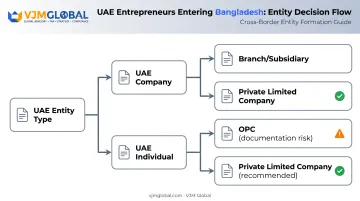
Bangladesh's OPC provisions (Section 392B) permit only one natural person to form an OPC. A UAE company, however small, cannot be that person. If your UAE entity wants a foothold in Bangladesh, OPC simply isn't on the table.
The Individual Barrier is Murkier
For a UAE-based individual, the law doesn't explicitly exclude foreign nationals. There's no clause saying "Bangladeshi citizens only." The practical friction comes from documentation:
- Registration typically flows through a National Identification Card (NID) followed by a Tax Identification Number (TIN)
- Some legal guidance suggests foreign passports might substitute for NID; other guidance disagrees
- No public RJSC (Registrar of Joint Stock Companies and Firms) instruction confirms which position applies
In other words, this is an unresolved documentation risk, not a settled legal prohibition. Anyone presenting it as a flat "no" for individuals is overstating the certainty.
There's also a post-incorporation route: shares can be transferred to another natural person after the OPC is formed, with no nationality qualifier in the transfer provision. But foreign or Non-Resident Bangladeshi (NRB) transferors typically need embassy-certified paperwork, and this doesn't solve the initial registration problem for a UAE founder starting from zero.
The Practical Recommendation
For UAE entrepreneurs and businesses, the better-supported path is:
- Private or public limited company — standard multi-shareholder structure, passport-based documentation accepted
- Foreign subsidiary or branch office — appropriate for UAE companies extending operations into Bangladesh
Both options deliver limited liability and full control without the OPC's documentation ambiguity.
Which structure fits depends on your ownership model, control needs, and timeline. VJM Global works across regulatory frameworks in 100+ countries and helps UAE businesses choose the right Bangladesh entity before they file.
Registration Requirements and Capital Rules for OPC in Bangladesh
Bangladesh OPC registration is open only to a Bangladeshi national. For UAE businesses comparing entry routes, that nationality rule is the first filter—here is what the statute requires.
Core conditions:
- A single natural person as shareholder and director
- One nominee, named with written consent
- Valid National ID (NID) and Tax Identification Number (TIN) for the shareholder
Capital and turnover thresholds:
| Metric | Minimum | Maximum |
|---|---|---|
| Paid-up capital | BDT 2.5 million | BDT 50 million |
| Annual turnover | BDT 10 million | BDT 500 million |
That capital floor is higher than many comparable regimes in the region. For UAE groups that cannot use OPC anyway, a private limited company is usually the more practical Bangladesh vehicle.
Further limits: an individual can form only one OPC at a time. However, that same person can act as a nominee for multiple OPCs owned by others. If capital or turnover exceeds the statutory ceiling, the company must convert into a private or public limited company.
Step-by-Step OPC Registration Process via RJSC
For eligible applicants, registration runs through the Registrar of Joint Stock Companies (RJSC) online portal.
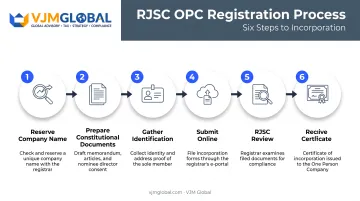
- Reserve a company name — Search and clear the name via RJSC's entity-name search, ensuring it carries the "OPC" designation
- Prepare constitutional documents — Memorandum of Association (including nominee details), Articles of Association, Form IX (director consent), Subscriber Page, and Form I
- Gather identification — Passport and TIN for the UAE (or other foreign) shareholder; NID/TIN for a Bangladeshi nominee, plus any attested supporting IDs RJSC requests
- Submit online — Upload documents through the RJSC portal and pay applicable fees and stamp duty
- RJSC review — The registrar scrutinises submissions; expect possible queries or resubmission requests
- Receive Certificate of Incorporation — Issued digitally once approved, enabling the company to operate as a legal entity
Post-Registration Compliance
Incorporation alone does not complete setup. New OPCs still need:
- Trade Licence from the local city corporation or municipality
- e-TIN registration
- VAT/BIN registration, if applicable to the business activity
- A corporate bank account opened in the company's name
Ongoing Compliance and Tax Obligations for an OPC
Running an OPC comes with recurring obligations, not just a one-time filing.
Financial reporting:
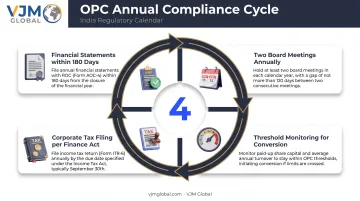
- Financial statements must be submitted to the Registrar within 180 days of the financial year's end
- The sole shareholder-director signs off on these accounts personally
Governance:
- At least one board meeting is required in each half of the calendar year — two meetings annually at minimum
- If capital or turnover breaches the statutory thresholds outlined earlier, conversion to a private or public company becomes mandatory
Tax treatment:
- Corporate tax rates for OPCs are set in recent finance legislation, with reduced rates available when conditions such as banking-channel receipts are met
- Rate details change with each year's Finance Act, so confirm the current applicable rate before filing rather than relying on older figures
These reporting, meeting, and tax duties form a steady annual cycle once the OPC is active.
How VJM Global Supports UAE Businesses Entering New Markets
Bangladesh isn't among VJM Global's currently listed delivery markets. But the broader challenge UAE businesses face—choosing the right entity structure before committing capital to a new jurisdiction— is exactly the kind of decision VJM Global's cross-border team handles regularly.
The firm delivers entity formation, tax, and compliance services across 16+ core markets and supports Employer of Record arrangements in over 100 countries. For UAE businesses weighing options such as:
- Private limited company versus branch office structures
- Ongoing accounting, payroll, and tax compliance once an entity is live
- Whether a target market's documentation rules actually permit foreign ownership at the individual level
VJM Global's team can walk through the practical realities before you register anything. With 30+ years of experience in tax, audit, and advisory work, and a team of 100+ professionals supporting cross-border clients across its core markets, the firm offers a structured way to evaluate unfamiliar regulatory environments rather than relying on generic online guides.
Frequently Asked Questions
What is a one-person company (OPC) in Bangladesh?
An OPC is a single-shareholder company structure introduced in 2020, letting one natural person hold full ownership with limited liability. It requires a mandatory nominee to ensure continuity if the owner becomes incapacitated.
How do I start a one-person company in Bangladesh?
Registration happens through the RJSC's online portal, involving name clearance, document preparation (MoA, AoA, Form IX), and submission with NID/TIN. This route is generally accessible to Bangladeshi nationals holding valid national identification.
How much does it cost to register a one-person company in Bangladesh?
Paid-up capital must fall between BDT 2.5 million and BDT 50 million, on top of standard government fees and stamp duty for incorporation. Costs scale depending on the capital bracket chosen.
Can a foreigner or UAE company register an OPC in Bangladesh?
A UAE company cannot, since the law requires a single natural person as shareholder. For UAE individuals, NID-based documentation creates practical uncertainty, so registering a private limited company is the more reliable route.
What is the difference between an OPC and a private limited company in Bangladesh?
OPC allows one shareholder-director with a mandatory nominee, while a private limited company requires at least two shareholders. UAE businesses typically choose private limited structures because they accept passport-based documentation without OPC's NID ambiguity.
What taxes does an OPC pay in Bangladesh?
Corporate tax rates for OPCs are set through each year's Finance Act and can vary based on conditions like receiving payments through banking channels. Confirm the current rate with a tax advisor before filing, since rates are periodically revised.