Most foreign founders default to a Sdn Bhd, Malaysia's private limited company structure. But a growing number of Australian businesses planning to raise public capital, list on Bursa Malaysia, or scale into a large enterprise are looking at the Public Limited Company (Berhad) structure instead.
This guide walks through what a Berhad actually involves, who it suits, and how an Australian entrepreneur can register one without relocating.
Key Takeaways
- A Berhad suits public share issuance or a future Bursa Malaysia listing, not routine market entry
- Australians can own and direct a Berhad remotely, but must appoint two Malaysia-resident directors and a licensed secretary
- Registration covers SSM name reservation, certification, incorporation filing, and LHDN tax registration
- Incorporation does not grant residency or work rights; separate pass applications apply
- Full setup typically takes several weeks with well-coordinated remote handling
What Is a Public Limited Company (Berhad) in Malaysia?
A Berhad (BHD) is a public limited company incorporated under the Companies Act 2016, built for businesses that may eventually offer shares to the public or list on Bursa Malaysia. It sits at the opposite end of the scale from a Sdn Bhd, which is designed to stay private.
A few structural points founders often get wrong:
- Shareholders: A Berhad needs at least one promoter or member, with no upper cap on shareholder numbers
- Directors: At least two directors must be ordinarily resident in Malaysia — this is stricter than the single resident director many assume applies
- Financial disclosure: Both public and private companies lodge financial statements with SSM. A Berhad must do so within 30 days of its AGM
- Audit: A Berhad cannot use the private-company audit exemption, regardless of its size or revenue
That last point matters more than people expect. Even a small, newly listed Berhad with modest revenue still faces a full statutory audit every year.
Berhad vs Sdn Bhd vs Other Structures
| Structure | Ownership & Directors | Disclosure/Audit | Best Fit for Australian Founders |
|---|---|---|---|
| Berhad | 1+ members, no cap; 2+ resident directors | Mandatory audit, no exemption | Large-scale capital raising, IPO plans |
| Sdn Bhd | Max 50 shareholders, restricted share transfer; 1+ resident director | May qualify for audit exemption under phased SSM thresholds | Most SMEs entering Malaysia |
| Registered branch/foreign company | Extension of the Australian parent | Follows Companies Act registration rules | Testing the market without a new local entity |
| Representative Office | Government-approved, foreign-funded | Cannot trade or sign contracts locally | Market research only, no revenue activity |
Most Australian SMEs enter Malaysia as a Sdn Bhd. They only convert to a Berhad once they need public capital or a larger shareholder base than the 50-person Sdn Bhd cap allows. Jumping straight to Berhad without that need usually just adds audit and compliance cost for no benefit.
Why Australian Entrepreneurs Consider a Berhad Structure in Malaysia
A Berhad isn't a universal upgrade — it makes sense under specific conditions, mostly tied to capital needs rather than day-to-day operations.
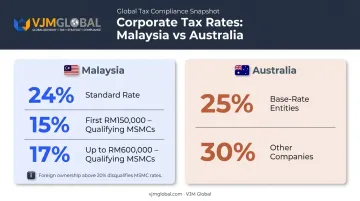
Tax positioning matters here, and it's more nuanced than founders expect. Malaysia's standard corporate tax rate is 24%. Resident micro, small and medium companies can access tiered rates of 15% on the first RM150,000 and 17% up to RM600,000.
But there's a catch for Australian-owned entities: this preferential MSMC treatment is unavailable once foreign ownership exceeds 20%, according to LHDN's Public Ruling 8/2025. A majority Australian-owned Berhad will typically sit on the flat 24% rate from day one.
Compare that with Australia's own system, where the ATO applies 25% to base-rate entities and 30% to other companies. The gap isn't dramatic, but it's still favourable for structuring regional revenue through Malaysia.
Structural advantages of Berhad over Sdn Bhd include:
- Allows unlimited shareholders, compared with the 50-shareholder cap for Sdn Bhd
- Enables public share offerings and a potential Bursa Malaysia listing
- Simplifies bringing in institutional or public investors at scale
These structural perks only pay off if you actually pursue capital raising; the tax picture below applies whether you list on Bursa Malaysia or not.
Tax incentives worth exploring through MIDA include:
- Pioneer Status: a five-year partial exemption where tax applies to only 30% of statutory income, for qualifying manufacturing activities
- Investment Tax Allowance: 60% of qualifying capital expenditure offset against 70% of statutory income over five years
The Malaysia-Australia Double Taxation Agreement, in force since 1980 and updated through protocols in 1999, 2002 and 2010, helps prevent the same income being taxed twice.
The trade-off? Higher compliance and disclosure obligations that never go away, even if capital raising plans stall.
Requirements and Step-by-Step Process to Register a Berhad Company in Malaysia from Australia
Here's the practical breakdown: what you need on hand, and the order things happen in. Most of this can be done remotely with the right local support.
Requirements for Australian Applicants
- Promoters/shareholders: At least one, Australian individuals or entities are both fine
- Resident directors: At least two directors ordinarily resident in Malaysia. This usually means engaging local professional directors if you have no existing Malaysia contact
- Company secretary: A licensed Malaysian company secretary must be appointed within 30 days of incorporation
- Documentation: Passport copies, proof of residential address, and director/shareholder declarations — Australian-origin documents often require notarisation or apostille
- Registered office: A physical Malaysian address, typically provided through your company secretary or registered agent
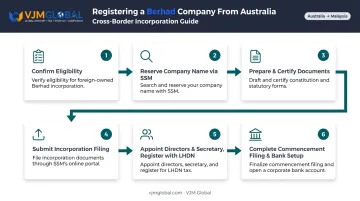
Step-by-Step Registration Process
- Confirm Berhad eligibility and finalise your business activity and share structure before filing anything
- Reserve your company name via the SSM (Companies Commission of Malaysia) e-Search/MyCoID portal (RM50, valid 30 days, extendable up to 150 days)
- Prepare and certify incorporation documents from Australia, including director/shareholder declarations
- Submit incorporation filing to SSM and receive your registration number
- Appoint resident directors and company secretary, then register with the Inland Revenue Board (LHDN) for tax purposes
- Complete public-company commencement filing where applicable, apply for sector-specific licenses, then move to bank account setup
Common mistake: assuming a Sdn Bhd checklist transfers over cleanly. It doesn't. A Berhad's disclosure obligations, director count, and audit requirements are all different, and treating them as identical is how founders end up delayed at the SSM filing stage.
Costs, Banking, and Visa Considerations for Australian Founders
This is the part most Australian founders underestimate — not the paperwork itself, but the logistics of doing it all from a distance.
Cost of Incorporation
The current SSM fee structure sets incorporation at RM1,000 for a company limited by shares. This flat fee applies equally to Sdn Bhd and Berhad; it isn't a sliding scale tied to share capital, despite what older guidance sometimes suggests. Name reservation adds another RM50.
The real ongoing cost difference is audit. Berhad companies face mandatory annual audit regardless of revenue size, since public companies are excluded from SSM's private-company audit exemption entirely. Budget for a company secretary retainer and audit fees as recurring, non-negotiable line items.
Opening a Corporate Bank Account Remotely
Malaysian banks apply strict know-your-customer checks covering legal existence, ownership structure, and beneficial owners. Most banks, including major players like Maybank, require all directors and authorised signatories to appear in person at a branch with original identity documents.
For Australian founders not ready to travel immediately, multi-currency platforms such as Wise Business or Payoneer offer interim options for receiving and moving funds while the formal corporate account is arranged.
Visa and Residency Reality Check
Incorporating a Berhad does not grant residency or the right to work in Malaysia. These are separate applications entirely:
| Visa Type | Purpose | Key Limitation |
|---|---|---|
| Employment Pass | Tied to your named Malaysian company | Changing employers means reapplying |
| Investor Pass | Business-visitor facility under the Social Visit Pass, valid up to six months (extendable by six months) | Does not permit employment |
Founders planning to operate on the ground need to plan these applications alongside incorporation, not after it.
How VJM Global Supports Australian Businesses Expanding into Malaysia
VJM Global has worked with 250+ Australian businesses on cross-border expansion, backed by more than 30 years of tax, audit, and advisory experience across 16+ markets. That cross-border grounding matters directly for a Berhad registration, which requires:
- Coordinating notarised documents from Australia
- Tracking resident director and company secretary requirements
- Managing LHDN tax registration alongside the SSM filing timeline
For Australian founders without an existing Malaysia contact, the paperwork itself is usually manageable. Finding people on the ground to fill the resident director and secretarial roles the Companies Act requires is the bigger hurdle. VJM Global's chartered accountants and multi-jurisdiction compliance professionals work through that coordination directly with clients, rather than leaving them to source local contacts independently.

For businesses not yet ready to commit to a full Berhad structure, VJM Global's Employer of Record capability spans 100+ countries. It offers a way to hire in Malaysia and test market conditions before locking in a public company structure and its audit obligations.
Conclusion
Registering a Public Limited Company in Malaysia from Australia is entirely achievable without relocating, provided the resident director, company secretary, and documentation requirements are handled correctly from the outset. A Berhad suits businesses genuinely planning large-scale capital raising or a future listing. For smaller market entries, a Sdn Bhd remains the simpler, lower-compliance default.
Getting the compliance, banking, and visa logistics right early, ideally with support from a cross-border specialist like VJM Global, is what separates a smooth six-week setup from a six-month one.
Frequently Asked Questions
What is a public limited company in Malaysia?
It's a Berhad (BHD) company under the Companies Act 2016, permitted to issue shares publicly, with no maximum shareholder count. The structure carries mandatory financial disclosure and annual audit requirements.
Can a foreigner own a company in Malaysia?
Yes. Australians and other foreigners can own up to 100% of most Malaysian companies. Some regulated sectors apply activity-specific equity conditions through licensing, so confirm your sector's rules before assuming a blanket 100% policy applies.
What's the difference between a Berhad (PLC) and a Sdn Bhd (private limited) company?
A Berhad allows unlimited shareholders and public share offerings but carries mandatory audit and disclosure obligations. A Sdn Bhd caps shareholders at 50 and may qualify for audit exemption depending on its size.
Do I need to be physically present in Malaysia to register a Berhad company?
Most of the filing process can be completed remotely with the right documentation support. Bank account opening is the exception — most banks require at least one director to appear in person.
How much does it cost to incorporate a public limited company in Malaysia from Australia?
The SSM incorporation fee is a flat RM1,000, plus RM50 for name reservation. The bigger ongoing cost is mandatory audit and company secretary retainer fees, which apply regardless of revenue size.
Does incorporating a company in Malaysia give me a visa or residency?
No. Incorporation alone grants no residency or work rights. Australian founders need a separate Employment Pass or Investor Pass to legally work or spend extended time in Malaysia.