Introduction
Malaysia pulled in RM190.3 billion in approved investment during the first half of 2025 alone, up 18.7% year-on-year and tied to more than 89,000 new jobs, according to MIDA's 2025 investment data.
That's not a coincidence. Malaysia has spent years building a reputation as one of Southeast Asia's most foreigner-friendly places to set up shop.
But most "start a business in Malaysia" guides are written for a generic foreign founder. They skip the questions that actually matter to Australians: How does the tax treaty affect your ATO obligations? What does a resident director really cost? Can you run this from Sydney or Melbourne without relocating?
This guide walks through entity types, registration steps, real costs, visa pathways, and where cross-border professional support earns its fee.
Key Takeaways
- Most sectors allow 100% foreign ownership through a Private Limited Company (Sdn Bhd) structure
- A resident director is mandatory, but doesn't require you to give up equity or control
- Government incorporation fees start at about RM1,000; plan a higher total for professional setup
- The Australia-Malaysia tax treaty prevents double taxation on business profits and dividends
- Employment Pass and MTEP visa routes let founders relocate without needing Malaysian PR
Why Malaysia Appeals to Australian Entrepreneurs
Malaysia sits at a crossroads for Australian businesses looking at Asia. It's close enough for a same-day flight, cheap enough to test a market without burning cash, and structured enough legally that Australians aren't navigating a completely foreign rulebook.
Trade and Tax Protections Under AANZFTA and the DTA
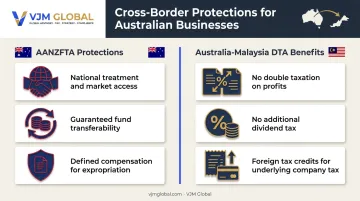
The ASEAN-Australia-New Zealand Free Trade Agreement gives Australian businesses national treatment and market-access commitments across most sectors. It also adds investment protections, including guaranteed fund transferability and defined compensation terms if expropriation occurs.
On top of that, the Australia-Malaysia Double Taxation Agreement matters more than most founders realise. Under the treaty:
- Business profits are only taxed in Malaysia if attributable to a Malaysian permanent establishment
- Dividends paid to an Australian resident carry no additional Malaysian dividend tax
- Australia generally credits Malaysian tax paid, including underlying company tax when an Australian company holds 10%+ voting power
That's confirmed directly in the ATO's synthesised treaty text. In plain terms: you're not paying tax twice on the same dollar.
The Cost Gap Is Real
Kuala Lumpur is dramatically cheaper to operate in than Sydney, Melbourne, or Singapore. Numbeo's 2026 mid-year Cost of Living Index makes the gap clear:
| City | Cost of Living Index |
|---|---|
| Singapore | 90.8 |
| Sydney | 79.2 |
| Melbourne | 77.3 |
| Kuala Lumpur | 38.8 |
Office rent in KL runs roughly RM6–RM11 per square foot per month. The national median formal-sector wage sits around RM3,167 monthly.
For an Australian founder used to Sydney commercial rents, that's a fraction of the burn rate.
English and Common Law: A Practical Head Start
Malaysia's legal system is built on English common law and equity, and English is widely used in business, government, and banking.
You won't be reading contracts through translation software or hiring a lawyer just to interpret basic terms. Bahasa Malaysia remains the official language, but for commercial purposes, English carries most of the weight.
Business Structures Available to Australian Entrepreneurs
Your choice of entity depends on one question: are you trading in Malaysia long-term, extending an Australian parent's operations, or just testing the water?
Private Limited Company (Sdn Bhd)
This is the default structure for foreign founders. The Companies Act 2016 doesn't impose a blanket foreign-ownership cap, and most non-regulated sectors permit up to 100% foreign equity.
There's one non-negotiable requirement: at least one director who ordinarily resides in Malaysia. This is a director rule, not a shareholder rule. You don't need a local shareholder or partner.
If you don't have someone based in Malaysia already, nominee director services fill that gap. Vet the arrangement properly, since that director carries statutory duties under Malaysian law.
Branch Office
A branch operates as a direct extension of your Australian company rather than a separate Malaysian legal entity. That means:
- Your Australian parent company bears full liability for the branch's obligations
- Registration fees apply to the parent foreign company, not a new local entity
- Better suited to short-term market entry than long-term operations
Representative Office
This option is deliberately restrictive. A representative office can conduct market research, feasibility studies, and liaison work, but it cannot sign contracts, earn revenue, or trade.
Funding must come entirely from outside Malaysia, and MIDA's benchmark for operating expenditure sits at a minimum of RM300,000 per year. Think of it as a scouting mission, not a business.
LLP and Restricted Entities
A Limited Liability Partnership blends partnership flexibility with liability protection, but it requires a compliance officer who is a Malaysian citizen or permanent resident, ordinarily based locally. Registration costs RM500.
Sole proprietorships and conventional partnerships aren't available to you at all as an Australian without Malaysian PR status. These structures are restricted to citizens and permanent residents, full stop.
Step-by-Step: How to Register Your Business in Malaysia
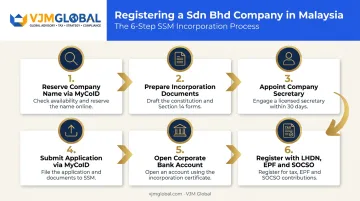
Incorporating an Sdn Bhd follows a fairly linear path through SSM, Malaysia's Companies Commission.
Reserve your company name via the MyCoID 2016 portal. Reservation costs RM50 per 30-day block, extendable up to a maximum of 180 days. You can also skip reservation and incorporate directly.
Prepare your incorporation documents. You'll need:
- Passport copies for all directors and shareholders
- Proof of your Australian residential address
- Statutory particulars (registered office, business activity, share structure)
- Signed director consent and non-disqualification declarations
Appoint a licensed Malaysian company secretary within 30 days of incorporation. This is a statutory deadline, and the role is separate from your resident director.
Submit your application through MyCoID. Incorporating a company limited by shares costs RM1,000 in government fees. SSM issues a registration notice automatically; a formal certificate is optional and costs an extra RM20 if you want one.
Open a corporate bank account. Banks like Maybank require certified constitutional documents, director passports, the incorporation notice, board resolutions, and typically a minimum opening deposit around RM1,000. Some banks allow partial online setup, though most still expect a director to appear for identity verification.
Register with LHDN for a tax identification number. Companies incorporated through MyCoID often receive this automatically. If you're hiring staff, complete EPF registration within 7 days of becoming liable and SOCSO registration within 30 days of your first hire.
Costs, Capital Requirements & Taxation for Australian-Owned Companies
What Incorporation Actually Costs
Government fees are modest on their own:
- Name reservation: RM50 per 30 days
- Sdn Bhd incorporation: RM1,000
- Optional certificate: RM20
- Foreign branch registration: RM5,000 to RM70,000, depending on authorised share capital
Professional fees for a company secretary, registered office, and incorporation support sit on top of those figures. They are quote-based, not fixed by SSM, so budget them as separate line items—the RM1,000 government fee is not your total cost.
Paid-Up Capital: Legal Minimum vs. Practical Reality
The Companies Act does not set a universal paid-up capital minimum for incorporation. Practical thresholds still apply once visas and licences enter the picture:
- Employment Pass (100% foreign-owned company): RM500,000 paid-up capital under MIDA's current guideline
- Key post designation: RM1 million
- Banks and licensing bodies: capital levels that show genuine operating intent, not just the legal floor
Corporate Tax Rates
Malaysia's general corporate tax rate for resident and non-resident companies is 24%.
Reduced SME rates—15% on the first RM150,000 and 17% up to RM600,000—apply only if paid-up capital is RM2.5 million or less and foreign ownership does not exceed 20%. Most Australian-controlled Sdn Bhd companies will not qualify, so plan around the standard 24% rate.
Two incentive programmes worth investigating (Malaysia Digital replaces the old MSC framework):
- Pioneer Status: five-year partial exemption for qualifying manufacturing; only 30% of statutory income is taxed
- Malaysia Digital status: 0% tax on qualifying IP income and reduced rates on non-IP income for 10 years (minimum paid-up capital RM50,000)
Visas & Work Passes: Living and Working in Malaysia as an Australian
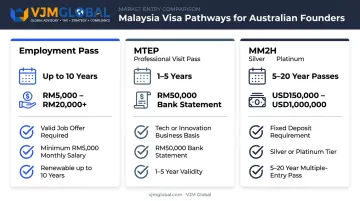
If you want to relocate rather than run things remotely, three pathways stand out.
Employment Pass
This is the standard route for founders who want to work inside their own Malaysian company. Salary thresholds determine your category:
| Category | Monthly Salary | Pass Duration |
|---|---|---|
| Category I | RM20,000+ | Up to 10 years |
| Category II | RM10,000-RM19,999 | Up to 10 years (with succession plan) |
| Category III | RM5,000-RM9,999 | Up to 5 years (with succession plan) |
Eligibility also depends on your company's paid-up capital: generally RM500,000 for a fully foreign-owned entity, and RM1 million for key-post designations.
Malaysia Tech Entrepreneur Programme (MTEP)
Better suited to founders without deep capital reserves.
- New entrepreneurs: one-year Professional Visit Pass
- Established founders: up to a five-year pass
- Typical MDEC ask: three months of personal bank statements showing at least RM50,000
- Programme fee: from around RM2,700
Malaysia My Second Home (MM2H)
This is a lifestyle-driven, longer-term residency option rather than a business visa. Revised tiers require fixed deposits plus minimum property purchases:
- Silver: USD 150,000 deposit, 5-year pass
- Platinum: USD 1 million deposit, 20-year pass
Only the Platinum tier permits business ownership and work directly. Silver and Gold are largely residency-only.
Overcoming Challenges: Why Work with Cross-Border Experts
Three problems trip up Australian founders more than anything else:
- Finding a resident director who's reliable, properly vetted, and understands their statutory liability under Malaysian law
- Sector-specific ownership restrictions that aren't obvious from a general "100% foreign ownership allowed" headline
- Bank due diligence, where KYC requirements and in-person verification expectations vary by institution and catch founders off guard
None of these are insurmountable, but they're exactly the kind of detail that generic guides gloss over and local Malaysian professionals handle daily.
You still need the Australian side handled with the same care. Cross-border specialists keep the parent company's reporting, DTA claims, and ATO obligations aligned with what the Malaysian entity is doing on the ground.
VJM Global has worked with 250+ Australian businesses on cross-border entity formation, accounting, and tax compliance. That work includes structuring AU parent reporting, filing DTA claims correctly, and keeping both jurisdictions' statutory calendars in sync.
Coordination between two tax authorities is where founders most often make expensive mistakes. Get a second opinion before you sign anything.
Frequently Asked Questions
Can foreigners start a business in Malaysia?
Yes. Malaysia is open to foreign investment, and most sectors permit full foreign ownership through a Private Limited Company structure. A handful of regulated industries carry sector-specific ownership limits.
How much does it cost to start a company in Malaysia?
Government incorporation fees start at RM1,000, plus RM50 for name reservation. Add company secretary and registered office fees, and factor in paid-up capital of RM500,000+ if you're pursuing an Employment Pass.
What business can a foreigner do in Malaysia?
Tech, consulting, trading, and e-commerce businesses generally allow 100% foreign ownership. A small number of regulated sectors, such as certain financial services, require a local partner or licence conditions.
Is Malaysia a good place to start a business?
Malaysia offers low operating costs, a common law legal system, and strong ASEAN market access through agreements like AANZFTA. For Australian founders testing Southeast Asia, it's a lower-risk entry point than most regional alternatives.
Do Australians need a local partner to own a Malaysian company?
No. Most sectors allow full foreign ownership without a local shareholder. What's required instead is a Malaysia-resident director, which is a role, not an ownership stake.
Can I run my Malaysian business remotely from Australia?
Day-to-day operations can be managed remotely. The company must still maintain a resident director and a registered physical address in Malaysia at all times, regardless of where you're based.