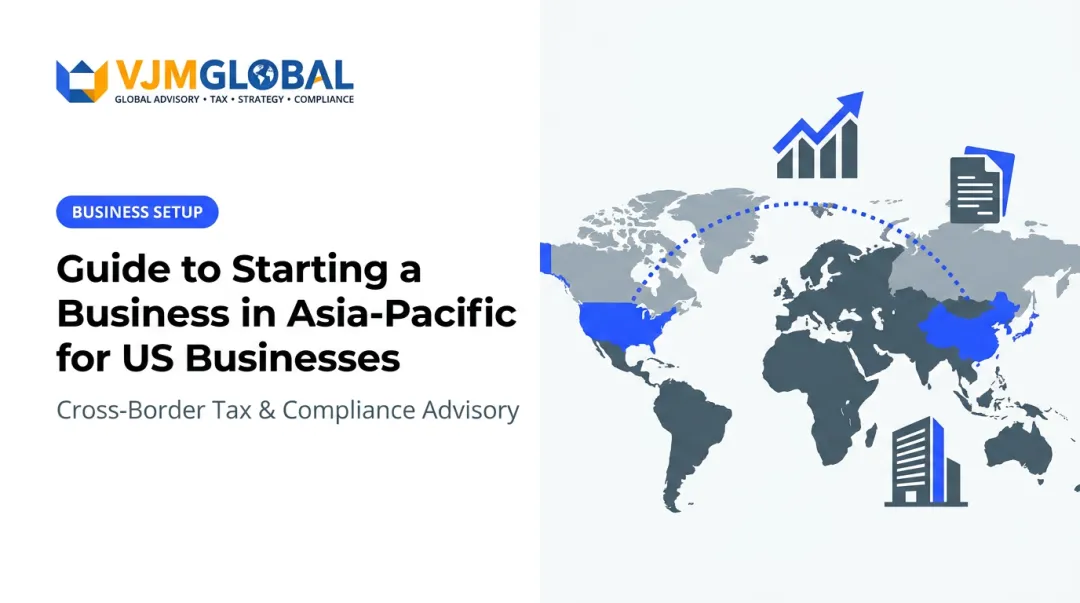
Many US founders and finance leaders struggle with a basic question: which country, which entity, and what happens to the tax treaty situation? The IMF projects Asia-Pacific will drive about 60% of global growth in 2025, continuing at a similar pace through 2026 — a pull too strong to ignore.
This guide walks through country selection, entity structures, the actual setup steps, tax and repatriation basics, and the mistakes that trip up US companies most often.
Key Takeaways
- APAC offers growth and talent, yet Singapore, Hong Kong, India, and Australia each apply different entity and tax rules
- Subsidiaries are the most common low-liability entry path; branches and liaison offices carry more exposure
- Choose a country on market fit and US tax treaty status, not headline tax rates alone
- Country-specific professional support lowers compliance risk and shortens time to market entry
Why US Companies Are Expanding into Asia Pacific
US companies expanding into Asia Pacific are chasing capability at scale, not labor arbitrage alone. India alone now hosts over 1,700 Global Capability Centers (GCCs), generating $64.6 billion in revenue and employing 1.9 million professionals, according to Nasscom/Zinnov data. That's a scale of engineering and operations talent few other regions can match.
Cost still matters, though. Nasscom's own benchmarking shows:
- 20-30% lower salary costs in India's non-metro cities compared to major hubs
- 40-50% lower real-estate costs outside metro centers
- Comparable cost gaps in Vietnam and the Philippines for support and back-office roles
Common use cases driving US expansion into APAC:
- Global Capability Centers for shared engineering, finance, and analytics work
- SaaS customer support and technical operations
- Manufacturing and sourcing partnerships
- Regional headquarters coordinating ASEAN or broader APAC sales
None of this works, though, without picking the right country first, and that decision is more nuanced than most founders expect.
Choosing the Right APAC Country for Your Business
Tax rate alone is a poor filter. The better questions are: where's your target market, does the US have a tax treaty with that country, and does the local ecosystem fit your industry?
Comparing the Major APAC Hubs
| Market | Strength | Tax Treaty with US? |
|---|---|---|
| Singapore | 17% corporate tax, English-speaking, ASEAN gateway | No |
| Hong Kong | China access, territorial tax (only local-source profit taxed) | No |
| India | Deepest talent pool, large domestic market | Yes |
| Australia | Transparent regulation, established legal system | Yes |

This treaty distinction matters more than people assume. The IRS's list of US tax treaty countries includes Australia, India, Japan, and Korea — but not Singapore or Hong Kong. That absence changes how withholding tax and permanent establishment risk get calculated on cross-border payments.
Other factors worth weighing:
- Free trade agreements and special economic zones that reduce duties or import costs
- Infrastructure quality: Singapore, Hong Kong, and Tokyo are consistently easier to operate in than emerging markets in the same region
- Sector-specific incentives (fintech in Singapore, manufacturing zones in Vietnam, Global Capability Center (GCC) incentives in certain Indian states)
A US SaaS company targeting ASEAN customers might pick Singapore for its predictability. A company building an engineering GCC will likely land in India regardless of the treaty complexity, because the talent pool justifies it.
Entity Structures and Step-by-Step Setup Process
Most US companies choose between five structures:
- Wholly-owned subsidiary — separate local legal entity, limits parent liability
- Branch office — extension of the US parent, less liability protection
- Liaison/representative office — for market research only, cannot generate revenue
- Joint venture — shared ownership with a local partner
- Acquisition — buying an existing local business
Subsidiaries dominate for a simple reason: they cap liability at the local entity. They also simplify tax reporting compared with a branch, which is treated as an extension of the US parent.

The Typical Setup Sequence
- Decide the entity structure based on liability tolerance and tax goals
- Reserve a company name and file incorporation documents with the local regulator
- Obtain director and shareholder identification — rules differ by market (Singapore needs an ordinarily resident director; India needs a DIN and Digital Signature Certificate)
- Open a local bank account for capital remittance and operations
- Remit capital and complete any required regulatory reporting
That last step deserves its own warning. In India, inbound equity capital must be reported to the Reserve Bank of India via Form FC-GPR within 30 days of share issuance, and no later than one year from incorporation. Miss it, and you're dealing with a Late Submission Fee mechanism the RBI introduced specifically for these delays.
Before commencing operations, most jurisdictions also require sector-specific licensing — food business licensing in India (FSSAI), import-export codes, or industry permits depending on what you're doing.

VJM Global's cross-border team supports entity formation and registration in India and Singapore for US businesses. Work runs through each market's own regulators—the Registrar of Companies and RBI in India, ACRA and IRAS in Singapore—not a single generic template.
Tax, Compliance and Repatriation Considerations
Once the entity exists, the real work starts: tax obligations, transfer pricing, and getting money back to the US parent without losing a chunk of it to withholding tax.
Withholding Tax Realities
- Singapore: 15% withholding on gross interest paid to a non-treaty recipient, 17% on service fees performed locally, per IRAS
- Hong Kong: Territorial system leaves foreign-source profits untaxed; domestic non-resident withholding still applies to certain payments
- India: Section 195 baseline 20% on dividends and royalties; US-India treaty can reduce this with proper documentation
- Australia: ATO lists 10% on interest, 30% on unfranked dividends and royalties, with treaty relief available
Transfer Pricing and Ongoing Filings
Intercompany royalties, management fees, and loans between the US parent and the APAC subsidiary need arm's-length documentation. Filing triggers differ by market:
- Singapore: Required once revenue crosses S$10 million
- Hong Kong: Master and local files due within nine months of period close
Repatriation Paths
How profits typically move back to the US parent—and how they're taxed:
- Dividends — subject to withholding, often reduced by treaty
- Royalties — frequently the highest-scrutiny category for transfer pricing
- Management fees — must reflect real services rendered
- Interest on intercompany loans — subject to thin capitalization rules in some markets

Ongoing Local Compliance
Tax is only one track. Plan for:
- Statutory audits and annual registrar filings
- Payroll and employment-law compliance
- Beneficial ownership disclosures in several markets
Common Mistakes and Challenges When Expanding to APAC
Even well-funded US companies stumble on predictable things.
- Sending capital before confirming FDI approval: in India, moving funds before Foreign Exchange Management Act (FEMA) reporting is cleared creates real regulatory exposure
- Missing reporting deadlines: India’s FC-GPR filing (post-investment FDI reporting) has a hard 30-day window, and penalties compound quickly
- Underestimating cultural and language barriers: filings in India or Vietnam often stall without a local partner who knows the real paperwork path, not just the published checklist
- Treating APAC as one market: rules and infrastructure differ sharply between Singapore and rural manufacturing zones elsewhere in Southeast Asia
One quieter mistake is assuming an Employer of Record solves everything. An EOR lets you hire compliantly without incorporating, but it does not replace an entity when you need local invoicing, IP ownership, or a regulated licence in-market.
How VJM Global Supports US Companies Expanding into Asia Pacific
VJM Global brings 30+ years of experience in tax, audit, and cross-border advisory. The firm delivers entity formation, accounting, and compliance across 100+ countries, with dedicated capability in India and Singapore for US businesses entering those markets.
What this looks like in practice:
- Entity structuring and registration filed with the correct local regulator: the Registrar of Companies and RBI in India, ACRA and IRAS in Singapore
- FEMA/FDI advisory for US companies remitting capital into India, including FC-GPR filing support
- Employer of Record services that let US companies hire compliantly in APAC markets without incorporating first
- Ongoing bookkeeping, statutory audit, payroll, and ROC/GST filing support once the entity is live
US clients including Incubit GBS have used VJM Global to manage Indian accounts and related compliance, so internal teams can stay focused on operations. You get a team that works with each market's own statutory instruments—not a one-size-fits-all playbook.
Frequently Asked Questions
Which country is best to set up business?
There's no universal answer. It depends on your target market, industry, and US tax treaty status. Singapore, Hong Kong, and India are the leading APAC options, each suited to different business goals.
What is the cheapest country to start a business?
India and Vietnam generally offer lower incorporation and operational costs than Singapore or Hong Kong. Total cost still depends heavily on your ongoing compliance needs.
What is the most common way for a US company to enter an APAC market?
Incorporating a local subsidiary is the most common structure. It limits liability and is generally simpler to manage than a branch office.
Do US companies need a local bank account to operate in Asia Pacific?
Yes, in nearly all cases. A local bank account is typically required early on for capital remittance and day-to-day operations.
How long does it take to register a company in Asia Pacific from the USA?
It varies widely. Hong Kong can issue an electronic certificate within an hour. Singapore often clears simple filings quickly, though complex cases can take up to 15 working days. India's timeline depends on documentation readiness.
Are there tax treaties between the US and APAC countries?
Yes for some, no for others. India, Australia, Japan, and Korea have US tax treaties; Singapore and Hong Kong do not, which changes how withholding tax and permanent establishment risk apply.