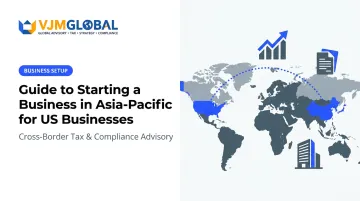
For commercial purposes, "Asia-Pacific" spans East Asia (China, Japan, South Korea), Southeast Asia (Singapore, Vietnam, Indonesia, Malaysia), South Asia (India, Bangladesh), and Oceania (Australia, New Zealand). Each has its own rulebook.
That's the catch. US businesses expanding into APAC face 40-plus distinct regulatory, tax, and cultural environments, and there's no shortcut around that complexity. This guide breaks down the opportunities, the real challenges, a practical setup roadmap, the strongest country options, and where specialist advisory support can save you time and risk.
Key Takeaways
- APAC's consumer base and capital flows are expanding faster than most Western markets
- The biggest barrier to entry is regulatory variance, not market demand
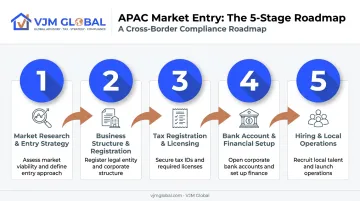
- Setup typically follows five stages: research, registration, tax compliance, banking, and hiring
- Singapore, Hong Kong, India, and Australia each solve a different business problem
- Each destination pairs its own mix of talent cost, market size, and FDI momentum - the right fit depends on your goals
Why US Businesses Should Expand to Asia-Pacific
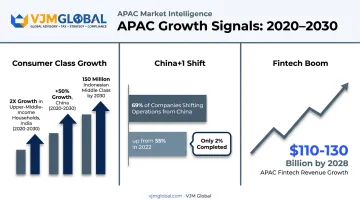
The math behind APAC expansion starts with consumers. Upper-middle-income households (those earning $22,000 to $80,000 in 2011 PPP terms) are forecast to double in India and grow nearly 50% in China between 2020 and 2030, per McKinsey's research on Asia's consumer map. Indonesia's middle class alone is projected to hit 150 million people by 2030.
Tax Incentives Worth Knowing
Several APAC governments actively compete for foreign capital. Singapore offers a Pioneer Certificate exemption or a Development and Expansion Incentive rate of 5% or 10% (versus the standard 17%), typically for an initial five-year period, subject to approval. India takes a similar approach with its Production Linked Incentive (PLI) scheme, which covers 14 sectors with an outlay of ₹1.97 lakh crore, aimed squarely at manufacturers relocating supply chains.
The China+1 Shift Is Real, But Incomplete
Companies are diversifying around China rather than abandoning it outright. In a 2024 Bain survey, 69% of companies reported shifting operations out of China, up from 55% in 2022. Yet only 2% had actually completed the reshoring process. That gap is the opportunity. Early movers into Vietnam, India, and Malaysia are securing supplier relationships before the crowd arrives.
Sector-wise, fintech is a standout. McKinsey projects APAC fintech net revenue to roughly double, reaching $110-130 billion by 2028, an implied CAGR near 12%. Manufacturing, IT/BPO, and e-commerce are seeing similar momentum, particularly in markets offering both scale and cost efficiency.
Challenges US Businesses Face When Entering APAC
Regulatory frameworks vary enormously across the region: Singapore allows a foreign parent company to hold 100% ownership of a local subsidiary, with no local partner required. India, by contrast, permits 100% FDI through the automatic route in most sectors, but retains sectoral caps and government-approval requirements for retail, defense, and select industries.
Beyond the regulations, cultural friction is just as easy to underestimate: negotiation pace, hierarchy expectations, and hiring norms differ sharply between markets. Budget extra time for relationship-building in your target market before pushing for contract terms, since rushing this step tends to backfire.
Then there's the money.
- Transfer pricing: Singapore requires contemporaneous documentation once gross revenue exceeds S$10 million, with a 5% surcharge on adjustments
- Double taxation: A US tax treaty with your target market can help, but US corporations still need Form 1118 to claim foreign tax credits, and permanent-establishment rules still apply
- Repatriation: Currency controls and central bank approval requirements can delay profit transfers out of the destination country if structures aren't set up correctly from day one
None of this is insurmountable, but missteps here cost far more to fix than to prevent. Most US businesses solve this by bringing in local tax and legal expertise before completing incorporation, not after.
Step-by-Step Guide to Starting a Business in APAC
Specifics vary by country, but the sequence stays fairly consistent. A local advisor familiar with country-specific nuances will save you far more time than it costs.
Complete these five steps in order:
Conduct market research and choose an entry strategy. Evaluate demand and competition, then choose your vehicle: wholly-owned subsidiary, joint venture, branch office, or distributor arrangement. The right call depends heavily on the target country's foreign investment rules; some sectors simply won't allow full ownership.
Select a business structure and register your entity. Common structures include Private Limited companies, LLPs, and branch offices, though naming conventions vary by market. Several markets, including Singapore, Australia, and India, require a locally resident director or registered agent as a legal prerequisite for incorporation, not just recommended practice.
Complete tax registration and regulatory licensing. GST or VAT registration, corporate tax registration, and sector-specific licenses all need to happen before you can legally invoice customers, and compliance deadlines carry real teeth. Late filing penalties in many APAC markets can be steep and cumulative. Firms like VJM Global handle these filings for clients entering the Indian market, reducing that risk.
Open a local bank account and set up financial systems. Nearly every APAC jurisdiction requires a local business bank account before you can operate, and some markets also impose minimum capital requirements. Setting up compliant bookkeeping systems from day one, rather than retrofitting them later, avoids messy reconciliations down the road.
Hire talent and establish local operations. Local employment law compliance and payroll setup come last but matter most for day-to-day operations. As a budgeting benchmark, India's corporate salary increases are projected to hold at 9.5% for 2025, according to a WTW survey of 1,414 companies, so factor that escalation into multi-year staffing budgets, not just year-one costs.
Best Asia-Pacific Countries for US Businesses to Start In
There's no single "best" country. It depends on your industry, budget, and target market. A fintech startup and a manufacturing exporter will land in very different places.
Singapore
Singapore's flat 17% corporate tax rate, 100% foreign ownership allowance, and English-speaking workforce make it the default regional hub. It ranked 1st in the 2026 IMD World Competitiveness Ranking. Best suited for companies that need a regional headquarters, not necessarily direct consumer access.
Hong Kong
Hong Kong charges no capital gains tax and operates a simple two-tier profits tax (8.25% on the first HK$2 million, 16.5% above it). Its main draw is proximity: a genuine gateway to mainland China for trade-focused US businesses that need logistics and banking access without mainland complexity.
India
India combines a massive consumer market with manufacturing incentives through the PLI (Production Linked Incentive) scheme and multiple entry structures, including Private Limited Company, LLP, and Branch/Liaison Office. For US companies chasing cost-effective operations and skilled, English-speaking talent, this market is hard to overlook.
Australia
Australia offers a transparent regulatory environment and a straightforward registration process through ASIC and the Business Registration Service. A proprietary limited company filing runs around A$636. Rule of law here is strong, making Australia a lower-risk entry point, particularly for services-oriented US businesses.
Why India Stands Out as a Strategic APAC Entry Point for US Businesses
India's numbers back up the hype. Total FDI inflow reached $81.043 billion in FY2024-25, up 14% year-over-year from $71.279 billion, according to India's Department for Promotion of Industry and Internal Trade. That's real capital voting with its feet.
The catch: India's regulatory landscape is uniquely layered, with several overlapping systems to track:
- FEMA rules govern foreign exchange and repatriation
- GST applies across goods and services
- TDS obligations hit payroll and vendor payments
- Corporate tax slabs vary by entity type and turnover
Getting any one of these wrong isn't a minor paperwork issue; it can trigger penalties or stall your entity's ability to operate.
This is where specialized local expertise stops being optional.
VJM Global has spent over 30 years navigating exactly this terrain, working with a dedicated team of CPAs, Chartered Accountants, and US-compliant professionals who understand both Indian regulatory frameworks and US GAAP requirements. The firm has helped 500+ American businesses set up and operate in this market, covering:
- Entity structure selection and FDI policy guidance
- Full incorporation support, from digital signatures to Certificate of Incorporation
- GST, TDS, and corporate tax compliance
- FEMA advisory for capital inflows and repatriation
- Ongoing accounting, payroll, and back-office support

If you're weighing this market against Singapore or Australia, that regulatory complexity shouldn't be the deciding factor against a market this large. Consult VJM Global's team for personalized guidance on structuring your India market entry correctly from the start.
Frequently Asked Questions
Which country is the best for startup in Asia?
It depends on your industry, budget, and goals. Singapore suits regional headquarters, Hong Kong suits China-adjacent trade, and India suits companies chasing scale and cost-effective talent.
Can a foreigner set up a company in Malaysia?
Yes, foreigners can incorporate as a Sdn Bhd (private company limited by shares). Requirements include a registered local address and, in most cases, a director who is ordinarily resident in Malaysia.
What is the Asia Pacific region for business?
APAC covers East Asia, Southeast Asia, South Asia, and Oceania. Under the UN ESCAP definition, it represents roughly 60% of the world's population and a major share of global GDP.
How much does it cost for a US company to start a business in APAC?
Costs vary widely by country and structure. Lower-cost markets like Malaysia and Vietnam contrast sharply with higher-cost markets like Japan and Australia, where registration, office setup, and compliance fees run considerably higher.
Do I need a local partner or director to start a business in an APAC country?
Requirements vary by country. Singapore, Malaysia, and Australia require a locally resident director, while some jurisdictions allow full foreign ownership without any local partner requirement.
What business structure should a US company use to enter the Indian market?
Common options include a Private Limited Company, LLP, or Branch/Liaison Office. A Private Limited Company is typically preferred since it offers the most operational flexibility for growing businesses.