It's no surprise that UK entrepreneurs are looking elsewhere. Dubai offers zero personal income tax, incorporation that can happen in days rather than months, and a launchpad into the Middle East, Africa and South Asia. This isn't just a large-corporate trend either. Freelancers, established SMEs looking to diversify, and multinational firms scouting a UAE base are all asking the same question.
Starting a business in Dubai from the UK means incorporating and licensing a UAE entity — one you can run remotely or relocate to manage in person. This guide walks through the structures, real costs, UK tax traps, and the actual registration process.
Key Takeaways
- Setup timelines range from a few days to around four weeks, depending on jurisdiction and structure
- Free Zone gives 100% foreign ownership but restricted market access; Mainland gives full UAE access
- Basic setup costs start from a few thousand pounds, rising with visas and office space
- Staying UK tax resident or controlling the company from the UK can still trigger HMRC liability
- Early advice on structure, banking and cross-border tax reduces delays and compliance risk
Why UK Entrepreneurs Are Choosing Dubai Right Now
Dubai isn't automatically the right move for every UK business. It suits companies that benefit from lower tax, faster incorporation, or direct access to the Middle East and Africa. If your customers are entirely UK-based, the calculation looks different.
The UK Cost Pressure Is Real
Beyond the £25 billion compliance bill mentioned earlier, larger UK companies face a 25% Corporation Tax rate on profits over £250,000. Combine that with rising business rates and employer National Insurance, and the maths starts to shift for founders deciding where to expand next.
Dubai's Tax Position Is Genuinely Different
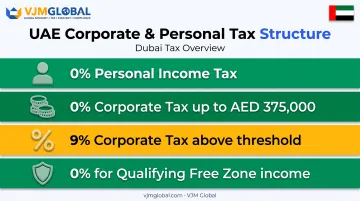
- 0% personal income tax on salary or dividends drawn as an individual
- 0% corporate tax on taxable income up to AED 375,000
- 9% corporate tax only on profits above that threshold
- Qualifying Free Zone entities can retain 0% on qualifying income if conditions are met
Faster End-to-End Setup
Some Free Zones now issue licences in under an hour for straightforward activities, while others run closer to 10 working days once documents are complete. UK company registration typically takes about 24 hours online, so Dubai isn't always faster on paper. Its approvals and visa process often move quicker end-to-end for founders relocating operations.
Market Access and Sector Fit
The UK Department for Business and Trade confirms that more than 5,000 British companies already operate in the UAE, including BP, Rolls-Royce and HSBC. Dubai's DIFC free zone runs on English common law principles. That makes it a natural fit for UK financial services, consultancy and professional services firms already familiar with those legal terms.
What to Know Before You Start: Structures, Costs and UK Tax Rules
Incorporating in Dubai is genuinely straightforward. Staying UK tax-efficient afterwards is the part most UK entrepreneurs get wrong.
Choosing Your Structure
| Structure | Ownership | Market Access | Best For |
|---|---|---|---|
| Free Zone company | 100% foreign-owned | Restricted to free zone/international trade | Consultants, e-commerce, exporters |
| Mainland LLC | 100% foreign-owned (activity-dependent) | Full UAE domestic market | Businesses selling directly in the UAE |
| Branch of UK company | 100% parent-owned | Same activities as parent | Firms extending an existing UK entity |
Free Zone forms include the FZE (single shareholder) and FZCO (2-50 shareholders). A Mainland LLC needs sector-specific approvals depending on the activity, and a branch keeps your UK company intact while trading under a separate UAE licence.
Licence type follows activity, not preference. Commercial, Professional and Industrial licences each unlock a different set of permitted activities, so nail down what you're actually doing before choosing a jurisdiction.
What It Actually Costs
Typical cost patterns:
- Free Zone packages: often from a few thousand pounds for a basic licence and single visa
- Mainland setups: usually higher once you add office space and local approvals
- Renewals: often run 80-90% of your initial setup cost, not a fraction of it
Budget for that recurring bill, not just the first invoice.
The UK Tax Reality Check
This is where relocation plans fall apart. If you still live in the UK and make the real decisions from here, HMRC can still treat your Dubai company as UK tax resident under Central Management and Control rules. The test looks at where control actually happens, not where the certificate was issued or where board meetings are formally minuted.
Two other UK-side triggers to flag before you finalise anything:
- UK VAT registration: there's no threshold exemption for non-established businesses making taxable UK supplies — registration can apply from the first pound of qualifying sales
- Exit charges: migrating an existing UK company can trigger a UK Corporation Tax charge on unrealised gains under TCGA 1992 s.185
Get a cross-border tax adviser such as VJM Global involved before you sign anything in Dubai, not after.
How to Start a Business in Dubai from the UK – Step by Step
Once your structure and tax position are settled, registration becomes a documentation and approvals process. It runs alongside your visa and banking applications rather than after them.
Common mistakes worth avoiding upfront:
- Picking a Free Zone purely on advertised price, then discovering it doesn't cover your actual activity
- Submitting UK documents without proper attestation
- Leaving the bank account application until after the licence is already issued
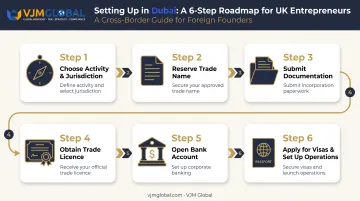
Choose your business activity, jurisdiction and legal structure Your core activity determines which licence type and jurisdiction you qualify for. Decide between Free Zone, Mainland or Offshore based on one question: where are your actual customers, and do you need direct UAE market access to reach them?
Reserve a trade name and apply for initial approval Trade names must avoid religious or political references and may need an Arabic translation. Submit your initial approval application with a business plan and passport copies to your chosen Free Zone authority or the Department of Economic Development.
Prepare and submit your documentation Gather passport copies, your Memorandum of Association, and office lease or Ejari documents. If you're migrating an existing UK entity, those UK-issued documents need attestation through UAE consulates. Start this early: attestation delays are the most common holdup for UK applicants specifically.
Obtain your trade licence Once documents clear approval, pay the licensing fee and receive your trade licence. Standard cases often process within one to two weeks. Confirm precisely what your licence permits, particularly if you're a Free Zone entity that might want mainland access down the line.
Open a corporate bank account Approach UAE banks with your trade licence and MOA in hand. Shareholders or signatories are frequently required to attend in person. Expect thorough KYC/AML checks; UAE banks scrutinise newly formed, foreign-owned companies closely.
Apply for visas and set up operations Apply for your own residency visa first, then family and employee visas as needed. Arrange mandatory employee health insurance and finalise your office or warehouse space before you start trading.
How VJM Global Supports UK Businesses Expanding to Dubai
Paperwork alone will not protect you. Your UAE structure and UK tax position need to work together, or you risk a liability HMRC flags eighteen months later.
VJM Global has worked with 250+ UK businesses, delivering entity formation and compliance support that spans both sides of the setup:
- UAE entity formation: Mainland LLC, Free Zone (including DMCC, JAFZA, DIFC, ADGM and RAKEZ) and offshore structures
- Corporate tax and VAT compliance: Federal Tax Authority registration, UAE Corporate Tax filings, and ongoing VAT support
- Accounting, bookkeeping and payroll: day-to-day financial management once you're trading, including Wages Protection System compliance
- UK-side advisory: residency questions, Central Management and Control exposure, and exit-charge implications for anyone migrating an existing UK company

VJM Global ties each UAE setup decision to your UK tax position before you commit, so the two sides stay aligned instead of needing to be untangled later.
Conclusion
Starting a business in Dubai from the UK is mostly procedural: paperwork is clear, timelines are reasonable, and the tax environment genuinely favours certain business types. What matters longer term is keeping your structure, licensing and UK tax position aligned for years—not only the first six months.
Getting Free Zone versus Mainland right, budgeting for realistic renewal costs, and understanding your actual UK tax exposure matter far more than how fast your licence arrives. Speed is nice. Getting it right the first time is what actually saves money.
Advisers who cover both UAE licensing and UK tax exposure reduce the chance of a costly restructuring later. VJM Global helps UK businesses with Dubai entity formation, ongoing compliance and cross-border tax alignment so the setup stays sound well beyond day one.
Frequently Asked Questions
How much does it cost to start a business in Dubai from the UK?
Free Zone setups typically start from a few thousand pounds for a basic licence and one visa. Costs rise sharply with extra visas, office space and the activity you're licensed for.
Can a UK citizen start a business in Dubai?
Yes. UK citizens can own up to 100% of many Free Zone and Mainland businesses, registered either online or in person, depending on the jurisdiction chosen.
What business can I start in Dubai with 50,000 AED?
That budget generally covers a Free Zone licence for consultancy, trading, e-commerce or professional services with modest visa needs. Final cost still depends on your activity and the jurisdiction’s fee schedule.
Do I still have to pay UK tax if I move my business to Dubai?
It depends on your residency status and where the company is actually controlled from, not just where it's registered. Staying UK-resident and running the business from home can still trigger HMRC liability.
Is it quick and easy to set up a business in Dubai?
It can be. Many setups complete in a few days to around four weeks, but speed depends on your activity type and whether documents are correctly attested from the start.
Should a UK entrepreneur choose a Free Zone or Mainland company?
Free Zone suits international or free-zone trade with full foreign ownership. Mainland suits businesses that need full UAE market access. The right choice comes down to where your customers actually are.