The registration process itself is largely digital and quick. The real difficulty for UK founders isn't the paperwork, it's choosing the right jurisdiction and getting UK tax obligations right from day one.
This guide walks through the exact steps to register, your jurisdiction options, realistic costs, required documents, and the UK-specific tax rules that catch founders out.
Key Takeaways
- Free Zone licences typically issue in 5-10 working days, depending on document approval.
- Mainland, Free Zone, or Offshore is your biggest decision, shaping ownership, market access, and taxes.
- 100% foreign ownership applies to most Mainland and Free Zone activities, with few exceptions.
- UK tax residency rules and Central Management and Control still decide how Dubai profits are taxed.
- Professional guidance prevents the delays and tax missteps that trip up first-time founders.
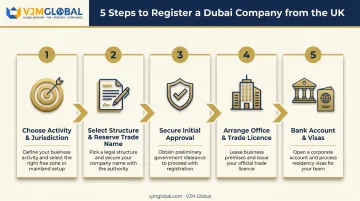
Step-by-Step: How to Register a Company in Dubai from the UK
Step 1: Choose Your Business Activity and Jurisdiction
Dubai's official investment portal lists over 2,000 approved business activities, each falling under a commercial, professional, or industrial licence category. Your activity choice isn't just administrative; it determines which jurisdiction you can even register in.
Not every activity is permitted in every Free Zone or Mainland setup. A consultancy might work fine as a Free Zone company, while a retail business needing UAE-wide trade will need a Mainland licence. Decide activity and jurisdiction together, not sequentially.
Step 2: Select Your Legal Structure and Reserve a Trade Name
UK founders typically choose from:
- LLC – for Mainland companies trading across the UAE
- Free Zone Establishment (FZE) or Free Zone Company (FZCO) – for single or multiple shareholders in a Free Zone
- Branch Office – for an existing UK company extending operations into Dubai
Once you've picked a structure, reserve your trade name. UAE rules require names to be distinct from existing brands, free of religious or political references, and reflective of your business activity. This approval locks in your name while you complete the rest of the setup.
Step 3: Secure Initial Approval and Prepare Legal Documentation
Initial approval is the government's confirmation that it has no objection to your business concept. It requires passport copies of all shareholders and directors, but it doesn't yet authorise trading.
At this stage, you'll also draft your Memorandum of Association (MOA), or a Local Service Agent agreement if your structure requires one. Some documents need notarisation before submission, so factor this into your timeline.
Step 4: Arrange Office Space and Apply for Your Trade License
Mainland companies must register a physical office through Ejari, Dubai's tenancy registration system. There's no way around this for a standard Mainland licence.
Free Zones are more flexible. Options range from flexi-desks to serviced or private offices, which suits UK founders managing operations remotely. DMCC, for instance, ties your visa quota to the workspace package you choose.
With your approved name, MOA, and lease documentation in hand, submit your trade licence application to Dubai's Department of Economy and Tourism (Mainland) or your chosen Free Zone Authority.
Step 5: Open a Corporate Bank Account and Apply for Visas
UAE banks including Emirates NBD, RAKBANK, and Mashreq will ask for your trade licence, MOA, and shareholder passport copies. Be realistic about timelines here: Emirates NBD's digital application route requires at least one UAE-resident signatory, and RAKBANK requires in-person Emirates ID verification for signature.
Non-resident account opening isn't a guaranteed quick process — it can take anywhere from a few days to several weeks depending on your bank's KYC review.
Once your company is registered, it becomes eligible to sponsor investor/partner and employee residence visas. A physical visit to Dubai is typically required for bank signing and visa biometrics, even if you plan to run the business remotely afterwards.
Choosing the Right Jurisdiction: Mainland vs Free Zone vs Offshore
Jurisdiction affects market access, ownership rules, tax exposure, and audit obligations. Get this decision right before you touch any paperwork.
Here's how the three options stack up on the factors that matter most:
| Factor | Mainland | Free Zone | Offshore |
|---|---|---|---|
| Foreign ownership | Up to 100% (few exceptions) | 100% | Not applicable (no local trading) |
| UAE trade access | Full access, incl. government contracts | Restricted (needs local distributor) | None |
| Physical office | Required | Flexi-desk/virtual options | Not required |
Mainland
Mainland companies can trade anywhere in the UAE and bid for government contracts. Most activities now permit 100% foreign ownership, though a small number of strategic-impact activities still carry restrictions.
The trade-off is compliance. You'll need a registered physical office, and LLCs or joint-stock companies must appoint an auditor for annual financial statements.
Free Zone
Dubai has more than 20 Free Zones, such as DMCC and DIFC (the official list changes periodically), each offering 100% foreign ownership, tax incentives, and a largely online setup process. The catch: Free Zone companies generally can't trade directly with the UAE mainland without appointing a local distributor.
Flexi-desk and virtual office packages make Free Zones the go-to choice for UK founders planning to run their business remotely, without relocating.
Offshore
Offshore companies (JAFZA being Dubai's main offshore registry) work best for holding assets, IP, or facilitating international trade. They can't trade within the UAE itself, but setup costs are relatively low and there's no local UAE tax on offshore income.
One thing worth flagging: if you're a consultant, agency, or freelancer simply invoicing Dubai-based clients remotely, you may not need a UAE entity at all. Many UK founders in this position keep operating through their existing UK company.
Costs and Documents You'll Need
Estimated Setup Costs
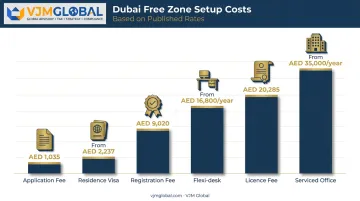
Costs vary widely by jurisdiction, activity, and authority. DMCC's published 2023 figures give a useful benchmark for Free Zone budgeting:
| Cost Item | Typical Range |
|---|---|
| Application fee | AED 1,035 (one-time) |
| Registration fee | AED 9,020 (one-time) |
| Licence fee | AED 20,285 (annual, varies by activity) |
| Flexi-desk | From AED 16,800/year plus deposit |
| Serviced office | From AED 35,000/year |
| Residence visa | From AED 2,237 (one year) |
(Source: DMCC official 2023 published rates)
Mainland setups generally cost more overall, mainly because of the mandatory physical office lease, Ejari registration, and additional government approval fees that Free Zones don't require.
Required Documents Checklist
Have these ready before you start:
- Passport copies of all shareholders and directors
- Trade name reservation certificate
- Memorandum of Association (MOA) and Articles of Association (AOA)
- Proof of address for shareholders
- No Objection Certificate (if a shareholder holds employment elsewhere in the UAE)
- Business plan (required by some Free Zones for specific activities)
If any shareholder already holds UAE residency, add their Emirates ID and entry stamp to the file.
Tax and Compliance: What UK Business Owners Must Know
Dubai charges 0% personal income tax, but since 2023 a federal Corporate Tax applies: 0% on taxable income up to AED 375,000, and 9% above that threshold (UAE Ministry of Finance). Free Zone companies can still access a 0% rate on "Qualifying Income," but only if they meet substance requirements and stay compliant. This isn't automatic tax-free status for every Free Zone entity.
Where UK Founders Get Caught Out
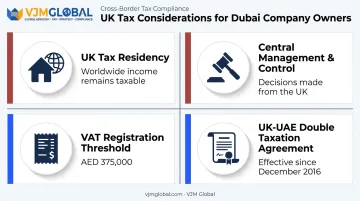
UK tax residents remain taxable on their worldwide income, including Dubai profits, regardless of where the company is incorporated. This holds true unless non-UK tax residence has been properly established under the Statutory Residence Test.
Two rules trip people up repeatedly. First, Central Management and Control: if key strategic decisions for your Dubai company are actually made from the UK, HMRC can treat it as a UK-resident company for tax purposes, regardless of where it's incorporated. Second, VAT registration becomes mandatory in the UAE once turnover exceeds AED 375,000.
The UK-UAE Double Taxation Agreement, in force since December 2016, helps prevent being taxed twice on the same income (GOV.UK, 2016 UK-UAE Double Taxation Convention). But eligibility depends heavily on your residency status and the type of income involved. It's not a blanket exemption.
Managing tax and accounting compliance across two jurisdictions is genuinely where most UK founders need expert support. VJM Global supports UK founders with the cross-border tax and compliance side of this, from UK Statutory Residence Test questions to the reporting obligations that come with running an overseas structure, so your UK tax position stays accurate as you expand.
Common Mistakes UK Entrepreneurs Make When Registering in Dubai
Watch for these recurring errors:
- Assuming Dubai is "fully tax-free" without factoring in UK tax residency and Central Management and Control rules, which can trigger an unexpected UK tax bill
- Choosing jurisdiction on cost alone without confirming it permits their specific business activity or intended market
- Skipping professional guidance on MOA drafting, which often leads to delayed applications or rejected trade name and activity approvals
- Underestimating physical presence requirements for bank signing and visa biometrics, which can delay actual trading by weeks
Most of these mistakes stem from treating Dubai registration as a purely one-sided decision. It isn't. Your UK tax position and your Dubai structure need to be planned together, not separately. Experienced cross-border tax and compliance advisors can help founders spot these gaps before they become expensive problems.
Frequently Asked Questions
Can a UK citizen set up a company in Dubai?
Yes. UK citizens can own up to 100% of most Dubai companies in both Mainland and Free Zone jurisdictions. Visiting to set up doesn't require a visa, but operating the business long-term typically means applying for a residency visa.
Is Dubai 100% tax free?
Personal income tax is 0%, but a 9% federal corporate tax applies above AED 375,000. UK residents also remain liable for UK tax on worldwide income unless non-residence is properly established.
Do I need a local sponsor or partner to register a company in Dubai?
Most Free Zone and Mainland activities now allow 100% foreign ownership. A local service agent is only required for a small number of regulated or strategic activities.
How long does it take to register a company in Dubai from the UK?
Free Zone licences can often be issued within 5-10 working days once documents are approved. Mainland setups usually take longer due to additional office registration and government approvals.
Do I need to relocate to Dubai to run my business?
No, many founders manage their Dubai company remotely from the UK. You'll still need a physical visit for bank account signing and visa processing. Staying a UK tax resident also affects how your profits get taxed.
Does the UK have a double taxation agreement with the UAE?
Yes, the UK-UAE Double Taxation Agreement has been in force since December 2016 and helps prevent being taxed twice on the same income. Eligibility depends on residency status and income type, so professional tax advice is worth getting early.