
For UAE-based entrepreneurs, the appeal is straightforward: a domestic market of over 100 million people, comparatively lower operating costs, and a location that bridges Africa, the Middle East and Europe.
Three groups are watching this corridor closely: UAE SMEs looking to diversify regionally, Egyptian expats in the UAE who want to invest back home, and GCC investors eyeing Egypt's free zones. This guide walks through entity structures, registration steps, realistic costs and the visa planning that founders often leave too late.
Key Takeaways
- UAE nationals can own up to 100% of most Egyptian companies under Investment Law 72/2017
- Match LLCs, JSCs, branches, representative offices, or free zones to your liability, capital, and activity needs
- GAFI is Egypt's single-window authority for registration, licensing and approvals
- Budget and timeline hinge on entity structure and how ready your documents are
- Visa and residency planning is a separate track that should start before, not after, incorporation
Why UAE Entrepreneurs Are Expanding Into Egypt Now
A Corridor Backed by Real Capital
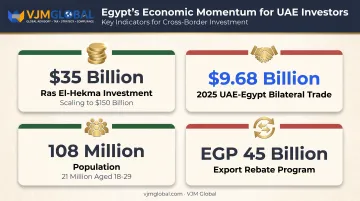
The Ras El-Hekma deal is Egypt's largest-ever direct investment agreement: an initial $35 billion, with room to reach $150 billion once fully implemented, according to Reuters.
That single agreement equaled more than three times Egypt's entire net FDI for the previous fiscal year.
Bilateral trade is following the same trajectory. Egypt-UAE trade exchange hit $9.68 billion in 2025, split between $6.99 billion in Egyptian exports and $2.69 billion in imports, according to Egypt's State Information Service. That is existing trade at scale, not a pipeline still on paper.
Scale, Demographics, and Trade Position
Egypt's population passed 108 million in 2025, with more than 21 million people aged 18-29 — a demographic that drives demand for retail, services and digital products. Beyond consumer numbers, Egypt sits at a genuine trade crossroads:
- Direct sea and land access connecting African, Gulf and European markets
- Suez Canal proximity for manufacturers and logistics-linked businesses
- Comparatively lower commercial real estate and staffing costs than most UAE metro markets
Egypt's floating exchange rate and its FY2025/26 Export Rebate Programme, budgeted at EGP 45 billion, also make export-focused manufacturing and outsourcing more attractive for UAE-based investors right now.
CEPA negotiations, still ongoing as of late 2025, are focused on textiles, engineering, chemicals, digital trade and services — a useful signal for where policy support is heading, even though the agreement isn't finalized yet.
Business Structures Available for UAE Investors in Egypt
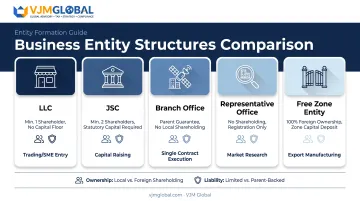
Structure choice depends on your ownership goals, planned activity, and your intended scale. Under Investment Law 72/2017, most sectors allow up to 100% foreign ownership. A handful of regulated activities still require Egyptian participation or prior approval, so it's worth checking your specific activity code with GAFI before committing.
| Structure | Minimum Requirement | Best Suited For |
|---|---|---|
| LLC | 2+ shareholders, generally no statutory minimum capital | Trading, services, SME market entry |
| JSC | 3+ shareholders, EGP 250,000 issued capital | Larger capital raises, future fundraising |
| Branch Office | EGP 5,000 minimum capital | Executing one specific Egyptian contract |
| Representative Office | No trading permitted | Market research before committing capital |
| Free Zone Entity | Activity and location restricted | Export-oriented manufacturing |
Limited Liability Company (LLC)
An LLC needs at least two shareholders and generally carries no statutory minimum capital. Partners simply set and fully pay whatever amount they list in the articles. This flexibility, combined with full foreign ownership in most sectors, makes it the default choice for UAE trading businesses and SMEs.
Joint Stock Company (JSC)
A JSC requires three shareholders minimum and EGP 250,000 in issued capital, with 10% deposited at incorporation and the balance paid over five years. It suits businesses planning to raise outside capital or bring on institutional investors later.
Branch Office
A branch lets your UAE parent company operate in Egypt under its own name, but only to execute a specific project or contract. It has no separate legal personality from the parent, meaning liabilities flow back to the UAE entity.
Representative Office
This structure is restricted to liaison and market research work: no invoicing or sales. It's useful for testing the Egyptian market before you commit capital. Registration must be renewed annually, and the parent must decide within three years whether to formalize a company or branch.
Free Zone / Investment Zone Entity
Free zone entities get customs and VAT exemptions on exports and project imports, along with faster approvals. Trade-offs include:
- Activities and locations are restricted
- Alcohol, weapons, and security-sensitive industries are excluded
- Sales into the Egyptian domestic market are treated as imports
How to Start a Business in Egypt from the UAE: Step-by-Step
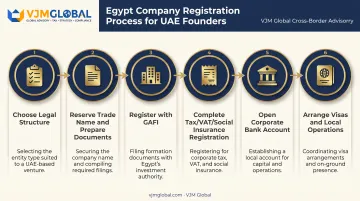
This is the GAFI registration journey broken into practical stages. A common cause of avoidable delay: founders treat visa and banking steps as afterthoughts instead of sequencing them alongside incorporation.
Step 1 – Choose Your Legal Structure and Market Entry Approach
Choose an LLC, a branch or a free zone entity based on ownership goals, activity scope and liability preference. A frequent misstep: defaulting to a branch structure out of familiarity, when a standalone LLC would offer better liability protection and more operating flexibility.
Step 2 – Reserve Your Trade Name and Prepare Core Documents
Reserve your trade name through the commercial registry, then prepare the Memorandum of Association and Power of Attorney. Documents signed in the UAE typically need attestation through UAE MOFA and the Egyptian consulate before Egyptian authorities will accept them. Submitting an incomplete attestation chain is one of the most common causes of rejection and resubmission.
Step 3 – Register with GAFI and Obtain Commercial Registration
Submit your full incorporation application to GAFI, Egypt's one-stop investment authority, to receive your Commercial Registry extract and incorporation certificate. Don't underestimate the Arabic-certified translation requirements for any foreign-issued documents; this step trips up more founders than any other.
Step 4 – Complete Tax, VAT and Social Insurance Registration
Obtain your Tax Identification Number from the Egyptian Tax Authority and register for VAT where applicable. If you plan to hire locally, social insurance registration follows immediately after. Missing either deadline triggers penalties before your business has even opened its doors.
Step 5 – Open a Corporate Bank Account and Deposit Capital
Select an Egyptian bank with experience handling foreign investors, then deposit any required share capital to obtain the bank certificate GAFI needs for filing. Your UAE banking relationships and KYC documentation won't transfer automatically. Egyptian banks apply their own onboarding requirements regardless of your existing profile elsewhere.
Step 6 – Arrange Visas, Work Permits and Set Up Local Operations
Apply for the visa category that matches your role—business, investor or work permit—aligned with the residency provisions under Investment Law 72. From there, set up office premises, secure any sector-specific licenses, and build a compliance calendar covering annual audit, tax filing and GAFI reporting.
Given how many moving parts run in parallel, some founders bring in a cross-border partner such as VJM Global. A partner like this can manage entity formation, tax registration and ongoing compliance in Egypt so the UAE team can run the business instead of chasing paperwork.
Costs, Taxes & Visa Requirements to Plan For
Budget Expectations
Your realistic first-year budget should cover GAFI registration fees, legal and notarization costs, translation and attestation, and initial compliance work. Costs shift based on:
- Entity structure chosen (LLC capital is flexible; JSC requires EGP 250,000 issued capital)
- Whether your activity needs regulator pre-approval
- Foreign-document legalization and Arabic-certified translation volume
- Whether you engage local professional representation
Core Tax Obligations
| Tax | Rate |
|---|---|
| Corporate Income Tax | 22.5% |
| Standard VAT | 14% |
| Employer Social Insurance | 18.75% of insurable salary |
| Personal Income Tax | 0% to 27.5%, tiered by income band |
These figures come from PwC's Egypt tax summary, current as of early 2026. Reconfirm rates and thresholds before filing, as they can change.
Visa Isn't the Same as Residency
A short-trip business visa is not the same as the investor residence status you need to operate long-term.
Under Investment Law 72, GAFI can grant a diligent investor a five-year renewable residence permit. Approval depends on your company's capital, workforce and activity; it is not automatic at incorporation. Treat visa entry and investor residency as two separate workstreams from day one.
Common Mistakes UAE Founders Make When Entering the Egyptian Market
UAE founders often hit the same avoidable snags when setting up in Egypt. Most come from assuming the two markets work the same way.
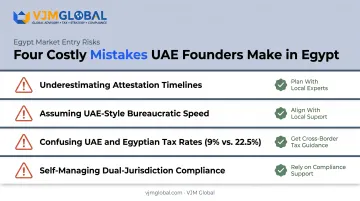
- Underestimating attestation timelines. Document legalization between UAE MOFA and the Egyptian consulate can stretch registration by several weeks if you start late.
- Assuming Egyptian bureaucracy mirrors the UAE's. Approvals move slower, documentation is Arabic-first, and UAE-speed expectations only create frustration.
- Confusing UAE and Egyptian tax frameworks. UAE Corporate Tax is 9% above AED 375,000 via the FTA; Egypt applies a flat 22.5% through the ETA. The regimes and filing calendars are entirely separate.
- Trying to self-manage dual-jurisdiction compliance. Entity formation, tax registration, and payroll across two legal systems is complex. A dual-market firm such as VJM Global helps founders avoid costly missteps and delays.
Frequently Asked Questions
How much money do you need to start a business in Egypt?
An LLC generally has no statutory minimum capital, while a JSC requires EGP 250,000 issued capital. Budget separately for legal, translation, attestation, and first-year compliance costs. Verify current fee schedules before you file.
Can a foreigner start a business in Egypt?
Yes. Investment Law 72/2017 permits up to 100% foreign ownership in most sectors. A short list of regulated activities requires Egyptian participation or prior approval, so confirm your activity code with GAFI first.
What is a good business to start in Egypt?
Sectors with strong UAE-Egypt trade alignment include manufacturing, fintech, and trading or logistics—areas also featured in UAE–Egypt CEPA talks. Export-oriented businesses also benefit from Egypt's rebate and incentive programs.
Can a UAE resident or company own 100% of an Egyptian business?
Yes, for most LLC and JSC activities a UAE resident or company can hold 100%. Check your exact activity code first—a few regulated sectors still need a local partner or ministerial approval.
Do I need to travel to Egypt to register my company, or can it be done remotely?
Much of the GAFI process, including portal submission, payment and e-signing, can be handled digitally with a properly legalized Power of Attorney. Banking setup and identity checks may still require in-person or bank-led steps.
How long does the Egypt company registration process take from the UAE?
GAFI advertises a one-business-day turnaround for complete LLC filings, but that excludes UAE attestation, translation and banking. Budget several weeks end to end, depending on document readiness.