Introduction
Dubai-based consultants, Amazon sellers in Sharjah, and SaaS founders working out of Abu Dhabi are all asking the same question lately: should I register a US company?
The appeal is obvious. A US LLC unlocks USD banking, gets you approved on Stripe and PayPal without the usual friction, and makes global marketplaces treat you like a domestic seller instead of an overseas applicant.
Delaware alone recorded 334,461 new business formations in 2025, more than 15% above 2024's total. Forming a US entity remotely has never been more common, even though state records don't break down applicant nationality.
Many UAE residents, including expat entrepreneurs from India and elsewhere, are exploring this path because US LLC laws don't require citizenship, residency, or relocation. This guide walks through entity types, the registration process, banking realities, and the tax obligations UAE founders can't afford to skip.
Key Takeaways
- UAE residents can own 100% of a US LLC or C-Corp with zero citizenship or residency requirements
- Wyoming and Delaware remain top choices for non-resident owners due to low costs and simple compliance
- Owning a US company grants no right to live or work in the US: that's a separate visa process
- Foreign-owned single-member LLCs must still file Form 5472 even with zero US income
- Bank account approval, not entity formation, is the real bottleneck for most UAE applicants
What Starting a US Business from the UAE Actually Involves
Starting a US business from the UAE means legally registering an LLC or C-Corp with a UAE-based owner who runs the operation remotely. Nothing about this requires stepping foot in America.
That distinction matters: this is entity formation and tax compliance, not immigration. Forming the company does not create a visa, a green card path, or any right to work inside the United States.
LLCs dominate this space for a reason. They offer:
- Pass-through taxation (profits flow to the owner without a separate corporate tax)
- Minimal paperwork
- No board or shareholder formalities
That's why most UAE consultants, freelancers, and e-commerce sellers default to this structure.
C-Corps work differently. They're taxed at a flat 21% federal rate. Dividends paid to a UAE owner are generally subject to 30% withholding on the gross amount, because the US has no income tax treaty with the UAE.
Most founders only choose this route when they're planning to raise US venture capital.
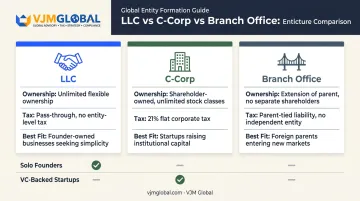
Which Structure Fits UAE Founders: LLC, C-Corp, or Branch Office?
| Structure | Ownership Rules | Tax Treatment | Best Fit |
|---|---|---|---|
| LLC | 100% foreign ownership allowed | Pass-through; no entity-level tax | E-commerce sellers, consultants, freelancers |
| C-Corp | 100% foreign ownership allowed | 21% corporate tax + 30% dividend withholding | VC-backed startups planning US fundraising |
| Branch Office | Extension of existing UAE entity | Taxed on US-source income only | UAE companies expanding US operations without a new entity |
Branch registration suits an existing UAE company that wants a US foothold without creating a separate legal entity. It's less common among solo founders, mostly because it ties US liability directly back to the parent company in the UAE.
Why UAE Entrepreneurs Are Choosing to Start Businesses in the USA
The real driver is practical access to financial infrastructure that's hard to get any other way.
Payment processing tops the list. Stripe, PayPal, and Mercury all favor US-registered entities, and many UAE-based businesses find these platforms restricted or heavily limited when applied for directly through a local entity.
Marketplace eligibility is the second driver. Amazon.com, Etsy, and Upwork often treat US-registered sellers more favorably, sometimes offering account features that aren't available to non-US sellers at all.
No public statistic breaks down how many Middle East-based founders have registered Wyoming or Delaware LLCs. State registries don't track applicant nationality that way.
What is clear: cross-border advisors are seeing more of these setups, driven by:
- Growing e-commerce activity from UAE-based Amazon and Shopify sellers
- More SaaS founders targeting US customers from day one
- Holding company structures that route international income through a US entity
What to Know Before You Start
Before filing anything, get these realities straight.
Owning a company isn't the same as having a visa. A US LLC doesn't grant residency or work authorization. Separate routes govern that:
- B-1 visitor visa : for short business trips, not ongoing work
- E-2 treaty investor : only available to nationals of treaty countries; the UAE is not currently on that list, so UAE nationality alone doesn't qualify
- EB-5 : an immigrant investor pathway requiring a substantial qualifying investment and job creation, unrelated to simply owning an LLC
Banking is the real friction point. Many traditional US banks still require an in-person branch visit, which is impractical for most UAE applicants. Fintech platforms like Mercury, Relay, and Wise Business accept non-resident applications entirely online. Approval still depends on a genuine US business address and operational plan.
Timelines vary by step. LLC filing can complete in days. EIN issuance without a Social Security Number takes longer, and bank approval can add several more weeks .
Compliance continues after formation. Plan for ongoing obligations such as:
- Registered agent renewal
- Annual state reports
- Franchise tax in states like Delaware
- Beneficial Ownership Information reporting under the Corporate Transparency Act (rules depend on how the entity was formed)
How to Start a Small Business in the USA from the UAE – Step by Step
Every step below can be completed without leaving the UAE. The most common mistakes UAE founders make:
- Picking a state for brand appeal instead of cost and tax fit
- Delaying the EIN application
- Waiting until after formation to plan US bank account logistics
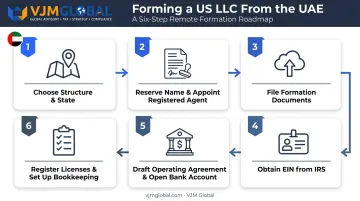
Step 1 – Choose Your Business Structure and State
Most UAE founders choose an LLC for pass-through simplicity and lower compliance load. A C-Corp makes more sense if you plan to raise US venture capital or issue formal equity.
State filing costs and trade-offs differ quickly:
| State | Filing fee | What to know |
|---|---|---|
| Wyoming | $100 | Member names stay off public record; low ongoing cost |
| Delaware | $110 | Stronger brand recognition with investors |
| Florida | $125 (incl. registered agent) | Annual report $138.75; $400 late penalty |
For most solo e-commerce or consulting LLCs, Wyoming's low ongoing cost wins out.
Step 2 – Reserve a Name and Appoint a Registered Agent
Every state requires a registered agent with a physical US address if the owner doesn't have one. That requirement is non-negotiable for UAE-based founders. Check name availability on the Secretary of State's online portal before you file anything else.
Step 3 – File Formation Documents with the State
Articles of Organization (LLC) or Incorporation (C-Corp) are filed entirely online. Processing is often near-instant for Wyoming's electronic filings, while Delaware offers paid expedited tiers ranging from same-day service up to 1-hour turnaround for $1,000.
Step 4 – Obtain an EIN from the IRS
Non-residents without a Social Security Number can still get an EIN by filing Form SS-4 and marking "foreign" on the responsible-party line. Fax applications generally get a response in about 4 business days; mailed applications can take close to 4 weeks.
Do not leave this until the last minute: the EIN blocks everything downstream, including banking.
Step 5 – Draft an Operating Agreement and Open a US Business Bank Account
Draft an operating agreement even for a single-member LLC. Banks, payment processors, and future partners often request it, and it documents ownership and decision rights.
For the account itself, banks and fintechs typically ask for:
- EIN confirmation letter
- Formation certificate
- Passport copy
Traditional banks may still want an in-person visit. Mercury, Relay, or Wise Business are practical alternatives for UAE applicants who cannot travel.
Step 6 – Register for Applicable State Licenses and Set Up Bookkeeping
Sales tax nexus rules differ by state and by how the business operates — a Shopify store selling into California triggers different obligations than a UAE-based consultant billing US clients directly. This is the point where working with a cross-border accounting partner like VJM Global helps UAE founders avoid missed filings before the business even scales.
US Tax, Visa & Compliance Obligations UAE Founders Must Not Ignore
Tax filings, ownership reports, and visa status run on separate tracks. Mixing them up is how UAE founders miss deadlines after year one.
Obligations most founders underestimate:
- Annual Form 5472 (with pro forma Form 1120) even at $0 US revenue
- ETBUS analysis before assuming no US income tax
- 30% withholding on many US-source payouts (no UAE treaty relief)
- BOI status checks after the 2025 FinCEN changes
- A visa path that is independent of your state formation filing
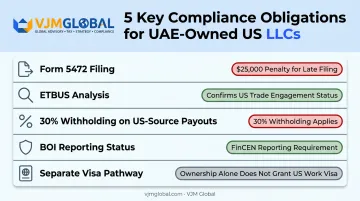
ETBUS decides whether you owe US income tax. If your LLC has no US-source income and no physical US presence, you are generally not "Engaged in Trade or Business in the US," so no US income tax is owed. Zero tax still does not mean zero paperwork.
Form 5472 is mandatory regardless of income. Foreign-owned single-member LLCs must file it with a pro forma Form 1120 every year, even at $0 US revenue. Skip it, and the IRS penalty starts at $25,000 for a late or missing filing, with further $25,000 penalties possible after 90 days of continued non-compliance.
Withholding is harsher because the UAE does not appear on the IRS income tax treaty list. US-source payouts such as C-Corp dividends are generally subject to the full 30% withholding rate, with no treaty reduction.
BOI reporting rules changed in 2025. Under FinCEN's March 2025 rule, US-formed companies and their US beneficial owners are exempt from BOI reporting. Foreign-formed entities that register to do business in a US state can still fall under the rule, so confirm your entity's status rather than assuming exemption.
Visa status does not come with your formation documents. An LLC or C-Corp filing does not authorize you to live or work in the US. Founders usually need a separate path (such as E-2 where eligible, L-1 for qualifying intracompany transfers, or another employment-based category) planned with immigration counsel alongside—not after—entity setup.
Entity formation and tax compliance are separate disciplines; treating them as one is where most UAE founders stumble after year one. VJM Global handles US entity formation and ongoing tax compliance across 100+ countries, including through its New York office, so the post-formation filing gap is covered. Immigration and visa work should stay with qualified counsel.
Frequently Asked Questions
How do I open an LLC in the USA from the UAE?
Choose a state (often Wyoming or Delaware), file Articles of Organization online, appoint a registered agent, and get an EIN from the IRS. You can then open a US bank account—all remotely from the UAE.
Can a UAE resident own 100% of a US LLC?
Yes. The US places no citizenship or residency restriction on LLC or C-Corp ownership. A UAE-based founder can be the sole member and owner.
Do I need to visit the USA to start a business there?
No visit is legally required for formation. You can complete formation online, though an in-person visit can sometimes make opening a bank account easier.
Which US state is best for UAE entrepreneurs?
Wyoming and Delaware are most common thanks to low fees, privacy protections, and manageable annual compliance. The right pick depends on your target customers and tax exposure.
Do UAE business owners pay US taxes on their US LLC?
It depends on whether the business has US-source income or a US trade/business presence. Even with zero tax due, informational filings like Form 5472 remain mandatory.
Can I open a US business bank account from the UAE?
Yes, through fintech platforms like Mercury or Wise Business, without traveling. Traditional banks may still require in-person verification or extra documentation for non-resident applicants.