UK entrepreneurs are drawn here for practical reasons: strong demand in tourism, retail and professional services, a comparatively simple tax structure, and the ability to form an entity remotely without setting foot in the state. Florida's accommodation and food-service sector alone generated $94.5 billion in sales in 2022.
We see interest from solo consultants testing the US market, e-commerce sellers wanting a US-based entity for payments and logistics, and established UK companies expanding south-east. This guide walks through entity choice, registration, tax, banking and visas, step by step.
TL;DR
- No Florida state personal income tax; LLC filing is ~$125, corporation filing ~$70
- UK citizens can own and register a Florida LLC or corporation fully remotely
- An E-2 or L-1 visa is needed only if you relocate to run the business in person
- Sunbiz typically processes filings within days once documents and a registered agent are ready
What Does Starting a Business in Florida From the UK Actually Involve?
It means forming a legal US entity—an LLC or corporation—registered with the Florida Division of Corporations (Sunbiz) while you stay based in the UK.
This is remote ownership and operation, not relocation. You do not need a US office or staff to run day-to-day; a Florida registered agent handles official state mail on your behalf.
Two structures dominate:
- LLC — pass-through taxation, lighter paperwork; common for solo founders and service businesses
- C-Corporation — better fit if you plan to raise US investment later
Why Florida Is a Strong Choice for UK Entrepreneurs
Florida isn't universally the "best" US state for every founder. For many UK entrepreneurs, it's a strong choice under specific conditions.
Tax and cost advantages
UK founders forming a Florida LLC benefit from one clear edge: no state personal income tax on profits that pass through to the owner. Federal tax still applies—at individual rates for most pass-through LLCs, or a flat 21% corporate rate for C-Corps (IRS Publication 542)—but there's no extra state layer on top.
Formation costs sit in the mid-range compared to other popular incorporation states:
| Item | Florida |
|---|---|
| LLC formation | $125 |
| Corporation formation | $70 |
| LLC annual report | $138.75 |
| Corporation annual report | $150 |
| Late filing fee | $400 |
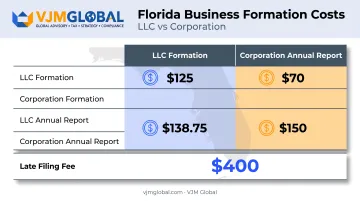
Delaware, Wyoming, Nevada and Texas all have their own fee structures, and Delaware in particular carries stronger name recognition with US investors. Florida doesn't compete on investor familiarity, but it doesn't need to for consumer-facing businesses.
Population and demand growth
Florida's population growth (up nearly 2 million residents since 2020) feeds directly into demand for tourism, retail and local services. Add logistics, tech and hospitality to the mix, and the state offers real breadth across sectors rather than a single-industry bet.
The trade-off: banking and investor networks in Florida are less mature than Delaware's. If you're chasing venture capital, Delaware still carries more weight. If you're building a consumer or service business, Florida holds up well.
What to Know Before You Start a Business in Florida
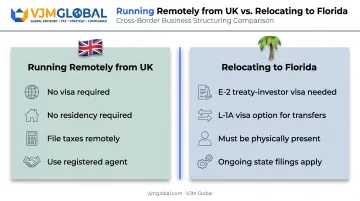
A Florida entity gives you ownership rights only. It does not grant immigration status or work authorisation, and it's a distinction that trips up a lot of first-time founders.
How you run the company decides whether you also need a visa:
- Running the business remotely from the UK — no visa required, no residency required
- Relocating to Florida to run it in person — you'll need an E-2 treaty-investor visa or, if transferring within an existing company, an L-1A visa
Tax and state filing rules apply either way. Federal tax obligations follow the entity regardless of where you live, and a C-Corp pays the flat 21% federal rate.
Florida filing obligations (annual reports, registered agent maintenance) apply whether you're in Naples or Norwich.
How to Start a Business in Florida From the UK – Step by Step
Here's the practical sequence, plus the mistakes we see most often: skipping the registered agent requirement, or assuming a UK insurance policy or bank account automatically covers US operations. It doesn't.
Step 1 – Choose Your Business Structure
For non-resident owners, the choice usually comes down to LLC versus C-Corp:
- LLC — simpler, pass-through taxation, ideal for solo founders and service businesses
- C-Corp — better suited to startups planning to raise US investment, since investors generally prefer this structure
Non-residents cannot form S-Corporations — that structure is restricted to US citizens and residents.
Step 2 – Pick a Compliant Business Name
Search name availability through Sunbiz's records search. Your name needs the correct designator (LLC, Inc, or Corp) and must be distinguishable from existing Florida entities on file.
Sunbiz doesn't offer name reservations or pre-approval, so also run a check on the USPTO trademark database before you commit, to avoid conflicts down the line.
Step 3 – Appoint a Florida Registered Agent
This is mandatory for every non-resident formation. Your agent needs a physical street address in Florida — a PO box won't cut it.
We appoint the registered agent as part of a combined formation, EIN and compliance engagement. When the same team handles the agent, the filing and the tax registrations, nothing falls between the cracks.
Step 4 – File Formation Documents with Sunbiz
You'll need:
- Articles of Organization (LLC) or Articles of Incorporation (Corp)
- Registered agent name and address
- Business address
- Member or officer names
Filing costs are $125 for an LLC and $70 for a corporation. Sunbiz doesn't publish a guaranteed turnaround, but its live processing queue shows filings typically clearing within a matter of days once submitted correctly.
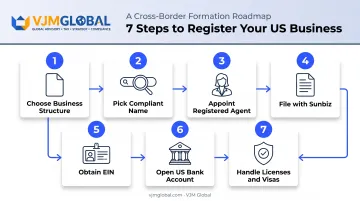
Step 5 – Obtain Your EIN and Handle US Tax Registrations
You'll need an EIN even without a US Social Security Number. The IRS instructions for Form SS-4 allow you to enter "foreign" or "N/A" on the relevant line if you have no SSN or ITIN — an ITIN is not a hard requirement just to get an EIN.
Non-residents can't use the IRS online EIN tool. Instead:
- Fax your SS-4 — the IRS generally processes these within four business days
- Mail your SS-4 — allow around four weeks
- Call the international applicant line — listed in the SS-4 instructions
Florida's lack of state income tax doesn't remove your federal tax obligations, and if you're selling into other states, you may trigger sales tax nexus there too.
Step 6 – Open a US Business Bank Account
You'll typically need:
- Your EIN confirmation letter
- Certificate of formation
- Proof of identity
- Proof of business address
Traditional banks often expect an in-person visit, which is impractical from the UK. Fintech platforms such as Wise and Mercury are built for remote onboarding and explicitly support non-resident founders. Eligibility isn't the same as approval: each still verifies your documents and business details individually.
Step 7 – Handle Licenses, Insurance and Visa Considerations
Florida runs a two-tier licensing system:
- A general business tax receipt, usually issued at county or municipal level
- Industry-specific permits, depending on your sector (regulated activities are listed by Florida's DBPR)
Check with the specific county or city where you'll operate. A registered agent's address doesn't settle your local licensing obligations.
Don't assume your UK business insurance travels with you. Most UK policies exclude US claims outright, so you'll need a separate US policy for liability and operations.
A visa is only needed if you're relocating to run the business in person. Remote ownership from the UK carries no visa requirement.
Conclusion
Starting a Florida business from the UK is achievable without relocating or applying for a visa, provided structure, registration and tax are handled correctly from day one. Florida suits consumer-facing and service businesses particularly well. It is less of a natural fit if you want Delaware-style investor recognition for a venture-backed startup.
Entity formation, EIN registration and multi-jurisdiction tax compliance touch several regulators at once. Coordinating them as one engagement saves UK founders time and rework.
VJM Global supports formation, tax and compliance for founders entering the US, including an established base of UK clients. The team can help structure a Florida entry that holds up on both sides of the Atlantic.
Frequently Asked Questions
How much does it cost to start a business in Florida?
An LLC costs $125 to file, while a corporation costs $70. Both also carry annual report fees ($138.75 for LLCs, $150 for corporations) due by 1 May each year.
How much does it cost to set up an LLC in Florida?
Sunbiz charges $125 to form an LLC: a $100 filing fee plus a $25 registered agent fee. The separate annual report fee is $138.75, due by 1 May.
What are the steps to start a business in Florida?
Choose a structure, secure a compliant name, appoint a Florida registered agent, then file with Sunbiz. After that, get an EIN, open a US bank account, and handle licensing or visa needs if you will operate in person.
Do I need to register my business in Florida?
Yes — Sunbiz registration is required to form and operate a Florida LLC or corporation, even if the owner lives in the UK.
How long does Sunbiz take to process an LLC in Florida?
Online filings usually clear within a few business days, based on Sunbiz’s live processing queue. There is no fixed guaranteed turnaround.
Can a UK citizen start a business in Florida?
Yes. UK citizens can own and register a Florida LLC or corporation remotely with no visa needed. A visa (E-2 or L-1) is only required if you plan to relocate and run the business in person.