Interest is being driven by diaspora ties, a desire to diversify beyond saturated UK and EU markets, and genuine opportunities in resources and manufacturing. It's not just large corporates looking either. UK SMEs exporting goods, solo founders, and Ghanaian-British diaspora investors are all exploring entry.
This guide walks UK residents through registering, structuring, and legally operating a business in Ghana, step by step.
TL;DR
- Foreign-owned firms must register with the Ghana Investment Promotion Centre (GIPC) and meet capital thresholds
- UK founders can pick a wholly foreign-owned company, joint venture, or branch—each with different capital rules
- Registration-to-operational timelines typically run from a few weeks to about two months
- Early legal, tax, and compliance support reduces delays and risk
- Confirm entity type, minimum capital, and GIPC rules before you file
What Is Involved in Starting a Business in Ghana from the UK?
Starting a business in Ghana from the UK means incorporating and registering a Ghanaian legal entity while remaining based in, or operating from, the UK. It's a different exercise entirely from simply exporting goods to Ghanaian buyers.
This route requires:
- Local incorporation with Ghana's Office of the Registrar of Companies (ORC)
- GIPC (Ghana Investment Promotion Centre) registration for any foreign-owned element
- Ongoing compliance with Ghanaian company law, tax rules, and payroll obligations
Common formats include a wholly foreign-owned company, a joint venture with a Ghanaian partner, or a branch (external company) representing a UK parent. Each carries distinct capital and compliance implications, covered below.
What UK Entrepreneurs Should Know Before Starting a Business in Ghana
Many UK founders underestimate the capital requirements and compliance layers involved in Ghana market entry. Build these constraints into your plan before you commit time and money.
Key facts to build into your planning:
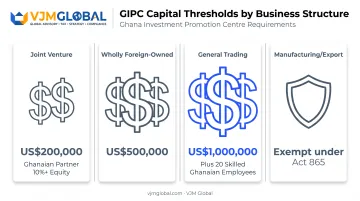
Capital thresholds (GIPC):
- Joint venture: at least US$200,000 in foreign capital, with the Ghanaian partner holding at least 10% equity
- Wholly foreign-owned company: US$500,000
- General trading: US$1 million plus at least 20 skilled Ghanaian employees
- Manufacturing and solely export-oriented businesses: exempt from the standard capital floor under Act 865, section 30
Operating and sector constraints:
- Remote management is possible, but you still need a local registered office and a resident representative
- Banking and capital verification often take longer than incorporation; UK funds need Ghanaian bank confirmation before Bank of Ghana sign-off
- Mining, petroleum, and telecoms impose ownership or procurement rules that limit UK-only control
- Petty trading, market stalls, and hawking are reserved exclusively for Ghanaian citizens
Get these fundamentals right early, and the rest of the process moves far more smoothly.
Why Ghana Appeals to UK Businesses (When It Makes Sense)
Ghana entry works well under specific conditions. It is not a guaranteed win for every UK business, but the case is strong when the fit is right.
- AfCFTA Secretariat in Accra gives Ghana-registered businesses a gateway into continent-wide trade access.
- ECOWAS membership opens regional trade beyond Ghana, though preferential tariffs apply only to qualifying products and approved enterprises.
- Free Zones incentives for export-focused firms: a 10-year income tax exemption, then a 15% capped rate, plus duty-free production inputs (at least 70% of output must be exported).
- English-speaking, skilled workforce reduces the communication friction that trips up many cross-border ventures.
- UK–Ghana trade reached £1.6 billion in the four quarters to Q1 2026 (£873 million in UK exports); UK outward FDI stock in Ghana was £1.8 billion at end-2024.

For UK firms with the right model, that momentum is already measurable in trade and investment flows.
Early Decisions UK Founders Must Get Right When Setting Up in Ghana
Most delays trace back to underestimating structuring complexity rather than lack of effort. Founders who plan these decisions upfront move faster.
Areas UK founders commonly overlook:
- Entity choice: Wholly foreign-owned, joint venture, and branch structures each carry different capital thresholds and compliance burdens—match the choice to your sector and capital appetite.
- Total set-up costs: Beyond registration fees, factor in GIPC filing fees, work permits, a registered office address, and professional advisory support.
- Capital timelines: A capital-importation certificate can take around 14 days on its own, before GIPC registration even begins.
- Sector reservations: Confirm your intended activity isn't reserved for Ghanaian citizens (market trading, beauty salons, sachet water production, and similar activities all fall into this category).
- Local representative: Founders staying UK-based need someone on the ground who can act as process agent while registrations and banking clear.
Skip any of these and the cost usually shows up three or four weeks in—not on day one.
How to Start a Business in Ghana from the UK – Step by Step
Most stages can be handled remotely from the UK if you have reliable local support. Flag these mistakes early:
- Underestimating capital verification timelines
- Ignoring sector ownership restrictions
- Delaying local representation until filings stall
Step 1 – Choose the Right Legal Structure and Sector Fit
Decide between a wholly foreign-owned company, a joint venture, or a branch/external company based on your capital appetite and the sector you're entering.
Before committing, confirm whether your intended activity is reserved for Ghanaian citizens or carries local content requirements. A common misstep is assuming a UK company can simply "branch out" into any Ghanaian sector without ownership restrictions. Petty trading, taxi fleets under 25 vehicles, and pharmaceutical retail are all off-limits to foreign entrants.
Step 2 – Meet Capital and GIPC Registration Requirements
Determine the capital threshold that applies to your chosen structure and sector:
| Structure | Minimum Foreign Capital |
|---|---|
| Joint venture | US$200,000 (Ghanaian partner holds 10%+ equity) |
| Wholly foreign-owned | US$500,000 |
| General trading | US$1,000,000 plus 20 skilled Ghanaian staff |
| Sole manufacturing/export | Standard GIPC minimum (Section 28) does not apply |
Prepare proof of capital, whether cash or in-kind, alongside your incorporation documents. The most common miss here is underestimating how long capital verification takes when funds are being transferred from a UK bank account.
Step 3 – Incorporate with the Registrar of Companies and Appoint Local Representation
Submit your incorporation documents to Ghana's Office of the Registrar of Companies. This includes company particulars, constitution, directors' details, and a beneficial-owner profile.
Appoint a local director, process agent, or manager as required, particularly if you're setting up a branch office. Leaving this until after incorporation is a frequent cause of delays in subsequent registration steps, since GIPC and GRA filings both expect local representation to already be in place.
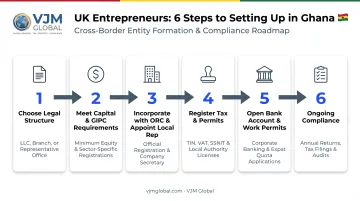
Step 4 – Register for Tax, Social Security, and Business Permits
Once incorporated, register with the Ghana Revenue Authority (GRA) for a Taxpayer Identification Number. Corporate income tax sits at 25%, and VAT registration (with associated NHIL and GETFund levies) applies once turnover crosses the GHS 750,000 threshold.
If you're hiring locally:
- Register employees with SSNIT for pension contributions (13% employer, 5.5% employee)
- Remit contributions within 14 days of month-end
- Obtain a Business Operating Permit from the local assembly covering your premises
Step 5 – Open a Ghanaian Corporate Bank Account and Secure Work Permits
Coordinate your KYC and AML documentation for account opening early. This step often takes longer for UK-owned structures than founders expect. A common miss is assuming an existing UK banking relationship will smooth the Ghanaian process. It won't. Ghanaian banks apply their own due diligence in full, regardless of your history elsewhere.
If UK staff will relocate or travel regularly to manage operations, apply for immigrant quotas and work/residence permits through the Ghana Immigration Service. Automatic quota bands scale with paid-up capital, ranging from one permit at US$50,000–250,000 up to four permits above US$700,000.

Step 6 – Get Ongoing Compliance and Advisory Support
Entity formation only starts the clock on ongoing accounting, tax filing, and statutory compliance.
UK founders running Ghana operations remotely usually need a cross-border partner who knows both UK and Ghanaian rules. VJM Global supports UK businesses entering Ghana with entity formation, GRA tax registration, PAYE and SSNIT payroll, and bookkeeping applied under Ghana’s own framework rather than a UK-centric add-on.
Conclusion
Starting a business in Ghana from the UK is achievable, but it demands getting capital, structure, and local compliance right from the outset. Speed of registration matters far less than clarity on entity choice and sector restrictions.
Long-term success comes from treating compliance as an ongoing process rather than a one-time set-up task. Founders who build that mindset from day one tend to avoid the costly surprises that catch out those who don't.
If you want help with entity choice, registration, or ongoing tax and compliance in Ghana, VJM Global supports UK businesses through setup and day-to-day statutory requirements in market.
Frequently Asked Questions
How much will it cost to register a business in Ghana?
Statutory costs include Office of the Registrar of Companies (ORC) incorporation fees from GHS 585, plus GIPC registration from the cedi equivalent of US$3,500 for joint ventures to US$7,000 for foreign trading entities. Professional advisory fees are quoted per engagement.
What businesses are most profitable in Ghana?
No government source guarantees profitability, but agribusiness, manufacturing, and export-oriented services benefit from Free Zones incentives and government-backed investment support. Commercial due diligence remains essential before entry.
What is the easiest business to start in Ghana?
Manufacturing and solely export-oriented businesses are exempt from Ghana's standard foreign-capital floor under Act 865, making them generally more accessible than general trading, which requires US$1 million in capital.
What businesses can I start in Ghana with small capital (e.g., 2,000–10,000 cedis)?
Low-capital options are largely limited to activities not reserved for Ghanaian citizens. Foreign ownership still triggers GIPC minimum capital requirements for most structures, regardless of the activity's scale.
What products sell fastest in Ghana?
Consumer goods, agricultural products, and imported goods aligned with Ghana's growing urban consumer base tend to move quickly, though specific product-level data requires market research beyond regulatory sources.
Can a UK citizen fully own a business in Ghana?
Yes. Wholly foreign-owned companies are allowed, with a US$500,000 minimum capital and GIPC registration, except in sectors reserved for Ghanaian citizens or covered by local content rules.