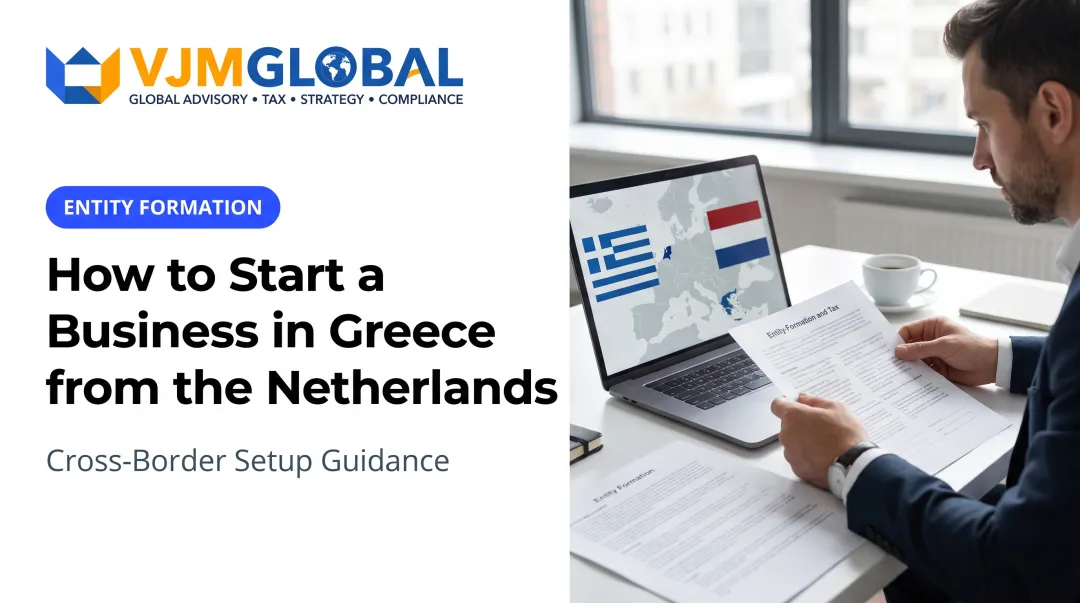
This guide walks through the entity options, registration steps, realistic costs, and the details that matter before you commit capital.
TL;DR
- Choose a wholly foreign-owned company, branch, or joint venture—costs and control rules differ for each
- Registration can move fast; banking, permits, and full operational readiness take longer
- Budget for GIPA capital rules, mandatory TIN registration, and sector-specific permits upfront
- Advisors fluent in both Dutch and Ghanaian systems cut most cross-border setup friction
What Does Starting a Business in Ghana Involve for a Netherlands-Based Entrepreneur?
In simple terms, it means setting up a legally recognised entity in Ghana that you or your Dutch company owns and operates, whether you run it remotely or put boots on the ground.
There are three common paths:
- External company (branch) – your existing Dutch entity registers to operate directly in Ghana
- Fully foreign-owned Ghanaian limited liability company – a new local entity, wholly owned from the Netherlands
- Joint venture – shared ownership with a Ghanaian partner, often required in restricted sectors
Foreign participation is governed by the Ghana Investment Promotion Centre (GIPC), a completely different system from the Dutch KVK registration most entrepreneurs are used to. There's no single online portal that mirrors KVK's speed, so expect more documentation at every stage.

What to Know Before You Start a Business in Ghana from the Netherlands
Dutch founders are accustomed to digital-first KVK registration completed in a day. Ghana's process is more paper-heavy and involves multiple agencies working in sequence rather than parallel.
Here's what actually matters before you commit:
- Capital requirements are changing. Ghana's Investment Promotion Authority Act (Act 1173) came into force in July 2026. Get written confirmation from GIPA on capital thresholds for your activity before budgeting—implementing guidance was still catching up at the time of writing.
- Trading is treated differently. Retail and general trading have historically needed higher foreign capital and local staffing than other sectors. Confirm current figures with GIPA, not older published thresholds.
- Time zones work in your favour. The Netherlands sits one to two hours ahead of Ghana, so a normal working day overlaps almost entirely and remote coordination stays manageable.
- Currency and repatriation need planning. Moving profits from Ghanaian cedis back into euros involves exchange controls and banking steps that differ from anything in the EU.
- Some sectors stay reserved for citizens. Informal retail and small-scale trading remain off-limits to foreign ownership, joint venture or otherwise.
Why Dutch Entrepreneurs Are Choosing Ghana (When It Makes Sense)
Ghana isn't a guaranteed win. It makes sense under specific conditions.
Regional access matters. Ghana's ECOWAS membership and its role hosting the African Continental Free Trade Area secretariat give a Ghana-based operation a logical gateway into a market of 55 countries and roughly 1.3 billion people.
That is a market-access rationale, not an automatic tariff entitlement—rules of origin still apply.
Political stability stands out relative to some neighbouring West African markets, which matters when you're managing an operation from 5,000 kilometres away.
Trade complementarity is real. The Netherlands' strength in agrifood and horticulture pairs naturally with Ghana's needs.
A 2025 Dutch trade mission brought 19 companies and expert organisations to Ghana, including visits to Dutch-linked agribusinesses such as Iribov and Fruit Masters. The trip renewed a memorandum of understanding on seeds, agribusiness, and cocoa cooperation, according to Agroberichten Buitenland's 2025 mission report. The Netherlands-Africa Business Council estimates 100–150 Dutch companies are already active in the market.
English removes a friction point most Dutch teams don't get elsewhere on the continent. No translation layer, no interpreter needed for contracts or negotiations.

Legal Structures and Registration Requirements in Ghana
Company Limited by Shares
This is the most common vehicle for foreign-owned ventures. Registration runs through Ghana's Office of the Registrar of Companies (ORC) under the Companies Act 2019 (Act 992), alongside GIPC registration.
Requirements include:
- At least two directors, with one ordinarily resident in Ghana at all times
- A qualified company secretary appointed by the directors
- Name search and reservation before filing
External Company (Branch)
This route lets your Dutch entity operate in Ghana under its existing name rather than incorporating a new company. You'll need a local manager who is resident in Ghana at all times.
ORC's published registration fee for this route sits at around $1,380. External companies must also file annual Group Accounts with ORC, which carries a separate processing fee.
Joint Venture
Often the only route into sectors reserved for citizens. Before filing anything, settle:
- Equity split
- Board seat allocation
- Profit-sharing terms
Put all of it in a shareholders' agreement first. Retrofitting these terms after incorporation causes far more disputes than agreeing them upfront.
Regardless of structure, every entity needs a Taxpayer Identification Number (TIN) from the Ghana Revenue Authority (GRA). Most ORC filings can now be done online, so you can complete registration without a trip from the Netherlands.
Ghana's standard corporate tax rate is a flat 25%, per GRA's Corporate Income Tax guidance. Sector licences may apply post-incorporation depending on your activity.

How to Start a Business in Ghana from the Netherlands – Step by Step
The most common mistake Dutch founders make is assuming an EU business licence transfers automatically, or underestimating capital thresholds until GIPA pushes back. Work through the stages below in order so neither issue stalls you mid-setup.
Step 1 – Choose Your Entry Structure and Validate the Opportunity
Decide between a wholly foreign-owned company, an external branch, or a joint venture based on your sector and available capital. Validate demand through market research or trade connections, such as the Netherlands-Africa Business Council network.
Common miss: entering a reserved sector without a compliant joint venture already in place.
Step 2 – Confirm Capital Requirements and Register the Entity
Get written confirmation from GIPA on your activity's classification and capital requirement, particularly if you're in trading. Prepare your name search, incorporation documents, and file with GIPA and the Registrar General.
Common miss: underfunding the entity relative to GIPA's expectations, which stalls registration mid-process.
Step 3 – Register for Tax (TIN) and Complete Statutory Registrations
Obtain a TIN for the company, its directors, and its shareholders through the GRA. Then assess your VAT exposure. Ghana's 2026 VAT reforms set the combined VAT, NHIL, and GETFund charge at 20% on the same taxable base (GRA VAT page). The goods registration threshold rose to GHS 750,000.
Common miss: delaying TIN registration. This single step blocks both bank account opening and invoicing.
Step 4 – Open a Corporate Bank Account and Set Up Financial Operations
Find a Ghanaian bank with actual experience handling foreign-owned accounts and euro transfers, not just a branch that technically offers business accounts. Set up local bookkeeping early, and map your audit obligations before the first filing cycle.
VJM Global supports Netherlands-based businesses at this stage with entity formation, tax registration, and ongoing accounting, so you do not need to build an in-country finance team.
Common miss: assuming Dutch banking history simplifies Ghanaian KYC checks. It doesn't. Ghanaian banks run their own independent verification regardless of your EU credit history.
Step 5 – Secure Permits, Staffing, and Local Presence
Obtain sector-specific permits. Importers additionally need customs documentation: bill of lading, attested invoice, packing list, and an Import Declaration Form from the Ministry of Trade, per GRA's import procedures.
For staffing, you have three options:
- Hire locally through your Ghanaian entity once it is registered
- Use an Employer of Record (EOR) model to hire without incorporating first
- Relocate Dutch staff under a work and residence permit
Common miss: underestimating how long work permit processing takes. Build in buffer time.
Step 6 – Launch, Monitor Compliance, and Stabilise Operations
Set up recurring GRA tax filing, GIPA reporting, and Registrar General renewals. Track financial performance and plan your repatriation strategy back to the Netherlands early, not after profits start piling up.
Common miss: treating Ghana compliance as a one-time task rather than an ongoing annual commitment.

Conclusion
Starting a business in Ghana from the Netherlands is achievable within weeks for straightforward structures, but it demands close attention to GIPA capital rules, tax registration, and sector restrictions. Dutch entrepreneurs who lock in structure, capital, and compliance early are best placed to enter Ghana's growing economy without mid-process surprises.
VJM Global supports this process with entity formation, tax registration, and ongoing compliance so your setup stays sound well after incorporation day.
Frequently Asked Questions
Which small business is most profitable in Ghana?
Agribusiness, consumer electronics trading, and digital or tech services currently show the strongest demand. Profitability depends heavily on capital access and, for trading, GIPC's capital rules for foreign investors.
What business can I start with €1,000 in Ghana?
That budget suits small local trading or service businesses run by Ghanaian citizens. Foreign investors typically face much higher GIPC capital expectations regardless of the business size.
How do I register a business in Ghana as a foreigner?
Complete a name search, choose your entity structure, file with GIPC and the Registrar General, register for a TIN with the GRA, and obtain any sector-specific permits your activity requires.
What sells very fast in Ghana?
Consumer electronics, imported goods, agribusiness products, and digital services all move quickly given current demand patterns and Ghana's growing middle class.
How long does it take to register a foreign-owned company in Ghana?
Core registration can move fairly quickly once documents are ready. Banking, TIN registration, and permits often stretch full operational readiness to several weeks.
Can a Dutch company open a branch in Ghana without a local partner?
Yes. The external company route allows this directly, provided you appoint a Ghana-resident local manager. A joint venture is only necessary for sectors reserved for citizens.