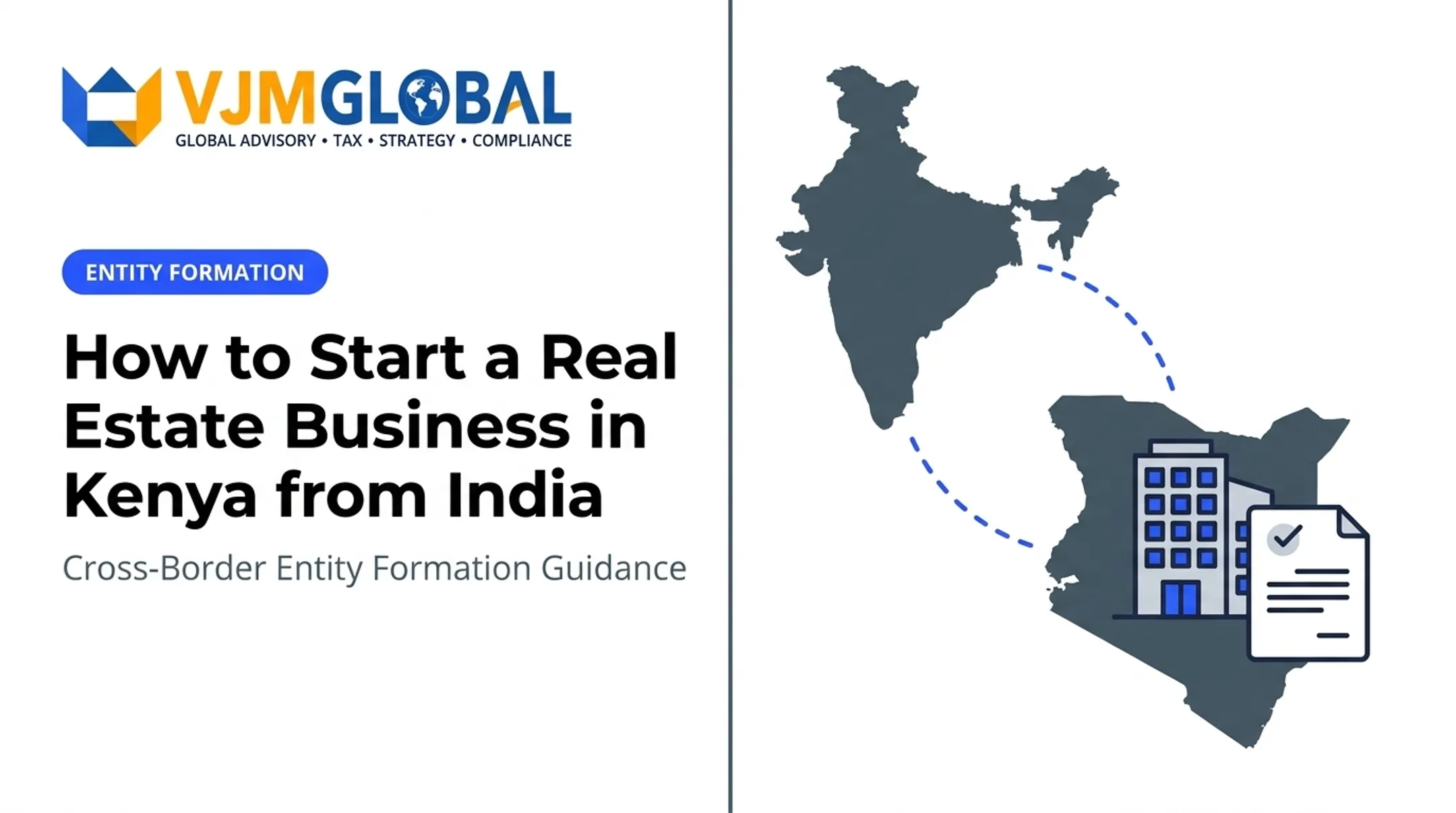
Many Indian entrepreneurs are looking past saturated Western markets toward Kenya's lower entry barriers, active SME ecosystem, and expanding tech and manufacturing base. Add in AfCFTA access, and Kenya starts looking like a regional platform, not just a single-country bet.
This interest isn't limited to one type of founder. First-time exporters, established Indian SMEs, and larger companies eyeing African expansion are all asking the same question: how do you actually set this up? This guide walks through the legal structures, compliance steps, and practical realities of starting a business in Kenya from India.
TL;DR
- Indians can fully own most Kenyan company types, with no local partner required
- Register online via eCitizen; plan tax, banking, and permits separately
- Private Limited Company and branch office are the main structures Indian founders use
- Cross-border advisors like VJM Global coordinate compliance across India and Kenya
What Starting a Business in Kenya from India Actually Involves
Starting a business in Kenya means establishing a legally recognised entity there as a foreign promoter. That includes company registration, a Kenya Revenue Authority (KRA) PIN, and ongoing operational compliance — not just shipping goods across the Indian Ocean.
This differs from exporting to Kenya. Exporting means selling into the market from India. Starting a business means creating an actual Kenyan legal presence with its own tax obligations and regulatory footprint.
Indian founders typically choose from:
- Wholly-owned private limited company — a separate Kenyan legal entity
- Branch office of an Indian company — an extension of the parent, not a new entity
- Representative/liaison presence for market study (though this cannot generate revenue)
What to Know Before You Start a Business in Kenya from India
Here's where most Indian founders trip up: they treat company registration as the finish line. Incorporation is only the first step. The gap between "incorporated" and "actually operating" is where the real work happens.
Before you file anything, set realistic expectations on timelines, permits, capital rules, and structure choices.
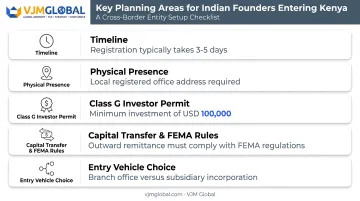
Key Areas to Plan For
- Timeline reality: Entity registration can finish in 3-5 days via Kenya's Business Registration Service, but KRA PIN issuance, county permits, and bank setup each take weeks on separate tracks
- Physical presence: Registration is largely remote with local representation; banking and immigration steps may still need in-person verification
- Class G Investor Permit: Required if an Indian director relocates to manage operations, with proof of at least USD 100,000 in available capital
- Capital transfer from India: FEMA and RBI rules apply. Individuals use the Liberalised Remittance Scheme (USD 250,000 annual ceiling); Indian companies use the Overseas Direct Investment framework
- Entry vehicle choice: A branch or representative office suits quick market testing; a subsidiary suits long-term operations
Why Kenya Makes Sense for Indian Businesses
Kenya is a sound choice when the conditions fit. These factors tip the scale in its favour:
- Growth momentum — Kenya posted 4.63% real GDP growth in 2025, per World Bank data. That is steady expansion in a market Indian firms are only beginning to tap in earnest.
- Regional reach — Kenya sits in the East African Community, a bloc of roughly 350 million people (EAC 2025 quarterly bulletin). AfCFTA widens the addressable market further, subject to rules of origin, tariffs, and standards by product line.
- Existing support network — Decades of Indian trade and diaspora presence mean founders are not starting cold. Advisory networks, sourcing relationships, and community knowledge already exist on the ground.
- Sector incentives — Kenya's push in tech, manufacturing, and export-oriented industries opens doors for Indian firms in IT services, textiles, and light manufacturing.
- Ownership freedom — Most unregulated sectors allow full foreign ownership, so you are not forced to take on a local shareholder. Caps and licensing rules still apply in regulated industries.
Legal Structure, Registration, and Compliance Essentials
Most delays Indian founders hit aren't about effort. They're about underestimating how many agencies need to sign off before a business can legally operate.
Choosing the Right Entity
| Entity Type | Best For | Key Feature |
|---|---|---|
| Private Limited Company | Long-term Kenyan operations | Capped at 50 shareholders |
| Branch Office | Extension of Indian parent | Not a separate legal entity |
| Representative Office | Market research only | Cannot generate revenue |
Every director, including Indian nationals who never set foot in Kenya, typically needs a KRA PIN if they'll earn income connected to the Kenyan entity. Confirm this requirement for each director based on their specific role.
Registration and Tax Steps
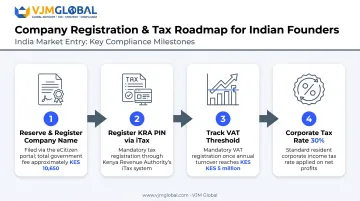
- Reserve a company name and register — one combined step on the eCitizen/BRS portal (BRS fee KES 10,650; about 3–5 days)
- Register for a KRA PIN through the iTax portal
- Track the VAT threshold — registration is mandatory once taxable turnover exceeds KES 5 million a year
- Know the corporate tax rate — resident companies and non-resident branches both pay 30% (from 2024). Branches also face repatriation tax on profits sent to India
Common miss: assuming Indian incorporation documents transfer directly into the Kenyan system. They don't — Kenya-specific certifications and filings (CR1, CR2, CR8, Memorandum and Articles of Association) are required regardless of your Indian paperwork.
Work Permits and Banking
The Class G Investor Permit requires Form 25, incorporation documents, KRA PINs, and documented capital of at least USD 100,000, per Kenya's Directorate of Immigration. Processing and annual issuance fees apply on top of that capital requirement.
Opening a Kenyan corporate bank account as a non-resident director means preparing:
- Certificate of incorporation and constitutional documents
- KRA PIN and tax documentation
- Passport and address evidence for all directors and beneficial owners
- Board resolution authorizing the account
- Clear source-of-funds explanation and expected transaction activity
There's no published standard turnaround for bank approval — build in buffer time, especially for non-resident KYC review.
Step-by-Step: How Indians Can Launch a Business in Kenya
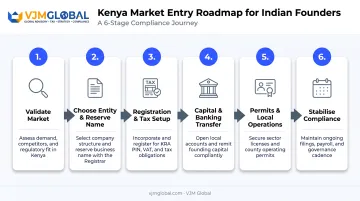
These six stages take an Indian founder from market check to steady Kenyan operations. Most delays come from a few avoidable misses:
- Skipping market validation before locking capital
- Underestimating India-to-Kenya fund-transfer timelines
- Leaving permit applications too late to correct
Step 1 – Validate the Kenyan Market Opportunity
Research demand, competition, and buyer behaviour specific to your sector in Kenya. Common miss: assuming what worked in India automatically works in Nairobi or Mombasa. Consumer habits, price sensitivity, and distribution norms differ significantly.
Step 2 – Choose Entity Structure and Reserve Company Name
Decide between a subsidiary, branch, or representative presence based on your long-term intent. Common miss: using a representative office to generate revenue it isn't legally permitted to earn.
Step 3 – Complete Registration and Tax Setup
Register through eCitizen, obtain your Certificate of Incorporation, KRA PIN, and the relevant county business permit. Common miss: not budgeting for county-level permit variations — requirements and processing times differ by county.
Step 4 – Arrange Capital, Banking, and Fund Transfer from India
Route investment through FEMA-compliant channels. Individuals work within the LRS ceiling; companies use the ODI framework, generally through one designated AD bank, filing Form FC for the transaction. Common miss: underestimating how long non-resident KYC checks take at Kenyan banks.
Step 5 – Secure Permits and Set Up Local Operations
Apply for the Class G permit if relocating, and consider an Employer of Record for faster hiring without waiting on full HR infrastructure. Kenyan registration, tax filings, and permits still have to line up with Indian FEMA duties. A firm like VJM Global coordinates both sides so founders are not running two unfamiliar systems alone.
Step 6 – Stabilise Compliance and Monitor Operations
Set up bookkeeping, VAT filing cadence, and annual return schedules. Common miss: treating Kenyan compliance as a one-time task. VAT filings, PAYE, and annual returns run on recurring calendars — miss one and penalties stack up quickly.
Conclusion
Starting a business in Kenya from India is achievable, and full foreign ownership removes a major hurdle Indian founders often face elsewhere. But success hinges on sequencing: registration, tax setup, capital transfer, and permits all move on different timelines and can't be rushed in parallel.
Plan the compliance calendar as carefully as the market opportunity. Working with advisors experienced in both Indian FEMA rules and Kenyan entity requirements , like VJM Global, reduces the friction of running two regulatory systems at once.
Frequently Asked Questions
Can I start a business in Kenya from India?
Yes. Indians can fully own most Kenyan company types remotely, though a local contact and a KRA PIN are required as part of registration.
What business can I start with $5,000 in Kenya?
That budget suits small-scale retail, trading, or service businesses. Budget separately for registration fees, county permits, and compliance costs on top of it.
Which business can I start in Kenya with 1,000 Kenyan shillings?
That amount only supports informal micro-trading or hawking. It won't cover registered company formation.
What is the easiest business to start in Kenya?
Low-capital service businesses like consulting, trading, or agency work have the fastest, least complex setup path for foreign founders.
Do I need to be physically present in Kenya to register a company?
No, not for registration itself. Registration is largely remote with local representation. Banking and permit steps may still require in-person verification.
How long does it take to fully set up a business in Kenya from India?
Incorporation alone can take 3-5 days. Add KRA PIN registration, county permits, and bank account opening, and realistic full setup often runs several weeks to a few months.