German SMEs, manufacturers relocating supply chains, freelancers, and larger companies opening subsidiaries are all looking at Malaysia for the same reasons: lower setup costs than Germany, faster incorporation, an English-speaking workforce, and a direct gateway to ASEAN's 677 million consumers as of 2023.
This guide walks German entrepreneurs through the legal steps to register and run a company in Malaysia, without needing to relocate first.
TL;DR
- Most activities allow strong foreign ownership via a Sdn Bhd or Labuan company; some regulated sectors still set equity conditions
- German founders cannot use sole proprietorships or partnerships—a private limited company is the realistic route
- Core steps: name reservation, SSM incorporation, a Malaysia-resident director and secretary, then LHDN tax registration
- Incorporation can move quickly; bank accounts and licences often add several weeks
- Annual returns, audits and ongoing filings need local expertise—a cross-border partner helps here
What Does Starting a Business in Malaysia from Germany Involve?
It means registering and legally operating a Malaysian company while you, the founder, remain based in Germany.
The core requirement doesn't change based on where you live. Incorporation runs through SSM (Suruhanjaya Syarikat Malaysia, the Companies Commission) using a structure that permits foreign ownership.
You must also appoint the local statutory roles Malaysian law requires, regardless of nationality.
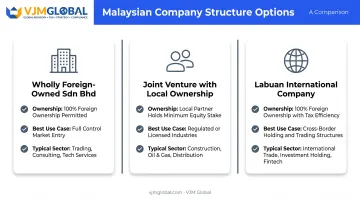
Common formats German founders use include:
- Wholly foreign-owned Sdn Bhd – the standard private limited company
- Joint venture with local ownership – required in select regulated sectors
- Labuan International Company – suited to holding or specific trading structures
Manufacturing carries no general foreign-equity restriction, though a manufacturing licence may still apply under the Industrial Coordination Act.
What to Know Before You Start a Business in Malaysia from Germany
Before you incorporate, get clear on the practical realities of time zones, documentation, and running the setup remotely from Germany.
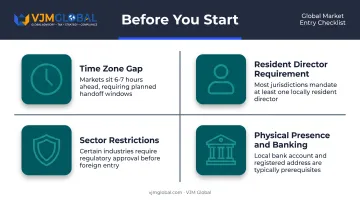
Time Zone and Coordination
Malaysia sits 6-7 hours ahead of Germany. That's manageable for emails and document exchanges, but it means:
- Live calls with SSM, banks, or agents need scheduling around a narrow overlap window
- Urgent document signatures can face a full business-day delay
- Working with a local partner who can act on your behalf during Malaysian business hours saves real time
The Resident Director Requirement
A Sdn Bhd needs at least one director ordinarily resident in Malaysia, with a principal Malaysian residence. Being a German shareholder doesn't satisfy this. Most foreign founders solve it by hiring a nominee director or engaging a corporate services firm that provides one.
Realistic Timelines
Name approval and incorporation can move in days once documents are ready. Bank account opening and specific licenses are a different story; expect several weeks for those, not days.
Sector Restrictions
Some regulated activities—including elements of education, banking, and agriculture—can carry partial Malaysian ownership conditions. Those conditions usually sit in specific licences or approvals, not a blanket rule. Check the exact activity before assuming any percentage.
Physical Presence and Banking
Physical presence is not mandatory for incorporation. Banks, however, often require authorised signatories to attend a branch appointment for account verification.
Why Start a Business in Malaysia from Germany? (When It Makes Sense)
Malaysia isn't a universal fit. It makes strategic sense under specific conditions.
Tax and Cost Advantages
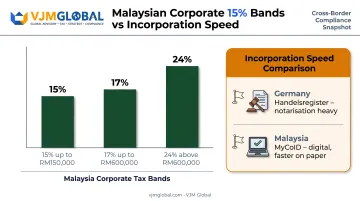
Malaysia's corporate tax structure includes reduced bands for qualifying companies. LHDN publishes 15% on the first RM150,000 and 17% up to RM600,000, before the standard 24% applies above that.
Whether a wholly German-owned Sdn Bhd qualifies for those reduced bands depends on eligibility conditions beyond the headline rates. Confirm this with a tax advisor rather than assuming it.
Operating costs—labour, rental, and utilities—generally run lower than in Germany, though exact comparisons vary by city and sector.
Trade Bloc Access
A Malaysian base gives access to:
- ASEAN's regional market
- RCEP, which MIDA describes as representing roughly 30% of world GDP
- Malaysia's broader trade agreement network
Investment Protection
Malaysia maintains Investment Guarantee Agreements that protect foreign investors against nationalisation risk. That protection matters for German companies moving capital or supply-chain operations abroad.
Faster Incorporation
Compared with Germany's notarisation-heavy registration process through the Handelsregister, Malaysian incorporation via SSM's digital MyCoID system moves faster on paper. Real-world timelines still depend on documentation readiness and bank and licence steps.
Early Decisions That Matter When Setting Up in Malaysia from Germany
Most delays German founders hit come from underestimating statutory requirements that only surface once they are mid-process.
Sdn Bhd vs. Labuan Company
| Factor | Sdn Bhd | Labuan Company |
|---|---|---|
| Capital | No fixed statutory minimum, but licensing/banking needs drive it | One share, no stated further minimum |
| Setup speed | Standard SSM process | Through a licensed Labuan trust company |
| Credibility | Higher for onshore operations | Suited to holding/international activity |
| Government fee | RM1,000 for incorporation | RM1,000-RM5,000 depending on capital band |
| Annual fee | Standard SSM compliance | RM2,600 (RM5,300 for foreign Labuan companies) |
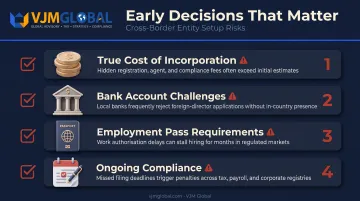
The True Cost of Incorporation
Beyond the RM1,000 SSM filing fee, budget for:
- Name reservation: RM50 per 30 days, up to 180 days
- Registered agent and company secretary fees (private engagement, varies by provider)
- Annual compliance costs (audits, filings, secretarial retainer)
Bank Account Challenges
Banks such as CIMB and Maybank rarely open accounts on incorporation papers alone. Expect:
- A Malaysian employment pass or work permit for foreign nationals
- An in-branch appointment with all authorised signatories present
Remote account opening is possible in limited cases, but plan for in-person activation.
Employment Pass Requirements
If you plan to relocate and manage operations locally, Malaysia's Employment Pass categories (effective policy for 2026) set salary thresholds from RM5,000 to RM20,000+ monthly, tied to pass duration and category. A director title alone isn't work authorization.
Underestimating Ongoing Compliance
Annual returns, audits, and tax filings all require a licensed Malaysian company secretary. That appointment is a recurring legal obligation, not a one-off setup task.
How to Start a Business in Malaysia from Germany – Step by Step
German founders can incorporate in Malaysia in a clear sequence—from structure choice through ongoing compliance—if the legal and banking steps are handled in order.
Watch for three common mistakes: assuming sole proprietorship is open to foreigners (it is not without Malaysian residency), leaving the local director arrangement until late, and underestimating how long bank account setup takes.
Step 1 – Choose the Right Business Structure
Compare your options against your actual goals:
- Sdn Bhd: best for onshore operations, hiring, invoicing, or manufacturing
- Labuan International Company: fits qualifying trading or holding activity
- Branch office: keeps direct legal exposure to the German parent
- Representative office: liaison and feasibility work only, not revenue-generating
Consider liability protection, capital needs, and how the structure scales as you grow.
Step 2 – Reserve Your Company Name and Prepare Documents
Submit a name search through SSM's MyCoID system and prepare identification, passport copies, and registered address details. Documents originating in Germany may need notarisation or legalisation depending on the receiving authority; confirm the exact requirement with SSM and your bank rather than assuming an apostille alone suffices.
Step 3 – Appoint a Local Resident Director and Company Secretary
This is a legal requirement, not a formality. You need:
- At least one director ordinarily resident in Malaysia
- A qualified, SSM-licensed company secretary appointed within 30 days of incorporation
Engaging a local corporate services partner solves both without requiring you to relocate.
Step 4 – Complete Incorporation with SSM
File your company particulars through MyCoID, covering name, business nature, registered office, members, and directors. Once the filing is complete and compliant, SSM issues a notice of registration and assigns your company number—keep that notice for tax, banking, and licence applications.
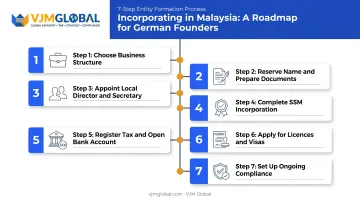
Step 5 – Register for Tax and Open a Corporate Bank Account
Register with LHDN for a Tax Identification Number and confirm which tax band your company qualifies for. For banking, expect KYC steps and likely a branch appointment; some founders explore fintech or digital banking alternatives to reduce in-person requirements, though availability varies.
Step 6 – Apply for Licences, Permits, and Visas (if applicable)
Identify any sector-specific licences your activity needs. If you will manage operations from Malaysia directly, apply for the appropriate Employment Pass category and align the pass timeline with your banking and hiring plans.
Step 7 – Set Up Ongoing Compliance and Accounting Systems
Bookkeeping, annual return filing, and audit prep should start from day one, not after your first filing deadline creeps up.
Ongoing multi-country books and tax are easier with a cross-border partner. VJM Global provides accounting, tax advisory, and compliance support across 16+ markets, using each jurisdiction’s own regulators and statutory frameworks.
Malaysia is not currently among the firm’s documented delivery markets. Remote bookkeeping, cross-border tax advisory, payroll, and Employer of Record coverage across 100+ countries can still support German founders handling accounting and hiring alongside a Malaysian entity. For Malaysia-specific statutory filings, pair that support with a licensed local company secretary.
Conclusion
Starting a business in Malaysia from Germany is legally straightforward on paper, but success depends on getting local director, banking, and compliance requirements right from day one. Skipping or underestimating any of these creates delays that cost more time than incorporation itself.
Getting the structure and documentation correct the first time avoids expensive rework. After incorporation, consistent compliance management from month one is what keeps the entity in good standing.
Frequently Asked Questions
Can foreigners set up a business in Malaysia?
Yes. Foreigners, including Germans, typically set up through a Sdn Bhd or Labuan company. Sole proprietorships and ordinary partnerships are restricted to Malaysian citizens or permanent residents.
What is the most profitable business in Malaysia?
E-commerce, manufacturing, tech services, and trading tend to perform well, but profitability always depends on market research, capital, and execution rather than the sector alone.
What business can I start with RM5,000 in Malaysia?
RM5,000 generally will not cover a fully foreign-owned Sdn Bhd once fees and compliance costs are included. A Labuan company or joint venture is usually a better fit at that budget—confirm the structure with an advisor first.
What business can I start in Malaysia from home?
Home-based options like e-commerce, consulting, or digital services are common, but you still need formal company registration to operate legally as a foreign-owned entity in Malaysia.
Do I need to be physically present in Malaysia to register a company?
Incorporation itself can often be completed remotely. Opening a bank account is a different matter; most banks require in-person verification of authorised signatories at a branch.
How long does it take to register a company in Malaysia from Germany?
Name approval and incorporation can take a few days to two weeks once documents are ready. Bank account setup and any required licensing typically extend the overall timeline to several weeks.