Introduction
Dutch entrepreneurs are looking east more than ever. Germany and the Netherlands moved €205.7 billion in goods between them in 2024, keeping the Netherlands as Germany's third-largest trading partner (Destatis, 2025). That kind of trade flow doesn't happen by accident.
Germany's large consumer base, its central logistics position, and the chance to scale a Dutch business model that already works are pulling founders across the border. Many struggle, though, with knowing which legal structure fits, or whether their nationality changes the rules entirely.
This confusion isn't limited to one type of founder. Dutch nationals, EU citizens living in NL, non-EU founders on Dutch residence permits, freelancers, and NL-registered companies wanting a German branch are all asking the same question. How do I actually do this?
This guide walks through the legal routes, structures, and registration steps specific to founders operating from the Netherlands.
Key Takeaways
- EU/EEA nationals, including Dutch citizens, can run a German business without a visa or residence permit
- Non-EU nationals in the Netherlands are assessed by nationality, not Dutch residency, for German immigration
- Common structures include Freiberufler, Einzelunternehmen, GmbH, UG, or a Zweigniederlassung (branch) of a Dutch BV
- Registration typically spans a few weeks to a couple of months, via the Gewerbeamt, Finanzamt, and Handelsregister
- Cross-border professional support helps avoid delays around banking, notarisation, and compliance
Can You Start a Business in Germany from the Netherlands?
Yes. In practice, this means legally registering and operating a business entity in Germany while being based, resident, or incorporated in the Netherlands. The legal basis for doing so depends heavily on who's asking.
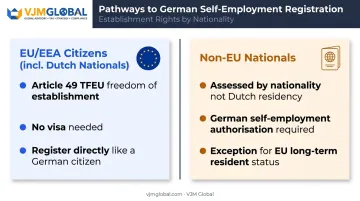
EU/EEA citizens have it straightforward. Article 49 of the Treaty on the Functioning of the European Union protects freedom of establishment (EUR-Lex). It gives Dutch nationals and other EU/EEA citizens the right to set up and run a business anywhere in the EU. No visa. No self-employment permit. Just the same registration process a German citizen would follow.
Non-EU nationals face a different reality. A Dutch residence permit doesn't transfer EU establishment rights. German authorities classify applicants by nationality, not by where they currently live (BAMF). A third-country national residing in the Netherlands generally still needs German self-employment authorisation, unless they hold recognised EU long-term resident status.
Two Ways In
Once eligibility is settled, the next decision is how to structure the German entity itself. Most NL-based founders choose between:
- Setting up a new standalone German entity – a fresh GmbH, UG, or sole proprietorship registered directly in Germany
- Opening a branch office (Zweigniederlassung) of an existing Dutch BV, letting the parent company operate under its own name in the German market
Neither route removes the paperwork. German authorities operate almost entirely in German, so even EU citizens typically need translated documents and local support to move through the Gewerbeamt, Finanzamt, and notary system without delays.
This is where firms like VJM Global come in, supporting companies of any origin, including Netherlands-based businesses, in setting up entities using Germany's own regulators and statutory instruments.
What to Know Before You Start: Structures and Requirements
Most delays for NL-based founders don't come from lack of effort. They come from picking the wrong structure or missing a requirement that only surfaces once it's too late to fix quickly.
Common Legal Structures for NL-Based Founders
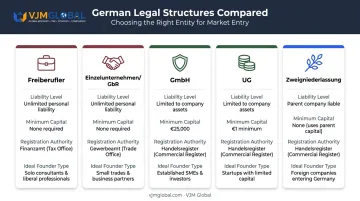
- Freiberufler (freelancer) – only needs Finanzamt registration; suited to consultants, IT professionals, and other liberal professions, with no Gewerbeanmeldung required
- Einzelunternehmen (sole trader) and GbR (partnership) – simple to set up for small-scale trading, but both carry unlimited personal liability
- GmbH – limited liability, requiring notarisation and Handelsregister entry; minimum share capital of €25,000, with at least €12,500 paid before registration
- UG (haftungsbeschränkt) – the lower-capital alternative, starting from €1, though cash contributions must be fully paid before filing
- Zweigniederlassung (branch) – lets an existing Dutch BV operate in Germany under the parent company, without forming a fully separate legal entity
Requirements and Documents Needed
Before registering anything, NL-based founders should have ready:
- A valid passport or ID and proof of Dutch address
- A German registered office address, physical or virtual
- A business plan showing market relevance and financial projections
- Notarised Articles of Association (for GmbH/UG only)
One detail catches many founders off guard. GmbH and UG structures typically need a managing director who is either resident in Germany or another EU/EEA state. German residence isn't strictly mandatory by law, but authorities expect an accountable domestic contact, something worth planning for even if relocation isn't on the table.
Why Germany Makes Sense for NL-Based Businesses
Expansion into Germany works best under specific conditions, not as a guaranteed win. A product or service already validated in the Dutch market, with visible cross-border demand, gives founders a real head start.
The numbers back up why Germany is a logical next market:
- €205.7 billion in bilateral goods trade in 2024 keeps the Netherlands among Germany's top three trading partners, as noted earlier (Destatis, 2025)
- Direct access to the EU single market, with no customs barriers between the two countries
- Short logistics distance, with many Dutch warehouses already serving German customers within a day
- A shared regulatory framework under EU law, even though local implementation still runs through German institutions
Proximity also changes how founders operate day to day. Many NL-based entrepreneurs manage German operations remotely, relying on a local director or partner, such as VJM Global's German entity formation and compliance team, to handle correspondence, filings, and anything requiring an in-person signature. This setup suits businesses that already run lean, distributed teams.
Step-by-Step: How to Register a Business in Germany from the Netherlands
This breaks the process into practical stages. Three mistakes trip up most NL-based founders: skipping the local director requirement, delaying tax registration, or assuming EU citizenship removes all German paperwork. It doesn't.
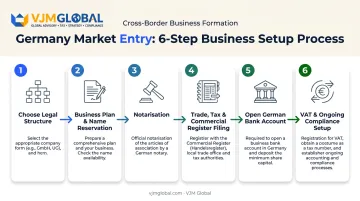
Choose your legal structure and entry route. Decide between Freiberufler, sole trader, GmbH/UG, or a branch of your existing Dutch BV based on liability exposure, available capital, and long-term plans. A common misstep is choosing GmbH purely for credibility without accounting for the €25,000 capital requirement and director-residency expectations.
Prepare a business plan and reserve your company name. Draft a business plan covering market relevance and financial projections. Check name availability with the local Chamber of Commerce (IHK) before drafting formation documents, which avoids costly redrafts later.
Notarise founding documents or register directly. GmbH and UG founders sign Articles of Association before a German notary. NL-based founders who can't travel often use a notarised power of attorney instead. Freelancers and sole traders skip this step entirely and register directly with the relevant office.
Register with the trade office, tax office, and commercial register. Submit the Gewerbeanmeldung at the Gewerbeamt, notify the Finanzamt for a tax number, and file with the Handelsregister if your structure requires it. IHK guidance generally allows about one week for uncomplicated Handelsregister filings, though that covers the register stage only, not banking or tax-number issuance.
Open a German business bank account. Traditional German banks usually require in-person or video verification along with extensive documentation. Fintech providers can often offer faster remote onboarding, which matters for founders who don't plan to travel for every step.
Manage cross-border VAT and ongoing compliance. Register for a German VAT ID, understand how NL-Germany cross-border VAT rules apply to your specific goods or services, and set up a filing calendar covering corporate tax, trade tax, and VAT returns. Firms like VJM Global coordinate this final step with the earlier registration filings, so VAT setup and tax compliance calendars align from day one rather than being bolted on afterward.
Costs, Compliance and Getting Support
Costs depend heavily on structure. Here's a realistic breakdown of what to expect:
| Cost Item | Typical Range |
|---|---|
| Gewerbeanmeldung (trade office) | €20–€60 |
| One-person UG notary fees | ~€105 (excludes disbursements, VAT, court fees) |
| Multi-person GmbH notary fees | ~€630 (excludes disbursements, VAT, court fees) |
| GmbH share capital | €25,000 (€12,500 minimum paid upfront) |
| UG share capital | From €1 |
Figures reflect statutory-fee examples; confirm current amounts with your notary or IHK, as totals vary by founder count and formation route.
Ongoing obligations don't stop at registration. Expect to manage:
- Annual financial statements
- Corporate and trade tax filings
- Regular VAT returns
- Handelsregister updates whenever directors or addresses change
Beyond these filings, cross-border founders also face double taxation risk. The Netherlands-Germany double tax treaty, signed in 2012, addresses this: it prevents income earned across both markets from being taxed twice, relevant for anyone running operations on both sides of the border.
Applying these treaty provisions well is where local expertise helps. VJM Global brings 30+ years of cross-border tax, audit, and entity formation experience across 100+ countries, including dedicated capability in both Germany and the Netherlands. For NL-based founders, that translates into support with director requirements, registration, and ongoing compliance without needing to relocate.
As revenue grows, many UG founders convert to a GmbH for its liability protection and investor appeal. Revisit your structure at that stage rather than treating day-one choices as permanent.
Frequently Asked Questions
How much money do I need to start a business in Germany?
Costs vary by structure. Freelancers may need only a few hundred euros for registration, while a GmbH requires €25,000 in share capital plus notary and registration fees, alongside ongoing accounting costs.
What are the best businesses for Dutch entrepreneurs to start in Germany?
Import-export, IT services, consulting, and e-commerce are commonly cited options for Dutch founders using EU market access. Success depends more on market validation and choosing the right entity structure than on business type alone.
Do Dutch citizens need a visa to start a business in Germany?
No. As EU citizens, Dutch nationals don't need a visa or residence permit to set up or run a business in Germany under EU freedom of establishment rules.
Can I run my German business remotely from the Netherlands?
Yes. Many NL-based founders operate remotely by appointing a Germany or EU-resident managing director or partner to handle local compliance and representation.
What business structure is best for a Dutch entrepreneur expanding to Germany?
GmbH suits founders prioritising credibility and liability protection. UG works for lower-capital startups. A branch of an existing Dutch BV fits companies already trading in Germany.
How long does it take to register a company in Germany from the Netherlands?
Freelancer registration can take just a few weeks. GmbH/UG formation typically needs several weeks longer, depending on notary scheduling and bank account opening.