Introduction
Pennsylvania's mix of tech, healthcare, and manufacturing, paired with its central mid-Atlantic location, keeps drawing new entrepreneurs. Between March 2023 and March 2024, the state saw 34,248 new business establishments open, according to the SBA's 2025 Pennsylvania Small Business Profile.
That interest isn't just local. Out-of-state founders relocating and international entrepreneurs entering the US market increasingly pick Pennsylvania as their base.
Even so, choosing an entity, registering with the state, securing licenses, and getting taxes right still trips up many first-time owners. This guide walks through structure, registration, licensing, and taxes—everything you need to legally start a business in Pennsylvania.
TL;DR
- LLC filing costs $125; corporations pay the same fee
- Register with the PA Department of State and get a free EIN from the IRS
- Plan for state/local taxes, industry licenses, and business insurance after formation
- Foreign founders can use PA for US market entry; secure cross-border compliance support early
What Is Required to Start a Business in Pennsylvania?
Starting a business in Pennsylvania means choosing a legal structure, registering with the state where required, and meeting tax and licensing obligations before you open your doors.
What you must file depends on structure:
- Sole proprietorship — Almost no state filing
- LLC or corporation — Registration with the Department of State, plus ongoing compliance
Pennsylvania suits domestic small businesses and non-US founders building a US presence. Its formal entity types are recognized in all 50 states.
What to Know Before You Start a Business in Pennsylvania
Many first-time founders underestimate the paperwork, tax registration, and ongoing filing obligations that come with running a legitimate business. Settle four things early: entity type, filing speed, DIY vs. help, and what you must file every year.
Entity Type and Liability
A sole proprietorship is fast and needs no state filing, but it offers zero liability protection. An LLC or corporation takes more setup work, yet it shields personal assets from business debts and lawsuits. That choice drives every filing step below.
Filing Timelines and Expedited Options
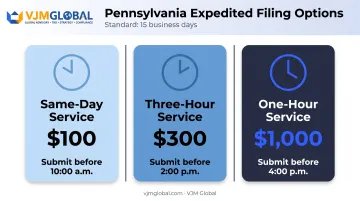
Standard LLC or corporation filings typically process within 15 business days. The Department of State reviews filings in the order received. Need it faster? Expedited options exist:
- Same-day service: $100 (submit before 10:00 a.m.)
- Three-hour service: $300 (submit before 2:00 p.m.)
- One-hour service: $1,000 (submit before 4:00 p.m.)
DIY Support and Ongoing Compliance
Handling registration, EIN applications, and tax setup yourself works for straightforward US-based founders. Non-US founders often hit friction with IRS processes and state tax portals, so guided support through formation and tax setup is usually the safer path.
Formation is only the start. Annual reports, tax filings, and license renewals continue after you are approved. Miss a deadline and the state can administratively dissolve your entity.
Why Start a Business in Pennsylvania? (When It Makes Sense)
Pennsylvania makes sense when your business benefits from mid-Atlantic access, skilled talent, or specific state tax incentives.
Key advantages:
- Central location: Ranks 6th in US GDP per Bureau of Economic Analysis data, within driving distance of New York and Washington, D.C.
- Talent access: Penn State, Carnegie Mellon, and UPenn feed a strong local workforce pipeline
- Tax credit programs: Keystone Innovation Zone credit offers up to $100,000 per company annually for qualifying startups under 8 years old
- Support network: Small Business Development Centers, chambers of commerce, and PIDA loans
- US market entry: Viable option for foreign companies forming a US LLC or corporation
Pennsylvania's corporate net income tax also fell to 7.49% for 2026. If mid-Atlantic access, talent, or those incentives matter to your model, PA belongs on your shortlist.
How to Start a Business in Pennsylvania – Step by Step
Registration and compliance are where most Pennsylvania startups hit friction. Common mistakes include skipping the name availability search, forgetting the registered office requirement, or ignoring local-level taxes entirely.
Step 1 – Choose Your Business Structure
Your options include sole proprietorship, partnership, LLC, and corporation. Most founders seeking liability protection and credibility choose an LLC.
Forming an LLC costs $125 for the Certificate of Organization. Corporations pay the same $125 fee for their Articles of Incorporation.
Common miss: Choosing sole proprietorship purely for convenience, without understanding that personal assets like your home, car, and savings become exposed to business liabilities.
Step 2 – Name Your Business and Check Availability
Search the Pennsylvania Department of State's business entity database before you fall in love with a name. It needs to be distinguishable from existing registered names.
Do you have to include "LLC" in your business name in Pennsylvania? Yes. LLCs must include "company," "limited," "limited liability company," or an approved abbreviation.
Operating under a different name than your legal entity name? File a fictitious name (DBA) registration, which costs $70.
Step 3 – File Formation Documents with the State
Register your Certificate of Organization (LLCs) or Articles of Incorporation (corporations) with the PA Department of State.
Pennsylvania requires a registered office, not a traditional registered agent. That means a physical street address in Pennsylvania. A PO box alone won't work. No suitable address? A Commercial Registered Office Provider can serve this function for you.
How do you register your business in Pennsylvania? File online through the Business One-Stop Shop and DOS Business Filing Services portal. Electronic filings still get human review before approval.
Step 4 – Obtain an EIN and Register for State Taxes
Apply for a federal EIN through the IRS. It's free. You'll need it for tax filing, hiring employees, and opening a business bank account.
Register for state taxes, including sales tax and employer withholding, through myPATH, Pennsylvania's current online business tax registration system (this has replaced the older PA-100 paper workflow).
Here's where things get more complicated for foreign-owned entities without a US Social Security Number: the IRS online EIN tool requires an SSN or ITIN for the responsible party. Without one, you're looking at fax or mail submission of Form SS-4, which can take four business days to four weeks.
VJM Global helps international founders clear this EIN hurdle as part of US entity formation, including registered office setup, formation documents, and FinCEN beneficial-ownership reporting.
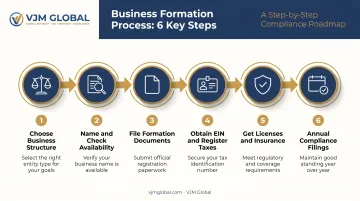
Step 5 – Get Licenses, Permits, and Insurance
Do you need a business license to operate in Pennsylvania? There's no blanket statewide license. However, industry-specific licenses (think food service, contracting, healthcare) and local municipal licenses often apply.
Insurance essentials:
- Workers' compensation: Mandatory for any business with one or more employees, including part-time staff and family members
- General liability: Optional but recommended, particularly for client-facing businesses
Common miss: Assuming that no state license means no license is needed at all, without checking what your city or county requires.
Step 6 – Understand Ongoing Compliance and Annual Filings
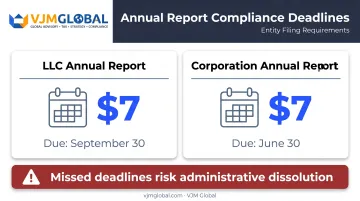
Are there annual fees or registration requirements for an LLC in Pennsylvania? Yes. Since January 1, 2025, Pennsylvania requires annual reports for LLCs and corporations, replacing the old decennial report system.
- LLC annual report fee: $7, due September 30
- Corporation annual report fee: $7, due June 30
Miss the deadline and you risk administrative dissolution of your entity. Build a compliance calendar tracking these dates alongside your federal and state tax return deadlines.
Estimated Costs of Starting a Business in Pennsylvania
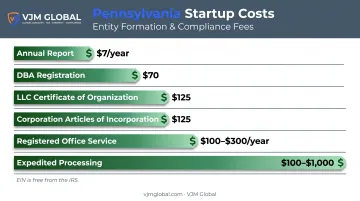
How much does it cost to start a business in Pennsylvania? Plan first for state filing fees, then add licenses and any professional help you use.
| Item | Cost |
|---|---|
| LLC Certificate of Organization | $125 |
| Corporation Articles of Incorporation | $125 |
| Fictitious name/DBA registration | $70 |
| Registered office service (if needed) | $100–$300/year |
| Annual report | $7/year |
| Expedited processing (optional) | $100–$1,000 |
Most formation filings are one-time. The annual report ($7) and any registered-office service are the main recurring state costs.
Budget beyond the table for:
- Federal EIN (free from the IRS)
- Industry or local licenses and permits (fees vary by city and activity)
- Professional formation or compliance support if you do not file yourself
DIY state filings often land near the table totals above. Assisted setup costs more upfront but can reduce errors and follow-up filings.
Conclusion
Starting a business in Pennsylvania comes down to matching the right structure to your goals, filing correctly the first time, and staying ahead of ongoing compliance. Cutting corners on the name search, registered office requirement, or annual report deadlines tends to cost more time and money later than getting it right upfront.
International entrepreneurs entering the US through Pennsylvania face the same requirements plus extra complexity. Cross-border tax treatment, EIN applications without an SSN, and multi-state compliance add layers domestic founders do not face.
Firms like VJM Global help foreign companies form and maintain compliant US entities, including formation documents, tax registration, and ongoing filings.
Frequently Asked Questions
How much does it cost to start a business in Pennsylvania?
LLC and corporation filing fees run $125 each. Add $70 if you need a DBA, plus optional registered office and licensing costs. Total costs depend heavily on your structure and industry.
What do I need to start a business in Pennsylvania?
You'll need a business idea, a chosen legal structure, a registered business name, an EIN from the IRS, and any industry-specific licenses your business requires.
How do I register my business in Pennsylvania?
File your formation documents online through the PA Department of State's Business One-Stop Shop, or by mail. LLCs file a Certificate of Organization; corporations file Articles of Incorporation.
Do I need a business license to operate in Pennsylvania?
There's no single statewide business license. However, many industries and municipalities require specific licenses or permits, so check both state and local requirements.
Are there annual fees or registration requirements for an LLC in Pennsylvania?
Yes. LLCs must file an annual report with a $7 fee, due September 30 each year, plus regular state and federal tax filings.
Do I have to include "LLC" in my business name in Pennsylvania?
Yes. Pennsylvania law requires LLCs to include "LLC," "limited liability company," or an approved variant in their registered legal name.