Here's where the confusion usually starts. Founders, startups, and foreign entrepreneurs often mix up state-level business registration with federal IRS registration, better known as an Employer Identification Number (EIN). Get this wrong, and you're looking at banking delays, hiring headaches, and messy tax filings.
This guide breaks down what IRS registration actually involves, walks through the step-by-step process, and flags the factors that determine exactly what your business needs.
TL;DR
- IRS registration mainly means getting a federal EIN, distinct from your state ID
- EIN requirements vary by entity type, from sole proprietorships to corporations
- Applying directly through the IRS is free and often finished the same day
- Foreign nationals can register a US company and get an EIN without holding an SSN
- Mixing up your EIN with a state ID can delay banking, hiring, and tax compliance
What Is IRS Company Registration?
IRS company registration is the process of obtaining a federal Employer Identification Number (EIN) and, where applicable, electing how the IRS will classify your business for tax purposes. Think of it as your business's federal fingerprint.
The outcome is a unique nine-digit number issued by the IRS that identifies your business for federal tax filing, banking, and hiring, according to the IRS's own EIN page. No two businesses share the same EIN, and it stays with the entity for its lifetime.
This is different from state-level business registration, which happens through your state's Secretary of State office. Both matter. They just serve different purposes.
Business Structures the IRS Recognizes
The IRS doesn't classify entities the same way your state does. LLCs, for example, are created entirely at the state level, but the IRS treats them based on elections made (or not made) after formation:
- Sole proprietorship - taxed on the owner's personal return, no separate entity classification
- Partnership - default classification for multi-member LLCs unless another election is filed
- LLC - can be a disregarded entity, partnership, or corporation depending on membership and elections
- Corporation (C-corp or S-corp) - taxed as a separate entity, with S-corp status requiring an additional election
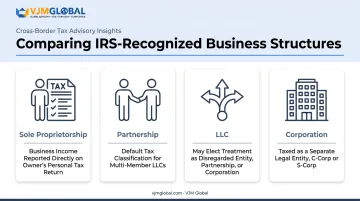
A single-member LLC defaults to being a "disregarded entity" for federal income tax purposes, meaning the IRS effectively ignores it as separate from its owner, unless the owner elects corporate treatment.
Is a Business Registration Number the Same as an EIN?
No. This is one of the most common mix-ups founders run into, and it trips up plenty of experienced business owners too.
A state registration or certificate number confirms your entity legally exists in that state. An EIN is a separate federal identifier used for tax filing, banking, and hiring. The Small Business Administration draws this exact distinction, noting that federal and state tax IDs serve different agencies and different purposes.
Bring the wrong number to your bank or payroll provider, and expect a rejected application.
Why IRS Registration Matters for US Businesses
An EIN does more than satisfy a compliance requirement. It functions as the key that unlocks basic business operations.
You'll typically need one to:
- Open a business bank account
- Hire employees and run payroll
- File federal tax returns
- Apply for business licenses or permits
Skip proper registration, and the consequences compound quickly. Payments to your business could face 24% backup withholding if you can't provide a correct taxpayer ID, according to IRS backup withholding rules. Building business credit becomes harder without a distinct federal identity, and compliance penalties pile on top of that.
Who Actually Needs an EIN?
| Business type | EIN requirement |
|---|---|
| Corporation | Required |
| Partnership | Required |
| Multi-member LLC | Required (defaults to partnership) |
| Single-member LLC with employees | Required |
| Sole proprietor, no employees | Often optional (SSN may work) |
That last row surprises a lot of solo founders. If you're a sole proprietor with no employees and no excise tax obligations, you can often use your Social Security Number instead of an EIN. But the moment you hire someone, add a partner, or bring on a co-owner, that exception disappears.
How to Register Your Company with the IRS: Step-by-Step Process
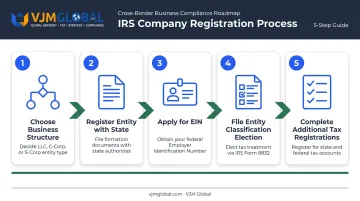
The full journey runs from choosing your structure, to registering with your state, to securing your EIN, and finally to any tax classification elections your entity needs. Here's how each piece fits together.
Step 1: Choose Your Business Structure
This decision shapes everything downstream: the tax forms you'll file, your ongoing compliance obligations, and, by default, how the IRS classifies your business. An LLC, corporation, partnership, or sole proprietorship each carries distinct rules, so getting this right upfront avoids costly restructuring later.
Step 2: Register Your Entity with the State
Before the IRS will issue an EIN for most entities, you need to register your name and formation documents with your state's Secretary of State. This produces your state registration certificate or number, the one that's often confused with an EIN.
Step 3: Apply for an Employer Identification Number (EIN)
Once your entity exists at the state level, apply for your EIN. This step is free when done directly through the IRS, and applications submitted online are usually approved and issued immediately, according to the IRS's EIN application guidance.
A few requirements to keep in mind:
- You'll need a "responsible party" — the individual who ultimately owns or controls the entity
- That person needs an SSN, ITIN, or an approved alternative for foreign applicants
- Your principal business location must be in the US or a US territory to use the online tool
Applications can also go by fax or mail, and eligible international applicants may apply by phone.
Step 4: File an Entity Classification Election (If Applicable)
If your LLC wants to be taxed as a corporation instead of the IRS default classification, you'll file Form 8832. There's a specific window here: the elected effective date can be no earlier than 75 days before filing and no later than 12 months after filing, per the Form 8832 instructions. Miss that window, and the IRS applies default dates automatically.
Step 5: Complete Additional Tax Registrations
Getting your EIN isn't the finish line. Depending on your business, you may also need:
- A state tax account for income or employment tax purposes
- A sales tax permit if you sell taxable goods or services
- Payroll tax registration and new-hire reporting once you bring on employees
These follow-on registrations vary by state, so check your specific state's requirements once your EIN is in hand.
Key Considerations and Common Mistakes in IRS Registration
Even founders who follow every step correctly still run into avoidable snags. Here are the ones that come up most often.
Treating a state number as your EIN. This is the classic error. Banks, payroll providers, and the IRS all expect the federal EIN specifically. Handing over your state certificate number instead will stall your application every time.
Forgetting to get a new EIN after a structural change. If a sole proprietorship converts to an LLC, or a single-member LLC adds a partner, the IRS generally requires a new EIN. Businesses that keep using the old number can run into filing mismatches down the line.
Paying for something that's free. The EIN itself costs $0 directly through the IRS. Yet plenty of founders pay third-party sites to "process" their application. State LLC filing fees, on the other hand, genuinely vary:
- Kentucky: around $40 for Articles of Organization
- California: around $70 for Articles of Organization
- Massachusetts: around $500 for a Certificate of Organization
That $40–$500 range reflects real state filing fees, not EIN costs, so don't let the two get blurred.
Foreign-owner considerations. Non-US residents and NRIs can register a US LLC or corporation and obtain an EIN, no citizenship or SSN required. Instead, applicants use the IRS's alternative procedure for the responsible party line on Form SS-4. That said, foreign founders typically still need a registered agent in their formation state, plus guidance on how the US entity interacts with tax obligations back home.
This is where specialized cross-border advisory firms add real value. VJM Global, with 30+ years of tax and business-advisory experience and a presence in New York, works with NRIs, OCIs, and international founders navigating cross-border compliance questions around US entity setup. That includes everything from FEMA advisory to international tax planning and DTAA considerations tied to income earned in the US.

Conclusion
IRS company registration boils down to one core task: getting your EIN and locking in the correct tax classification, distinct from whatever your state issued you. Confuse the two, and you're setting yourself up for banking issues, a round of tax penalties, and compliance cleanup that was easy to avoid.
Whether you're launching a solo venture or structuring a cross-border business between the US and India, getting the sequence right the first time saves real time. Firms like VJM Global help founders handle that sequence, from entity setup and EIN registration to ongoing tax filings, so nothing gets overlooked as the business grows.
Frequently Asked Questions
Is a business registration number the same as an EIN in the USA?
No. A state registration or certificate number confirms your entity exists at the state level, while the EIN is a separate federal tax identifier issued by the IRS. Businesses typically need both.
How do I register an LLC in the US?
File your formation documents with your state's Secretary of State first, then apply for a free EIN through the IRS. From there, file any needed tax classification elections, such as Form 8832 for corporate treatment.
How much money is required to register an LLC in the USA?
The EIN itself is free through the IRS. State filing fees vary widely, ranging from around $40 in Kentucky to around $500 in Massachusetts, depending on your state.
Do I need an EIN if my business has no employees?
Sole proprietors without employees can often use their SSN instead of an EIN. However, multi-member LLCs, partnerships, and corporations need an EIN regardless of employee count.
Can a non-US resident register a company and get an EIN in the US?
Yes. Foreign nationals can form a US company and obtain an EIN without an SSN by using the IRS's alternative application procedures for the responsible party section of Form SS-4.
How long does it take to get an EIN from the IRS?
Online applications are typically issued immediately upon approval. Fax applications take about four business days, while mailed applications can take around four weeks, per current IRS processing guidance.