Many first-time founders share the same worries: Will I be personally liable if the business gets sued? How will profits get taxed? Who actually owns the company if a partner leaves? Can someone outside the US even form an American company?
These concerns are valid. Choose the wrong entity, miss a state filing deadline, or misread federal tax rules, and you can end up with an unexpected tax bill or lose the liability protection you formed the entity to get in the first place.
This guide covers the four primary legal forms, how state and federal law work together, the formation steps in order, the compliance calendar that follows, and what changes for founders who live outside the US.
Key Takeaways
- State law creates LLCs and corporations; federal law adds tax, employment, securities, and interstate commerce rules
- Match your entity to liability exposure, tax goals, ownership, funding plans, and compliance capacity
- Forming in one state does not erase registration, tax, or licensing duties where you actually operate
- Confirm requirements with the Secretary of State, IRS, and regulators, and get legal or tax advice before filing
What Laws Govern Business Formation in the USA?
The US has no single federal process for forming an ordinary LLC or corporation. Each of the 50 states (plus DC) writes its own business-entity statutes, and you form your company under whichever state's laws you choose.
State agencies control the formation mechanics. A Secretary of State, or equivalent agency, approves your entity name, accepts your formation paperwork, records your registered agent, and issues confirmation that the entity legally exists.
Texas, for instance, processes certificates of formation through its SOSDirect portal and will reject a name that isn't "distinguishable" from one already on file.
Once your entity exists, federal law takes over in several areas:
- Tax registration and reporting with the IRS, including annual returns and employment taxes
- Employment rules covering wages, benefits, workplace safety, and required notices once you hire staff
- Securities compliance if you raise capital from outside investors
- Consumer protection and advertising standards enforced by the FTC
- Industry-specific regulation, which varies widely by sector
Formation Law vs. Operating Law
This distinction trips up a lot of founders. Your formation state typically governs internal affairs: ownership structure and how disputes between owners get resolved.
Any state where you actually operate can impose its own registration, tax, and licensing rules. That includes places where you have employees, an office, inventory, or regular customers.
Forming in Delaware doesn't exempt you from California's requirements if you're running the business out of Los Angeles. Confirm requirements directly with the IRS, SEC, FTC, Department of Labor, and the filing agency in every state where you operate. Rules shift by entity type, industry, and activity, so verify obligations before you file or expand.

What Are the Four Legal Forms of Business?
Four structures cover almost every US business: sole proprietorship, partnership, limited liability company, and corporation. A DBA or trade name is only a nickname your existing entity operates under—not a separate legal structure.
Sole Proprietorship
One owner, no legal separation between the owner and the business. It's the simplest structure to start, often needing only local registrations or licenses. But there's no liability shield, so business debts and lawsuits become the owner's personal problem too.
Partnership
Two or more owners sharing management, profits, and losses. Liability depends on the partnership type:
- General partnership: Liability splits among all partners by default
- Limited partnership (LP): One general partner carries unlimited liability; limited partners stay protected
- Limited liability partnership (LLP): Liability protection extends to every owner
A written partnership agreement matters more than most founders realize. Without one, state default rules decide how profits split, how decisions get made, and what happens when someone wants out.
Limited Liability Company (LLC)
An LLC is a separate legal entity that limits personal liability for business debts and lawsuits, provided you keep proper records and treat the company as genuinely separate. Management is flexible, member-managed or manager-managed, and taxation is usually pass-through by default.
A single-member LLC is disregarded as separate from its owner for federal tax purposes; a multi-member LLC defaults to partnership taxation. Either can elect corporate tax treatment via Form 8832. State filing and ongoing compliance requirements vary, so verify specifics with the formation state before assuming anything transfers from another state.
Corporation: C-Corp vs. S-Corp
A corporation is a separate legal person owned by shareholders and run by directors and officers, with formal governance requirements like bylaws, board meetings, and documented minutes.
- C-corporations can face double taxation (corporate level, then dividends) but have no shareholder-type or count limits—venture investors usually prefer this structure.
- S-corporations get federal pass-through tax treatment but face strict rules, including a 100-shareholder cap and a single class of stock.
The IRS requires a domestic corporation with allowable shareholders only: individuals, certain trusts, and estates qualify; partnerships, corporations, and nonresident aliens do not.
Choosing Between Them
There's no universally "best" entity. Weigh these factors instead:
| Factor | Consideration |
|---|---|
| Liability protection | Sole proprietorships and general partnerships offer none by default |
| Tax flexibility | LLCs and S-corps offer pass-through options; C-corps don't |
| Ownership and investment | C-corps handle multiple share classes and outside investors best |
| Administrative burden | Corporations require more formal governance than LLCs |
| Growth plans | Businesses planning to raise institutional capital often favor C-corps |
According to the Small Business Administration, sole proprietors have no separation between business and personal assets, which is exactly the exposure that pushes many founders toward an LLC or corporation instead.
How to Form a Business in the USA: Step-by-Step
Formation follows a consistent sequence, regardless of which entity you choose.
- Define your business model and ownership. Identify who owns the company, what it will do, where it will operate, and whether you'll sell to customers across multiple states. This shapes every decision that follows.
- Choose the entity and formation state. Popular formation states include Delaware, Wyoming, Nevada, Texas, Florida, and California, each with different governance rules, privacy provisions, and fees. Weigh where you'll operate against where you'll incorporate, and verify current state-specific requirements.
- Select and protect the business name. Check name availability with your state's filing agency, confirm required designations like "LLC" or "Inc.," and search the USPTO database for trademark conflicts before you commit.
- Appoint a registered agent. This person or service receives legal and official notices on the company's behalf. Most states require a physical in-state address, not a PO box, and expect the information to stay current.
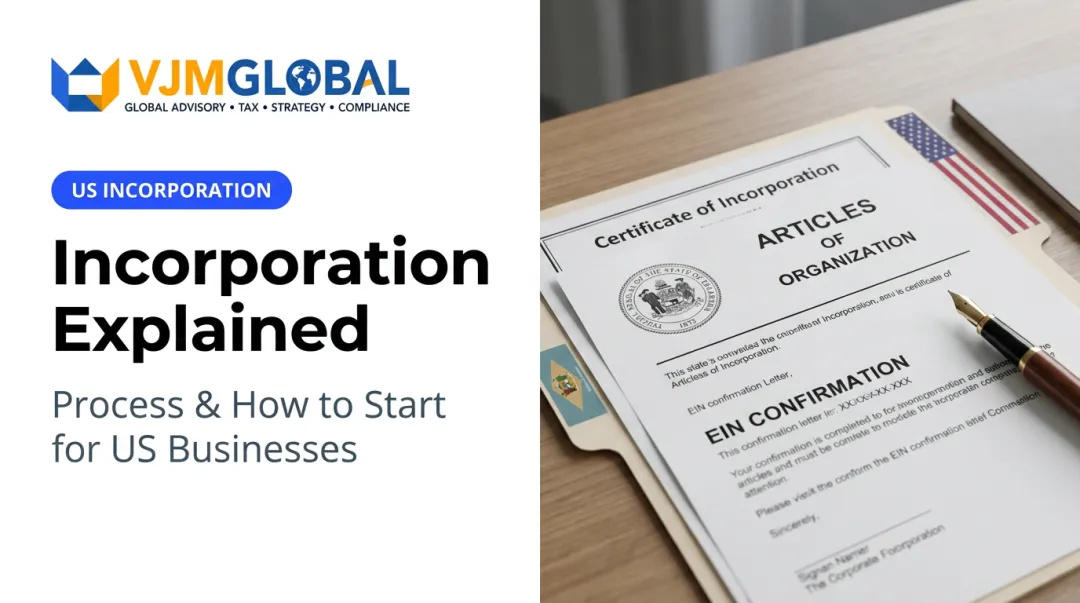
- File formation documents. LLCs file Articles of Organization; corporations file Articles of Incorporation. Each state form requires specific information, signatures, and a filing fee, with formal state approval confirming the entity exists.
- Create internal governance documents. LLCs should adopt an operating agreement; corporations should adopt bylaws, appoint directors and officers, and issue ownership shares. Document these initial actions in writing.
- Obtain federal, state, and local registrations. This includes an EIN from the IRS, state tax accounts, sales-tax registration where applicable, employer registrations, and any professional licenses or local permits your industry requires.
- Establish operational separation. Open a business bank account, keep separate financial records, sign contracts in the entity's name, and document major decisions. This paper trail is what actually protects your liability shield if it's ever tested in court.

VJM Global handles this filing and registration workload for founders who'd rather not chase paperwork across state and federal agencies. That help matters most when you need a registered agent, an EIN, and an operating agreement or bylaws set up correctly from day one.
State, Federal, and Ongoing Compliance Obligations
Formation gets your entity on the books. Staying compliant is an ongoing job that keeps it in good standing.
State-Level Compliance
Most states require annual or biennial reports, franchise or annual fees, and continuous registered-agent maintenance to keep your entity in good standing.
Georgia, for example, requires corporations to file their first annual registration within 90 days of incorporation and then between January 1 and April 1 every year after. Texas ties franchise-tax filings to the Comptroller's office rather than the Secretary of State. Always check your formation state's official filing agency for current deadlines and fees.

Federal Compliance
Federal obligations depend partly on your entity type:
- Income-tax reporting: most entities file annual returns; partnerships file information returns instead
- Payroll taxes: employers handle Social Security, Medicare, income-tax withholding, and FUTA
- Corporate return forms: Form 1120 for C-corps, Form 1120-S for S-corps, Form 1065 for partnerships
- Securities compliance if you're raising outside capital
- Beneficial-ownership reporting to FinCEN, where applicable
Multi-State Operations and Foreign Qualification
Operating in a state beyond your formation state, whether through employees, an office, inventory, or regular business activity, often triggers a requirement to register as a foreign entity there. Thresholds differ by state; New York, for example, requires a foreign LLC to apply for authority before doing business, and the application must identify the county of its in-state office.
VJM Global manages multi-state tax compliance in this situation, covering state income tax, sales tax, and payroll tax across the states a business actually touches.
Tax and Compliance Tracking
Keep a running calendar for:
- Filing deadlines and tax payments
- License and permit renewals
- Registered-agent updates
- Ownership changes
- Record retention
Consequences of Non-Compliance
Missing deadlines or losing your registered agent can lead to penalties, interest, loss of good standing, or administrative dissolution.
A dissolved entity typically can only wind up and liquidate until reinstated, and it may lose the ability to bring certain legal claims in the meantime. Verify current penalty specifics with your state's filing agency or a licensed professional rather than assuming a flat fee applies everywhere.
This section is educational. Entity selection, state registration, tax planning, securities matters, and regulatory interpretation should be reviewed with licensed US professionals before you act on them.
Special Considerations for Non-US Founders and Cross-Border Businesses
Non-US citizens and foreign companies can generally own a US entity. Formation alone doesn't grant immigration permission to work in or physically manage the business from inside the US, so this needs separate legal advice.
Practical requirements for international founders typically include:
- A US registered agent with a physical address
- Acceptable identification for filing and banking purposes
- An EIN via Form SS-4 (enter "foreign" if you lack an SSN; online filing usually needs a US address)
- An ITIN, if the individual needs one and can't obtain an SSN
- Bank due-diligence documents and beneficial-ownership disclosures where required
FinCEN's beneficial-ownership rules changed significantly. Under the current rule, US companies are exempt from BOI reporting entirely.
Only certain foreign companies registered to do business in the United States must still report. FinCEN confirms those companies don't report US-person beneficial owners or US-person company applicants. Verify the current requirement before assuming it applies to your entity.

International owners often face tax exposure on both sides of the border, including US federal and state filings alongside home-country tax, withholding, transfer-pricing, or permanent-establishment questions depending on the applicable treaty.
Those tax and presence questions also shape structure. Forming a new US entity is different from qualifying an existing foreign company to do business here. Existing companies weigh a US subsidiary, a branch, or simple foreign qualification based on liability exposure, tax treaty benefits, and how much US presence the business actually needs.
VJM Global supports the accounting, tax compliance, and financial advisory side of this work, including cross-border structuring such as Form W-8/W-9 handling, 1042-S filings, and GILTI-related planning for businesses managing operations between the USA and India.
This isn't a substitute for US legal counsel. Coordinate a US business attorney, a qualified tax professional, and, where relevant, a home-country adviser before finalizing ownership, tax classification, or expansion decisions.
Frequently Asked Questions
What are the major business laws in the USA?
State laws govern entity formation and internal governance, while federal law covers taxation, employment, securities, consumer protection, and interstate commerce. Which rules apply depends heavily on your entity type and business activities.
What are the four legal forms of business in the USA?
The four forms are sole proprietorship, partnership, limited liability company, and corporation. They differ significantly in liability protection, taxation, ownership flexibility, and ongoing compliance requirements.
What are the steps to form a company in the USA?
Choose an entity and state, clear the business name, appoint a registered agent, and file formation documents. Then adopt governance documents, obtain an EIN and required licenses, open a business bank account, and keep up with ongoing compliance.
What are the requirements for forming an LLC in California?
Confirm current requirements and fees directly with the California Secretary of State. They generally include name availability, a California registered agent, Articles of Organization, state tax registrations, applicable licenses, and a recurring Statement of Information filing.