
US business owners are drawn in for specific reasons: asset protection, the prestige of a Swiss corporate address, and holding structures that make sense for IP-heavy businesses. The interest spans everyone from solo SaaS founders to established US corporations opening a European foothold.
This guide walks through entity types, real costs, the registration process, and the compliance obligations that come with running a Swiss company as a US citizen or US-based business.
TL;DR
- Switzerland allows 100% foreign ownership, but you need a Swiss-resident director with signing authority
- GmbH requires CHF 20,000 minimum capital; AG requires CHF 100,000 (CHF 50,000 paid-in)
- US citizens face work permit quotas as non-EU/EFTA nationals; rules are stricter than for EU founders
- Registration takes 2-4 weeks once documents and capital are ready
- Corporate tax ranges from 11.85% to 20.5% depending on canton
What Does It Mean to Start a Business in Switzerland as a US Entrepreneur?
It means forming a legally recognized Swiss entity (or branch) while you're based in, or operating from, the United States.
There are two common paths:
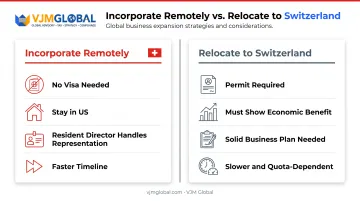
- Incorporate remotely: set up the company with a Swiss-resident director or manager while you stay in the US
- Relocate physically: move to Switzerland and run operations day-to-day, which triggers immigration requirements
Most US founders choose one of three structures:
- GmbH: Swiss limited liability company, favored by SMEs and bootstrapped founders
- AG: Swiss stock corporation, preferred by investor-backed or larger ventures
- Branch office: used by existing US companies extending operations into Switzerland
Can a US Citizen Start a Business in Switzerland?
Yes. A US citizen can start and fully own a Swiss company. The catch is status: US citizens are non-EU/EFTA nationals, and that single fact changes the process compared with a founder from Germany or France.
The Resident-Director Requirement
Non-EU/EFTA owners don't automatically get a Swiss residence permit just because they own a company. Both GmbH and AG structures require at least one Swiss-resident director or manager with signing authority. This is a company-law requirement, separate from immigration status.
Permit Quotas Matter If You're Relocating
If you want to move to Switzerland and run the business yourself, you'll need a work/residence permit (L or B). These are capped annually. For 2026, the Federal Council reserved 8,500 permits for third-country nationals: 4,500 B residence permits and 4,000 L short-stay permits. That pool covers the entire non-EU/EFTA applicant base, not just entrepreneurs.
Two very different paths:
- Incorporate remotely: faster, no visa needed; you stay in the US while a resident director handles legal representation
- Relocate to run the business: slower and permit-dependent; you must show economic benefit to Switzerland, a solid business plan, and adequate capital
Most US founders who don't plan to physically move choose the remote path. You can own 100% of the company without setting foot in Switzerland, as long as the resident-director box is checked.
Why Start a Business in Switzerland From the USA?
Switzerland isn't automatically the right move for every US business. It makes the most sense under specific conditions.
When it tends to pay off:
- USD 1 trillion+ in cumulative inward FDI as of 2022, with 41% from the United States (US Department of State, 2024)
- Combined corporate income tax of roughly 11.66%–20.54% by canton (PwC), competitive with other Western European jurisdictions
- Strategic access to Germany, France, and Italy without joining the EU
- Political and economic stability that makes it a favoured jurisdiction for holding structures and asset protection
- Patent Box regimes that can exempt up to 90% of qualifying patent income, plus R&D super-deductions in most cantons
None of this guarantees success. It fits businesses with genuine EU-facing ambitions, IP to protect, or capital that benefits from Swiss stability, not every US startup by default.
Early Decisions US Founders Often Get Wrong
Most early mistakes come from underestimating cantonal complexity and how Swiss rules overlap with US compliance.
Common missteps:
- Choosing a canton for brand appeal (Zurich sounds impressive) instead of actual tax fit for the business model
- Underestimating total setup costs: capital, notary fees, registration, and ongoing fiduciary/accounting fees
- Forgetting that US tax reporting (FATCA, FBAR, GILTI) runs in parallel with Swiss obligations, not instead of them
- Assuming remote incorporation removes the resident-director requirement. It doesn't.
- Not budgeting early for professional help (notary, fiduciary, cross-border tax advisor)
How to Start a Business in Switzerland From the USA — Step by Step
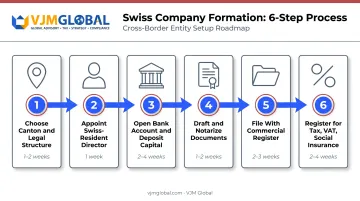
US founders who register cleanly in Switzerland work through six practical stages. The mistakes that cost the most time are skipping canton comparison, underestimating bank timelines, and ignoring US tax overlap until it is too late.
Step 1 – Choose Your Canton and Legal Structure
Different cantons serve very different business types:
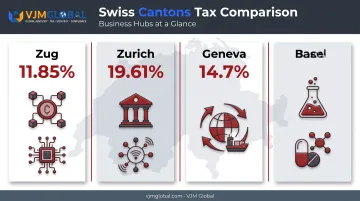
- Zug — lowest tax rate (around 11.85%), strong for headquarters and crypto/digital innovation
- Zurich — talent and finance hub, higher tax (roughly 19.61%), strong for ICT and life sciences
- Geneva — international business hub, around 14.7%, strong for finance and commodities trading
- Basel — life sciences and pharma hub, often chosen when sector networks matter more than the lowest headline rate
Then decide between GmbH (CHF 20,000, SME-friendly) and AG (CHF 100,000, better for investor-backed ventures).
Common miss: Picking Zurich for name recognition when the business would fit better—and cost less in tax—in Zug.
Step 2 – Appoint a Swiss-Resident Director
Mandatory for GmbH, AG, and branch offices alike. Many US founders use professional resident-director services rather than relocating staff or asking a Swiss contact to serve.
Common miss: Discovering this requirement only after already starting the formation process, which forces a restart.
Step 3 – Open a Swiss Bank Account and Deposit Capital
Deposit the full CHF 20,000 for a GmbH, or at least CHF 50,000 of the CHF 100,000 AG share capital, into a Swiss account before incorporation completes.
Banks apply enhanced due diligence for foreign-owned companies — often requiring an in-person meeting or extensive documentation. Foreign-owned entities should plan for 7–30 business days for onboarding.
Common miss: Assuming this step takes days instead of weeks.
Step 4 – Draft and Notarize Legal Documents
Prepare articles of association covering purpose, structure, and governance. All signatures must be authenticated by a Swiss notary.
Common miss: Submitting documents that don't meet Swiss formatting standards, which causes avoidable delays.
Step 5 – File With the Commercial Register
Submit notarized documents, bank confirmation, and director details through EasyGov or in person. Processing typically takes 5-10 business days, though it can stretch to 2-3 weeks if additional documents are requested.
Common miss: Incomplete paperwork, which is the single biggest cause of delay at this stage.
Step 6 – Register for Tax, VAT, and Social Insurance
Register for cantonal and federal tax. VAT registration becomes mandatory once worldwide turnover from taxable supplies reaches CHF 100,000 per year. Enroll for AHV/AVS social security and mandatory accident insurance if you're hiring staff.
Common miss: Assuming a Swiss entity replaces US filing obligations. It doesn't — both run in parallel.
What It Costs and How Long It Takes
Setup costs:
| Structure | Minimum Capital | Registration/Setup Fees |
|---|---|---|
| GmbH | CHF 20,000 | CHF 3,000–7,000 |
| AG | CHF 100,000 (CHF 50,000 paid-in) | Typically above the GmbH range (capital + notary) |
Standard setup fees for government charges, notary work, and document preparation typically run CHF 3,000–7,000, excluding share capital.
Ongoing costs:
- Fiduciary/accounting services: CHF 200–800/month
- Resident director fees if you outsource the role
- Annual compliance filings and statutory reporting
Realistic timeline: Registration itself takes 2–4 weeks. Factor in banking and, if relevant, permit processing, and the full timeline for US founders often runs 1–2 months.
Staying Compliant Across Two Countries: US + Swiss Obligations
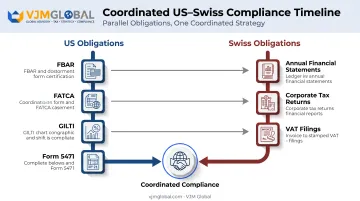
Forming a Swiss company doesn't pause your US tax obligations. As a US citizen or US entity owner, you still need to account for:
- FBAR — required when foreign account balances exceed USD 10,000 at any point in the year, per FinCEN's reporting requirements
- FATCA — foreign financial institutions may report your Swiss accounts to the IRS, and you may have separate reporting duties
- GILTI — calculated on Form 8992 if you're a US shareholder of a controlled foreign corporation
- Form 5471 — required for US persons who are officers, directors, or shareholders of certain foreign corporations (one form per entity)
Your Swiss entity runs on a separate clock, and those deadlines rarely line up with the US calendar:
- Annual financial statements
- Corporate tax returns
- VAT filings
Dual-compliance trips founders up because two regulatory calendars are easy to miss at once. VJM Global supports American business owners with cross-border accounting and international tax planning, including FBAR filings, FATCA/Form 8938 foreign reporting, and IRS foreign tax credits under Form 1116. That keeps US filings and Swiss company obligations on one coordinated track instead of two disconnected projects.
Conclusion
Starting a Swiss business from the US is achievable. It requires getting three things right: the resident-director rule, canton selection based on actual fit rather than name recognition, and dual-country compliance from day one.
Speed matters less than clarity here. A founder who spends an extra week comparing Zug against Zurich, or confirming their tax advisor understands both FATCA and Swiss VAT, will end up ahead of one who rushed the paperwork.
Registration is only the start. Long-term success depends on ongoing compliance management on both sides of the Atlantic, year after year.
Frequently Asked Questions
How much does it cost to start a business in Switzerland?
A GmbH requires CHF 20,000 in capital plus roughly CHF 3,000–7,000 in setup fees; an AG requires CHF 100,000 in capital with similar or higher professional fees. Ongoing fiduciary and accounting support typically runs CHF 200-800 per month.
Can a foreigner start a business in Switzerland?
Yes, 100% foreign ownership is permitted for both GmbH and AG structures. However, the company must have at least one Swiss-resident director or manager with signing authority.
Is it difficult for a US citizen to move to Switzerland?
Relocating requires a work/residence permit subject to annual quotas for non-EU/EFTA nationals — 8,500 total permits were set for 2026. Incorporating remotely, without relocating, avoids this permit process entirely.
Do I need to visit Switzerland in person to register a company?
Notarization and bank account opening often involve in-person steps, particularly for foreign-owned entities facing enhanced due diligence. Some of this can be handled through a local representative or resident director instead.
Will I still owe US taxes on a Swiss company I own?
Yes. FBAR, FATCA, GILTI, and Form 5471 obligations all apply to US persons who own or control a foreign entity, regardless of where the company operates.
Which Swiss canton is best for a US-owned business?
It depends on your business type: Zug offers the lowest tax rate and suits holding or digital companies, Zurich fits finance and tech ventures needing talent access, and Geneva suits international and commodities-focused businesses.