
Many UAE entrepreneurs still believe that starting a US business means relocating or wading through impossible red tape. That's outdated thinking. Foreign nationals can own and operate a US LLC or corporation entirely remotely, with the right structure in place.
This guide walks through the best small business ideas for UAE entrepreneurs entering the US market, plus the legal and compliance steps needed to launch one properly.
Key Takeaways
- Foreign owners can hold 100% of a US business with no residency requirement
- E-commerce, real estate, and franchising are the strongest remote-friendly models from the UAE
- Use an LLC for most small businesses; choose a Delaware C-Corp if you plan to raise capital
- Nail compliance (EIN, registered agent, tax filings)—it matters more than the idea you pick
Why the USA Is a Prime Market for UAE Entrepreneurs
For UAE founders, three structural advantages make the US especially workable:
- World's largest consumer market, with deep demand across product and service niches
- Strong legal protections for business owners and enforceable contracts
- No requirement for foreign nationals to live in the US to own a company
Trade volume supports that opportunity. UAE-US trade totaled $39 billion, with US exports of goods and services to the UAE reaching $31.4 billion, according to US-UAE Business Council trade data. The UAE has been the largest Middle Eastern market for US goods and services for 17 consecutive years.
That corridor means capital, supplier relationships, and sector know-how already flow both ways—useful when you pick a US niche you can actually serve from the Gulf. Below, the ideas that fit best are filtered by capital access, existing trade expertise, and US demand trends.
Top Small Business Ideas in the USA for UAE Entrepreneurs
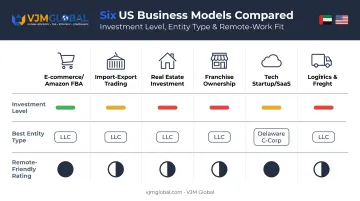
Each idea below was selected using four filters: alignment with UAE entrepreneurs' capital strength, existing trade networks, real US market demand, and how easily the business can run remotely or semi-remotely.
E-Commerce and Amazon FBA Business
E-commerce is one of the most accessible entry points for foreign owners. UAE entrepreneurs already familiar with online retail and regional supply chains can plug directly into US demand.
You rarely need a physical US footprint, and the same operation can scale across US and GCC markets at once.
| Factor | Details |
|---|---|
| Startup Investment Range | Low-to-mid capital; costs scale with inventory volume, advertising spend, and Amazon's Professional plan fee of $39.99/month plus selling fees |
| Best US Entity Type | LLC, commonly used by e-commerce sellers, though Amazon doesn't require incorporation to sell |
| Physical Presence Needed | None typically required; the business can run with a registered agent handling official correspondence |
Import-Export and International Trading Company
The UAE's position as a global trade hub gives entrepreneurs a natural edge here. Existing supplier relationships across Asia and the Middle East pair well with access to US distribution channels.
What makes this stand out is the combination of established sourcing networks and a market hungry for reliable imports.
| Factor | Details |
|---|---|
| Startup Investment Range | Moderate capital tied to inventory financing, freight, and customs bonding costs |
| Best US Entity Type | LLC or C-Corp, depending on investor structure and future fundraising plans |
| Key Consideration | US Customs and Border Protection requires Importer of Record registration, along with customs compliance and freight partnerships |
Note: US Customs and Border Protection doesn't impose a general importer license requirement, though product-specific permits may still apply depending on what's being imported.
US Real Estate Investment and Rental Business
Real estate appeals to UAE entrepreneurs already comfortable with property investment culture, given Dubai and Abu Dhabi's active markets. Foreign buyers aren't a small niche either: they purchased 67,100 US homes worth $45.3 billion in a recent 12-month period, according to National Association of Realtors data.
Stable rental yields and portfolio-building potential are the draw, and you don't need US residency to pursue either.
| Factor | Details |
|---|---|
| Startup Investment Range | Higher capital requirement than most service businesses; varies heavily by property type and market |
| Best US Entity Type | LLC, commonly used to hold and manage rental property while limiting personal liability |
| Key Consideration | FIRPTA rules apply; buyers of property from foreign sellers generally withhold 15% of the total amount realized on sale, so structure and exit planning matter |
Franchise Ownership in Retail or Food & Beverage
Franchising offers a proven playbook, which resonates with UAE entrepreneurs used to a franchise-heavy retail culture at home. Brand recognition and franchisor support reduce the market research burden considerably.
That built-in support system is exactly why this model works well for entrepreneurs entering an unfamiliar market.
| Factor | Details |
|---|---|
| Startup Investment Range | Wide range depending on brand; initial franchise fees alone typically run $20,000 to $50,000, with total investment often much higher once premises and equipment are added |
| Best US Entity Type | LLC, the standard structure for individual franchise operators |
| Key Consideration | Owners remaining in the UAE will likely need a US-based operating partner or manager; check the franchisor's disclosure document for any residency or control requirements |
Tech Startup or SaaS Business
UAE entrepreneurs plugged into the growing Gulf tech ecosystem often find natural synergy in launching a US-facing SaaS venture. The main draw is access to the world's largest tech investment pool and customer base.
US venture capital backs that up: firms completed 15,352 deals worth $320 billion in 2025, up 51% by value, according to the NVCA's 2026 Yearbook.
| Factor | Details |
|---|---|
| Startup Investment Range | Highly variable; depends on product development scope and whether you're bootstrapping or raising |
| Best US Entity Type | Delaware C-Corp, the common structure for startups seeking outside investment, largely due to investor familiarity with Delaware's corporate framework |
| Key Consideration | IP protection and investor-ready incorporation matter from day one; retrofitting a structure later is expensive |
Logistics and Freight Forwarding Services
The UAE's status as a logistics and re-export hub translates directly into an advantage for entrepreneurs offering freight services connecting US and Gulf trade routes.
E-commerce-driven demand for last-mile and cross-border logistics keeps growing in the US, which supports steady need for freight and forwarding capacity.
| Factor | Details |
|---|---|
| Startup Investment Range | Moderate capital for a lean operation; costs rise with fleet, warehousing, or brokerage bonding needs |
| Best US Entity Type | LLC, typical for logistics operators managing brokerage or forwarding services |
| Key Consideration | Property brokers need FMCSA authority, including a $75,000 bond and process-agent designation; ocean freight forwarders need FMC licensing or foreign registration |
How to Legally Set Up Your US Business as a UAE Entrepreneur
Address three pillars before you launch: entity formation, tax registration, and whether you need a visa or any physical presence in the US.
Choosing the Right Entity Type
An LLC suits most e-commerce, import-export, real estate, franchise, and logistics businesses on this list. It offers liability protection with simpler tax treatment. A single-member LLC defaults to disregarded status for federal tax purposes unless you elect otherwise.
A Delaware C-Corp fits tech startups planning to raise outside capital, since investors are generally more comfortable with Delaware's established corporate framework.
Foreign nationals don't need a Social Security Number or US residency to form or own either structure.
Visa and Physical Presence Options
Most UAE entrepreneurs can own and operate a US business remotely without any visa at all. That's the model most of the ideas above rely on.
Entrepreneurs wanting to relocate and actively run the business should research work-authorized categories such as:
- E-2 Treaty Investor: Requires nationality of a treaty country. UAE nationality is not currently on the State Department list
- L-1A/L-1B: For transferring an executive, manager, or specialized-knowledge employee from a qualifying foreign affiliate after one continuous year there
Treaty lists change. Confirm current eligibility with an immigration professional before you build a plan around either category.
Banking, Tax Registration and Ongoing Compliance
Before you start operating, you'll need an EIN, a US business bank account, and a registered agent in your state of formation.
Ongoing compliance typically includes:
- State annual report filings
- Federal tax returns (Form 1120 for C-Corps, Form 1065 for partnership-taxed LLCs)
- Sales tax registration, if your business model requires it
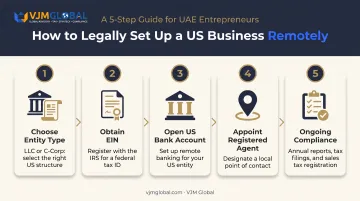
An EIN doesn't require an SSN. IRS Form SS-4 instructions allow applicants without one to enter "foreign" on the relevant line, though international applicants must apply by phone, fax, or mail rather than online.
This is where VJM Global fits in. The firm helps UAE-based and other foreign entrepreneurs with US entity formation, EIN registration, tax compliance, and back-office support, so founders can launch and run a compliant US business without relocating.
Key Factors to Consider Before Choosing Your Business Idea
UAE entrepreneurs commonly underestimate US compliance timelines or pick a business model that requires physical presence they hadn't planned for.
Before finalizing an idea, weigh these factors against realistic outcomes:
- Available capital — real estate and franchising need more upfront cash than e-commerce or freelance-style trading
- Industry familiarity — leaning on existing trade or property expertise shortens the learning curve
- Remote operability — e-commerce, SaaS, and import-export run remotely far more easily than a franchise location
- Long-term visa plans — staying fully remote versus eventually relocating shapes both entity choice and timeline
Conclusion
The business idea you choose matters less than the legal structure and compliance partner behind it. A great idea paired with the wrong entity type, or no compliance plan, tends to stall fast.
Before finalizing anything, evaluate your available capital, risk appetite, and genuine desire for US physical presence.
VJM Global has 30+ years in tax, audit, and advisory work and has served 500+ American business owners. For UAE entrepreneurs entering the US, that translates to practical help with entity formation, tax compliance, and ongoing accounting—so setup and filings stay aligned from day one.
Frequently Asked Questions
What is the most successful small business to start in the USA?
E-commerce, real estate, and franchise businesses often rank among the strongest options for foreign entrepreneurs because they scale and can run remotely. Results still depend on capital, market research, and solid compliance.
Can a UAE resident own a business in the USA without moving there?
Yes. Foreign nationals, including UAE residents, can own a US LLC or corporation remotely without residency or a visa, provided they meet registration and tax obligations.
What is the best US business structure for foreign entrepreneurs?
An LLC suits most small service or e-commerce businesses due to simpler tax treatment and liability protection. A Delaware C-Corp is generally preferred for tech startups planning to raise outside investment.
Do UAE entrepreneurs need a US visa to start a business in the USA?
No visa is required to own a US business remotely. Relocating to actively manage it typically requires a work-authorized visa, such as an L-1 or another category that fits your situation.
How much does it cost to register a business in the USA from UAE?
Expect roughly $50–$500 in state filing fees, about $100–$300 per year for a registered agent, and a free EIN from the IRS. Totals vary by state and entity type, so confirm current fee schedules before you file.
Is there a tax treaty between the UAE and USA to avoid double taxation?
No comprehensive UAE-US income tax treaty currently appears on the IRS's treaty list. Verify treaty and tax status with a cross-border tax advisor, since federal, state, and UAE rules can affect a foreign-owned business differently depending on structure.