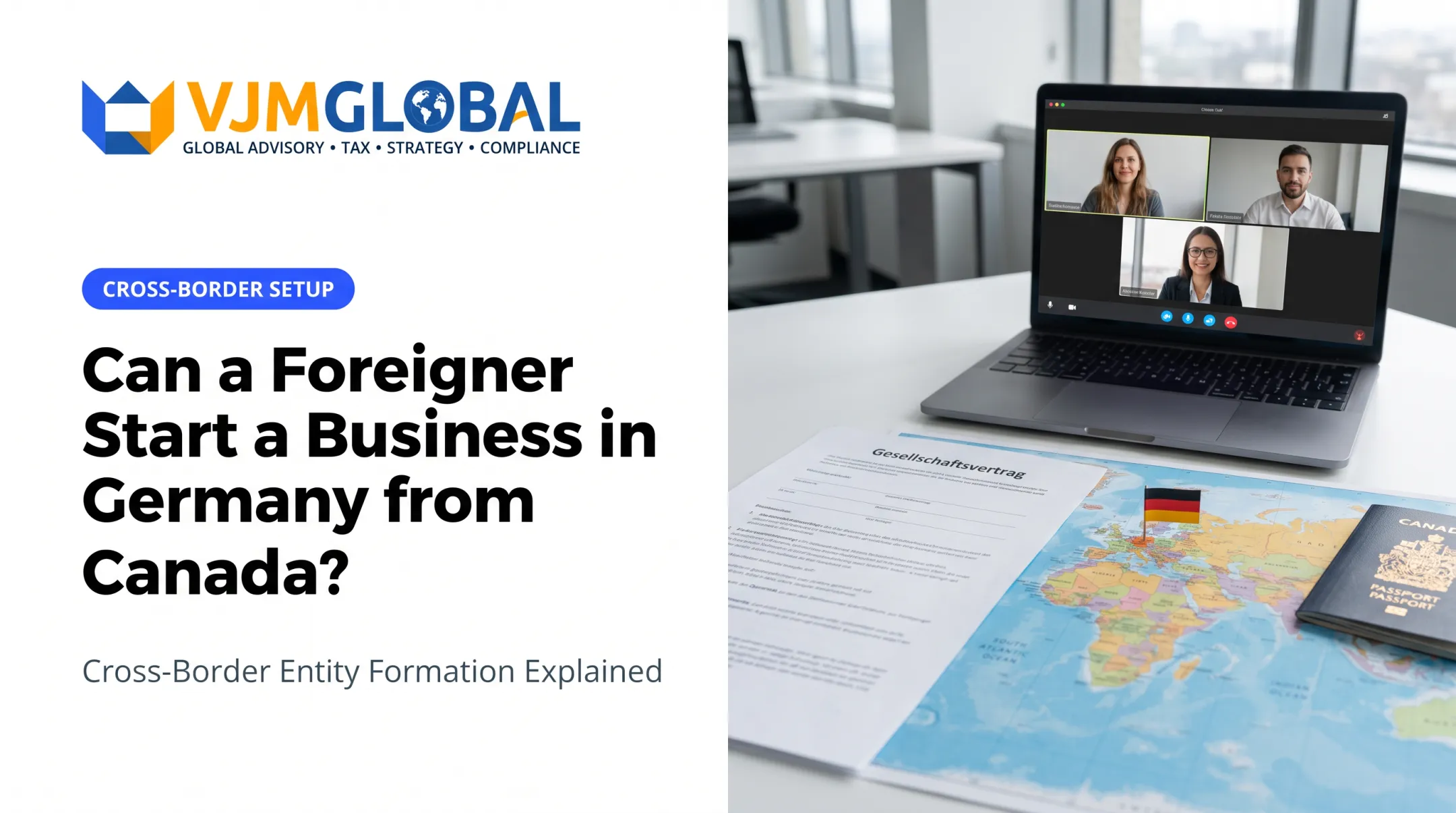
So, can foreigners actually start a business in Canada? Yes. German nationals and German companies can register and fully own a Canadian business, no citizenship required. That said, the process involves specific legal, tax and immigration steps that differ from what you'd expect back home.
This interest isn't limited to large corporates. German SMEs, manufacturers, and startups are increasingly exploring Canada as a North American foothold. This guide walks through eligibility, structure choices, registration steps, and the compliance details German business owners need to get right.
Key Takeaways
- Foreign and German companies can fully own a Canadian business—no citizenship required
- Entity choice (subsidiary, branch or partnership) sets liability, tax treatment and director rules
- Ontario, BC, Alberta and Quebec: no resident directors; federal incorporation needs 25% Canadian residents
- CETA and the Canada–Germany tax treaty limit double taxation and ease market access
- Hands-on help with formation, tax registration and compliance shortens setup and cuts risk
Can Foreigners Really Start a Business in Canada?
Non-Canadian citizens and foreign companies can absolutely start a business in Canada.
Corporations Canada's federal incorporation process doesn't list citizenship as a requirement anywhere in its steps. You need a corporate name, articles of incorporation, a registered office, and director details. That's it.
Ownership can be 100% foreign in most sectors. Restrictions apply only in a handful of strategic areas:
- Telecommunications (facilities-based carriers must file ownership disclosures)
- Banking (foreign bank branches fall under the Bank Act)
- Broadcasting (Canadian ownership and control requirements apply)
For a German engineering or manufacturing company, none of these restrictions typically apply.
Registering vs. Operating
Here's where it gets nuanced. Incorporating a Canadian entity doesn't require you to be physically present. You need a registered Canadian office address, but you can direct the incorporation from Frankfurt or Munich.
Actively working or managing the business inside Canada is a different story. That requires a valid work permit or visa. Starting the business and running it day-to-day on Canadian soil are legally distinct activities. German entrepreneurs often mix the two up.
Why Canada Is an Attractive Market for German Companies
Canada offers German companies a stable, English/French-bilingual economy and a local base with treaty reach into both the EU (via CETA) and the US (via USMCA).
The trade numbers back this up. Two-way Canada-Germany merchandise trade reached C$34.3 billion in 2025, a 61.1% increase from pre-CETA levels. Services trade climbed 73.0% over the same period. CETA eliminated duties on 99% of tariff lines, with 98% removed at provisional entry into force in September 2017.
Shared Industrial Strengths
Germany and Canada overlap heavily in sectors where both countries have deep expertise:
- Automotive manufacturing and supply chains
- Precision engineering and industrial equipment
- Clean technology and renewable energy
- Advanced manufacturing and automation
For German firms in these industries, Canada already understands and demands their expertise. Pair that with a skilled, bilingual workforce and treaty access to the broader North American market, and the commercial case holds up on capability, talent, and reach.
Choosing the Right Business Structure for Market Entry
This decision shapes everything downstream: liability exposure, tax filings, and how much local presence you need. German companies generally pick from four structures. Branch office. Fastest to set up. Your German parent company remains liable for the branch's obligations since there's no separate legal entity. The branch has no separate Canadian tax identity, so your German parent's full liability extends into Canada. Subsidiary corporation. A separate legal entity with limited liability protection. This is what most German companies expanding into Canada choose. It isolates risk and builds credibility with Canadian customers and partners who prefer dealing with a local entity. Partnership. Two or more owners share profits, responsibilities and liabilities. General partners carry joint and several liability, meaning each partner is on the hook for the whole debt, not just their share. Sole proprietorship. Rarely fits a German company's needs. It offers no legal separation from the owner and comes with unlimited personal liability.

Federal vs. Provincial Incorporation
| Factor | Federal (CBCA) | Provincial |
|---|---|---|
| Name protection | Nationwide | Single province only |
| Director residency | 25% must be Canadian resident (or 1 if fewer than 4 directors) | None required in Ontario, BC, Alberta, Quebec |
| Best suited for | Multi-province operations | Single-province operations |
| That director residency gap matters. If you incorporate federally under the CBCA, at least a quarter of your board needs Canadian residency. Ontario, British Columbia, Alberta and Quebec removed their residency requirements entirely (Alberta in 2021). That makes provincial incorporation in these provinces simpler for a German company without a ready-made Canadian director. |
Step-by-Step: How German Companies Can Register a Business in Canada
Registration follows a clear sequence, though the details shift depending on federal vs. provincial routes.
- Choose your structure and jurisdiction. Decide federal vs. provincial incorporation based on where you'll actually operate. Single-province plans favour provincial; multi-province plans favour federal.
- Run a NUANS name search. Confirm your chosen business name is available and compliant with Canadian naming rules. A federal NUANS report costs C$13.80 and is normally valid for 90 days.
- File incorporation documents. Submit articles of incorporation, your registered Canadian office address, and director details. Federal online incorporation costs C$200 with one-business-day processing; expedited service adds C$100 for a four-hour turnaround.
- Get your CRA Business Number. This unlocks registration for corporate tax, GST/HST and payroll program accounts. Non-resident corporations register through a dedicated CRA process, typically with a 21-business-hour service standard.
- Open a Canadian business bank account. Non-residents face extended KYC checks under FINTRAC. Banks verify identity from corporate records and beneficial ownership (directors and anyone who controls the company), and typically ask for ownership charts and source-of-funds documents.
- Secure licences and review Investment Canada Act obligations. Confirm any sector or municipal licences your activity needs. Some acquisitions or investments also require ICA notification to Innovation, Science and Economic Development Canada (ISED), especially above set enterprise-value thresholds.

Tax, Compliance and Immigration Considerations for German Business Owners
Once incorporated, ongoing tax and compliance obligations kick in immediately, and they're layered across federal and provincial levels.
Corporate Tax Rates
Canada's federal general corporate tax rate is 15%, dropping to a 9% small-business rate on income that qualifies for the small-business deduction—typically limited to Canadian-controlled private corporations (CCPCs). A German-owned entity does not automatically qualify as a CCPC; confirm status before relying on the lower rate.
Provincial rates stack on top of the federal rate:
- Ontario: 3.2% lower (small-business) rate
- British Columbia: 2% small-business rate
- Alberta: 8% general rate; 2% small-business rate
Jurisdiction choice meaningfully changes your combined tax bill.
The Canada-Germany Tax Treaty
This treaty prevents double taxation on cross-border income. Business profits are generally taxed where the enterprise is resident, unless it has a permanent establishment—such as a branch, factory, or place of management—in the other country.
Dividend withholding is capped at 5% when the recipient company holds at least 10% voting power, and 15% otherwise. Those caps matter directly for profit repatriation planning.

Immigration Pathways
Registering a business doesn't grant you the right to work in it. German entrepreneurs typically use one of these routes:
- Intra-Company Transfer Work Permit: Executives, managers, or specialized-knowledge staff moving from a German parent to a Canadian subsidiary or branch (one year prior employment required)
- C11 Entrepreneur Work Permit: For temporary owners who plan to leave Canada; officers weigh job creation, export growth, and innovation, and generally expect at least 51% ownership
- Provincial entrepreneur streams: Alberta’s Rural Entrepreneur Stream, for example, needs C$100,000 minimum equity and 51% ownership—and leads to permanent residency, not citizenship
Ongoing Compliance
After you start operating, expect these recurring obligations:
- Annual corporate returns (C$12, one-business-day processing federally)
- T2 corporate tax filings
- GST/HST returns (mandatory once you exceed the small-supplier threshold)
- Maintaining accurate registered office and director details
How VJM Global Supports German Companies Expanding into Canada
Navigating Canadian incorporation from Germany involves juggling federal and provincial rules, CRA registrations, and payroll obligations, often without a local team on the ground. That's the gap VJM Global fills.
VJM Global handles Canadian entity formation for clients of any nationality, including German companies, covering:
- Federal incorporation through Corporations Canada under the CBCA, or provincial incorporation in Ontario, BC, Alberta and Quebec
- NUANS name searches, articles of incorporation, and registered-office arrangements
- CRA Business Number registration, T2 corporate tax setup, GST/HST accounts, and Quebec's separately administered QST
- Payroll compliance, including CPP/QPP contributions, EI premiums, and T4 filings
The firm delivers this across 100+ countries, using each market's own regulators rather than a single template everywhere. That matters when you are managing German Handelsregister and Finanzamt obligations alongside Canadian ones at the same time.

For companies not ready to incorporate yet, Employer of Record services let you hire Canadian staff and run compliant payroll before committing to a full entity. This helps if you want to test the market first with a local sales or technical hire.
Frequently Asked Questions
Can a non-Canadian citizen start a business in Canada?
Yes. There's no citizenship requirement for business ownership. Director residency rules vary by province, and actively managing the business from inside Canada requires a valid work permit.
Can I get Canadian citizenship by investing C$100,000?
No, investment alone doesn't grant citizenship. Provincial programs like Alberta's Rural Entrepreneur Stream have investment thresholds around C$100,000, but they lead to permanent residency pathways, not automatic citizenship.
What is the 90% rule for non-residents in Canada?
This generally refers to individual tax residency thresholds, where non-residents earning 90%+ of income from Canadian sources can claim certain deductions under section 217. It's not a general corporate residency rule.
Do German companies need a Canadian partner to register a business?
No. A Canadian partner isn't required. Federal incorporation does require 25% Canadian-resident directors, though Ontario, BC, Alberta and Quebec have no such requirement.
How long does it take to register a business in Canada as a foreigner?
Federal online incorporation takes as little as one business day. However, banking, licensing and tax registration typically extend total setup time to several weeks.
What is the cost of starting a business in Canada for German entrepreneurs?
Government filing fees start around C$200 for federal incorporation plus C$13.80 for a NUANS report. Legal, professional and licensing costs vary by province and sector on top of that.