This pathway is more than a legal technicality. German entrepreneurs are increasingly incorporating in the US to tap into venture funding, build credibility with American clients, and reach the world's largest consumer market. German foreign direct investment in the US reached $677.327 billion in 2024, making Germany the third-largest source of FDI in the country, according to a SelectUSA fact sheet from the US Department of Commerce.
This guide walks through the legal basics, structure and state selection, the exact registration steps, realistic costs, and the compliance traps that catch unprepared founders.
Key Takeaways
- Form a US LLC or C-Corp from Germany with no visa, SSN, or US address via a registered agent
- Owning a US company does not grant the right to live or work in the United States
- Delaware, Wyoming, and Nevada favor foreign founders; sales tax nexus still applies
- US-Germany tax treaty limits double tax, but Form 5472 and IRS filings stay mandatory even if inactive
Can Foreigners From Germany Legally Start a Business in the USA?
Any foreign national, German or otherwise, can own 100% of a US LLC or corporation. There's no requirement for citizenship, a green card, or an SSN. State formation laws and IRS rules explicitly allow foreign ownership.
Ownership vs. Operation
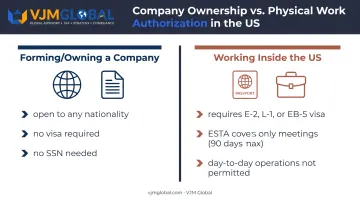
Forming and owning a US company is one legal matter. Living and working inside the US is another entirely, governed by immigration law, not corporate law.
- Forming/owning a company: Open to any nationality, no visa needed
- Working actively inside the US: Requires a specific visa category, such as E-2, L-1, or EB-5
German citizens can enter the US visa-free under the ESTA Visa Waiver Program for up to 90 days, covering activities like client meetings, site visits, or contract negotiations. ESTA does not cover running day-to-day operations from a US desk.
Germany's Investment Footprint in the US
Germany's position as the third-largest FDI source in the US, with a $677.327 billion FDI stock, reflects a deep commercial relationship built on decades of German companies establishing US entities to access financing, distribution, and enterprise clients that simply prefer working with a US-registered counterpart.
What About Government Funding for Foreign Founders?
This is a common misconception. There's no automatic grant program for foreign entrepreneurs. As of the SBA's current ownership rule, every owner of an applicant for an SBA-backed loan must be a US citizen or US national with a principal residence in the US, per the Small Business Administration's 2026 guidance. A wholly German-owned company doesn't qualify.
Most foreign-owned businesses instead rely on:
- Personal or family savings
- Angel investors
- Venture capital
- Revenue-based financing from private lenders
Choosing the Right Business Structure and State
Selecting a Business Structure: LLC vs. C-Corp vs. Branch
Your structure choice shapes your tax exposure and compliance burden for years to come.
| Structure | Taxation | Best For |
|---|---|---|
| LLC | Pass-through (disregarded entity for single-member) | Services, e-commerce, simpler compliance |
| C-Corp | Entity-level tax, then dividend tax (double taxation) | Startups courting VC funding |
| German branch office | Extension of German entity, no separate US legal shield | Testing US market before committing |
An LLC generally suits founders who want simplicity and don't need outside investors. A C-Corp is usually the better fit if you're planning to raise venture capital, since most US investors expect Delaware C-Corp stock structures.
The US-Germany tax treaty can reduce or eliminate double taxation on profit distributions, capping withholding tax on qualifying dividends at 5% or 15% depending on ownership structure. That said, treaty relief isn't automatic. It depends on beneficial ownership tests and limitation-on-benefits clauses, so talk to a cross-border tax advisor before finalizing anything.
One filing trap catches nearly every first-time founder: a single-member foreign-owned LLC must file IRS Form 5472 alongside a pro forma Form 1120 annually, even if the entity had zero US activity that year. Skip it, and the IRS applies a $25,000 penalty right out of the gate, per the IRS instructions for Form 5472.
Miss the deadline by more than 90 days after notice, and another $25,000 accrues per additional 30-day period.
Once you've chosen a structure, the next decision is where to form it.
Which US State Is Best for a Foreigner's LLC?
| Feature | Delaware | Wyoming | Nevada |
|---|---|---|---|
| Formation fee | ~$110 | ~$100 | ~$425 (includes license) |
| Annual tax/fee | $400 flat LLC tax | $60 minimum | $150 list + $200 license renewal |
| Member privacy | Not disclosed on filing | Not disclosed on filing | Managers/members disclosed |
| Best suited for | VC-backed C-Corps | Cost-conscious LLCs | Nevada-based operations |
Wyoming tends to win on pure cost efficiency. Delaware remains the default for founders anticipating institutional investment, given its established corporate law and investor familiarity. Nevada carries higher mandatory costs and requires public disclosure of managers, so its "privacy-friendly" reputation doesn't hold up as well as people assume.
Incorporation-friendly reputation shouldn't be your only filter. If your customers, warehouse, or team will be based in another state, you may owe taxes there regardless of where you incorporated. That's called nexus, and it follows the business, not the paperwork.
Step-by-Step Process to Register a US Company From Germany
Registering a US company from Germany follows a fixed sequence. Complete the steps in order so state filings, your EIN, and banking don't block each other.
- Finalize your structure and state based on your funding plans and where you'll actually operate.
- Verify your business name through the USPTO Trademark Search database and your target state's Secretary of State name search tool.
- Appoint a registered agent with a physical US address. This is mandatory since you're based in Germany and can't use your home address for legal notices.
- File Articles of Organization (LLC) or Incorporation (Corp) with the state, listing your registered agent and member or director details.
- Apply for an EIN from the IRS. Non-resident founders without an SSN or ITIN file Form SS-4 by fax or mail and enter "foreign" on the responsible-party line. Fax takes about 4 business days; mail about 4 weeks.
- Open a US business bank account. Traditional banks like Chase often require an in-person visit for multi-owner LLCs. Fintechs such as Mercury and Wise Business often support remote applications for foreign-founded entities.
- Set up compliance tracking for annual reports, registered agent renewals, and IRS informational filings so nothing slips through unnoticed.
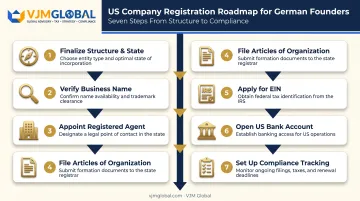
Each step is manageable alone. Across two time zones and two regulatory systems, the full sequence still needs tight coordination. Many German founders use a cross-border partner such as VJM Global as a single point of contact for the whole process.
Costs, Taxes, and Banking for German-Owned US Businesses
First-Year Cost Breakdown
Statutory baseline costs through your first annual cycle look like this:
- Wyoming: roughly $160 total ($100 formation + $60 minimum annual report)
- Delaware: roughly $510 total ($110 formation + $400 annual LLC tax)
- Nevada: roughly $425 at formation (articles, initial list, and business license combined)
- EIN: $0 directly from the IRS
- Registered agent: typically $50–$300 per year, depending on the provider
Add costs for expedited filing, certified copies, and professional tax preparation for Form 5472 compliance, and your realistic first-year budget often lands well above the bare statutory minimums.
US Tax Rates vs. Germany's Combined Burden
The US federal corporate tax rate sits at a flat 21%. State corporate income tax adds another layer, ranging from 2.0% in North Carolina to 11.5% in New Jersey.
Germany's average combined corporate burden runs closer to 30%, factoring in the 15% corporate income tax, a solidarity surcharge, and municipal trade tax that varies by location. Use both figures as planning inputs with your cross-border tax advisor when you model profit repatriation.
Sales Tax Nexus vs. German VAT
Germany runs on a national VAT system: 19% standard rate, 7% reduced rate, applied consistently everywhere. The US works nothing like that.
Following the South Dakota v. Wayfair ruling, states can require remote sellers to collect sales tax once they cross a sales or transaction threshold in that state, even without a physical presence there. Many states use a common trigger around $100,000 in sales or 200 transactions, but the exact figures differ. For e-commerce founders selling across multiple states, that means tracking nexus state by state rather than applying one flat national rate.
Banking as a Non-Resident German Owner
Opening a US business bank account is often harder than formation itself. Many traditional banks want a US person present, an ITIN or SSN, and sometimes an in-person visit.
Non-resident founders typically use one of three paths: a US trip to open the account in person, a fintech or startup-focused bank that onboards remote LLCs with an EIN, or a formation partner that introduces a banking relationship. Factor account setup into your timeline—approval can take days to several weeks after you receive the EIN.
Common Challenges and How Expert Support Simplifies the Process
German founders hit the same friction points over and over:
- State-specific rules that differ enough between Delaware, Wyoming, and Nevada to trip up anyone comparing them side by side
- Securing an EIN without an SSN, which means navigating fax or mail submission instead of the instant online tool
- Opening a bank account remotely, since not every bank accepts non-resident applicants without an in-person visit
- Staying current on multi-state compliance, particularly annual reports, registered agent renewals, and Form 5472 deadlines that carry steep penalties if missed
VJM Global covers those gaps through a US office and more than 30 years of tax and advisory experience. German founders work with one contact for incorporation, EIN acquisition, registered agent services, and ongoing US tax and compliance filings, instead of separate providers for each step.
The firm has supported 500+ American business owners and maintains a 95% client retention rate across accounting, formation, and compliance. When your US structure and German tax position need to stay aligned, that single coordinated team matters more than any incorporation-friendly state on its own.

Frequently Asked Questions
Do immigrants get money to start a business in the USA?
No automatic government grant exists for foreign founders. Most rely on self-funding, angel investors, or venture capital, since SBA-backed loans generally require US residency or an established US credit history.
Can a foreigner (for example, someone in Germany) start a business in the United States?
Yes. No citizenship, visa, or SSN is required to own a US LLC or corporation. Running the business day-to-day from inside the US is a separate step and requires an appropriate visa.
Which US state is best for foreigners to form an LLC?
Delaware and Wyoming lead for low fees and solid privacy protections. The better fit still depends on where your customers and operations actually sit.
Do I need a US visa to own a company in the USA?
No. Ownership and visa status are entirely separate. A visa only becomes necessary if you plan to actively work or reside in the US.
Can I get an EIN without a Social Security Number?
Yes. Submit Form SS-4 by fax or mail directly to the IRS. The instant online application generally requires an SSN or ITIN, which most German founders won't have.
Do I need to visit the USA in person to open a business bank account?
Many traditional banks require an in-person visit for multi-owner entities. Fintech providers such as Mercury and Wise, and some professional service partners, can often complete remote setup for eligible businesses.