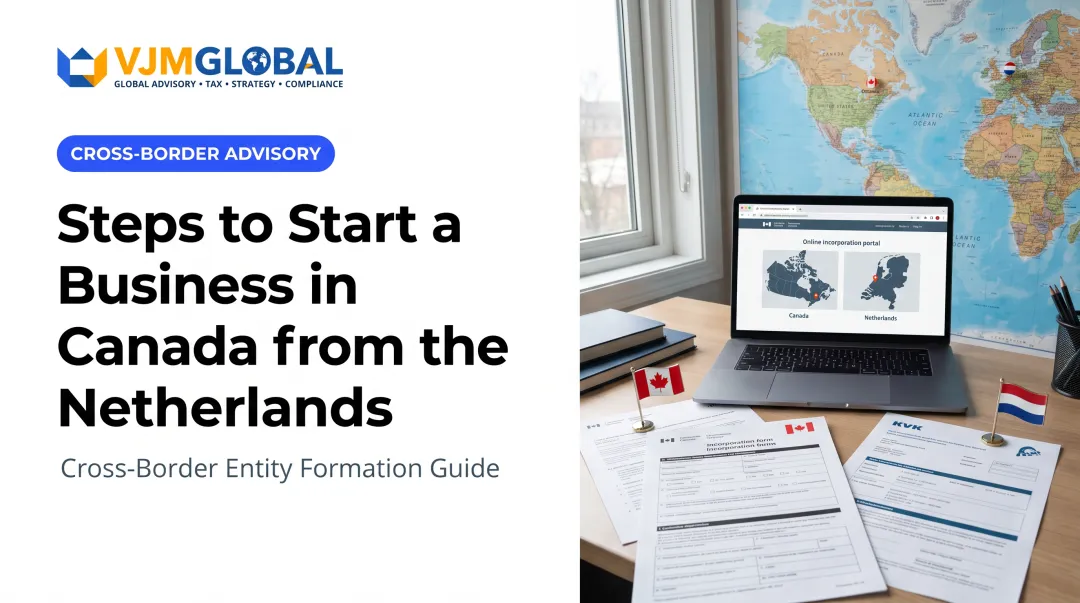
What's driving the interest isn't just large multinationals chasing scale. Dutch startups, SMEs, e-commerce sellers, and established firms are all exploring Canada, often because the entry barriers are lower than they assume. Full foreign ownership is possible in several provinces, and incorporation itself can be surprisingly fast.
This guide walks through eligibility, structures, realistic costs, and the compliance obligations Dutch nationals need to plan for.
TL;DR
- Dutch citizens can incorporate in Canada without residency; banking and immigration stay separate
- Ontario and BC allow 100% foreign-owned corporations with no resident director
- Incorporate remotely in days; a bank account usually needs an in-person visit
- Budget for filing fees, professional setup, and ongoing compliance (T2, GST/HST)
- Registration to a working bank account typically takes 4–8 weeks
What Does Starting a Business in Canada as a Dutch Foreigner Involve?
In simple terms: registering and legally operating a company in Canada while based in, or originating from, the Netherlands.
This covers company formation, tax registration, and ongoing compliance — not immigration or residency rights, which follow entirely separate rules.
Common formats include:
- Federal incorporation versus provincial incorporation (Ontario, BC)
- Sole proprietorship for solo freelancers or consultants
- Remote-managed businesses versus those requiring local, physical operations
What to Know Before You Start a Business in Canada from the Netherlands
Many Dutch founders confuse "can I register a company" with "can I operate one smoothly." The two aren't the same. Registration is only step one—plan for these operational realities before you file.
Key factors to plan around:
- Expect a 6–7 hour gap with Eastern Canada (e.g. Toronto), which slows replies to registry, bank, and accountant requests
- Run SaaS or consulting from Amsterdam with little friction; retail and food need a physical Canadian presence
- Incorporate in days if you want—but banking and full operational readiness still take weeks
- Own a Canadian company without any automatic right to live or work there; residency is a separate process
- Favour remote-friendly sectors (SaaS, trading, consulting) if you need to scale without being on site
Why Start a Business in Canada from the Netherlands? (When It Makes Sense)
Starting a Canadian business from the Netherlands works under certain conditions—not as a default move. Weigh these factors first.
Trade access: CETA has meaningfully opened the door. EU-Canada goods-and-services trade rose 71%, from EUR 72.2 billion in 2016 to EUR 123 billion in 2023, according to the European Commission's 2025 CETA evaluation. Services trade specifically grew 73% over the same period.
Structural advantages:
- A Canadian base offers proximity to the US and Mexican markets under USMCA
- Canada's incorporation process is largely online and predictable, unlike jurisdictions with heavier bureaucratic layers
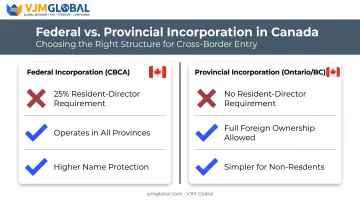
- Ontario and British Columbia permit full foreign ownership with no Canadian resident director requirement — a major difference from federal incorporation
If your business model is remote-friendly and you're targeting North American clients or trade flows, the conditions line up well. If you need boots-on-the-ground retail presence from day one, timing, cost, and immigration planning get harder.
Early Decisions That Matter When Registering a Company in Canada
Most delays come from underestimating documentation, banking timelines, or director-residency rules.
Areas Dutch founders commonly overlook:
- The true cost stack: government filing fees, professional/legal fees, a registered office, and annual compliance costs all add up separately
- Federal versus provincial incorporation: Federal (CBCA) corporations need at least 25% Canadian-resident directors (or one, if there are fewer than four). Ontario and BC have no director residency rule
- Banking reality: Most major banks require an in-person branch visit from at least one director; online applications alone rarely open an account
- Incorporation ≠ immigration: Owning a company grants zero work or residency rights in Canada
- GST/HST triggers: Registration becomes mandatory once your worldwide taxable revenue exceeds CAD 30,000 in a rolling four-quarter period
How to Start a Business in Canada from the Netherlands – Step by Step
The process breaks into six practical stages. Common mistakes include assuming Dutch business documents transfer directly, skipping name searches, or leaving bank account preparation until after incorporation.
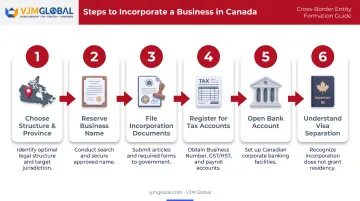
Step 1 – Choose Your Business Structure and Province
Decide between federal incorporation and provincial incorporation. Ontario and BC are popular choices because they do not require a resident Canadian director.
- Sole proprietorship: Suits solo freelancers with minimal liability exposure
- Incorporation: Better for liability protection and future growth plans
Common miss: Choosing federal incorporation without realizing the 25% resident-director rule applies.
Step 2 – Reserve Your Business Name
Run a NUANS report (federal) or a provincial name search to confirm your chosen name is available.
- Include a legal designator such as "Inc.," "Ltd.," or "Corp."
- Check against existing Canadian trademarks, not just company names
Common miss: Picking a name that clashes with an existing trademark, triggering a rejection or dispute later.
Step 3 – Prepare and File Incorporation Documents
Gather passports, proof of address, and share structure details for every director and shareholder.
- File Articles of Incorporation with Corporations Canada (federal) or the relevant provincial registry
- Establish a Canadian registered office address — this is a legal requirement, not optional
- Confirm director eligibility under the chosen jurisdiction's rules
Common miss: Filing before arranging a compliant registered office, which causes application rejections.
Step 4 – Register for Tax Accounts
Once incorporated, you'll need to register with the Canada Revenue Agency (CRA).
- Obtain a Business Number (BN)
- Register for GST/HST if revenue is expected to cross CAD 30,000
- Set up a corporate income tax account for T2 filings
Common miss: Delaying GST/HST registration and losing out on input tax credits in the early months.
Step 5 – Open a Canadian Business Bank Account
Prepare your Certificate of Incorporation, Business Number, and director ID documents.
- Major banks (RBC, TD, BMO, Scotiabank, CIBC) typically require an in-person branch visit from at least one director for identity verification
- Digital platforms and payment processors like Stripe can bridge the gap while a traditional account is pending
Common miss: Assuming account activation is instant. Realistically, this stage takes 3-6 weeks.
Step 6 – Understand Visa and Residency Separation
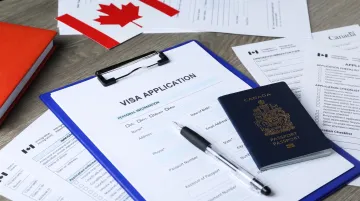
Incorporating a company grants no right to live or work in Canada. These are entirely separate application tracks.
- Options like Intra-Company Transfer permits exist for founders wanting hands-on management in Canada
- CETA does list the Netherlands among countries eligible for certain business-person categories, but this requires its own application
Common miss: Assuming company ownership fast-tracks a Canadian visa. It doesn't.
Compliance, Costs, and Where a Cross-Border Advisor Helps
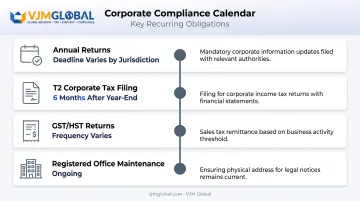
Incorporation is the start, not the finish line. Ongoing obligations include:
- Annual returns: Federal within 60 days of the incorporation anniversary; Ontario within 6 months of fiscal year-end; BC within 2 months of anniversary
- T2 corporate tax filings: Due within 6 months after year-end, even if no tax is owed
- GST/HST returns: Filing frequency depends on your reporting period
- Registered office: Keep the address current; missed filings can trigger penalties or administrative dissolution
Plan for more than filing fees. Most founders also budget annual accounting support, T2 and GST/HST preparation, and cross-border tax advice once the company is live.
Dutch entrepreneurs running a Canadian entity while remaining tax resident in the Netherlands juggle two tax systems at once. That means coordinating corporate filings, permanent-establishment risk, and double-taxation relief across both jurisdictions—not only Canadian forms.
A firm active in both markets closes that gap. VJM Global provides entity formation, tax compliance, and accounting across more than 100 countries, including Canada and the Netherlands. That footprint matters when you need one team tracking obligations on both sides.
Conclusion
Starting a business in Canada as a Dutch national is legally accessible, particularly through provincial incorporation in Ontario or BC where full foreign ownership is permitted without a resident director.
Success depends on getting the structure, banking, and compliance right from day one, not on how fast you file. Keep reviewing your tax position in both the Netherlands and Canada as the business grows. Cross-border tax is where most founders hit problems later.
VJM Global can help with Canadian entity formation, tax registration, and ongoing compliance so you can focus on building the business.
Frequently Asked Questions
Can I start a business in Canada without residency?
Yes. Residency isn't required for incorporation, though provincial director-residency rules vary and banking typically requires an in-person visit from a director.
How much money do I need to start a business in Canada?
Government filing fees range from CAD 200-380 depending on the jurisdiction. Add professional service costs (roughly CAD 500-3,000) plus ongoing annual compliance expenses.
What is the 90% rule for newcomers to Canada?
This Canada Revenue Agency (CRA) rule determines whether a non-resident can claim federal non-refundable tax credits, based on the share of net world income included in Canadian income. It applies to individual tax credits, not corporate ownership or incorporation eligibility.
What is the easiest business to start in Canada?
Sole proprietorships and remote-friendly service businesses (consulting, e-commerce, SaaS) are usually the fastest and least complex to set up, especially for solo founders.
Do I need a Canadian director or local partner to incorporate?
No, not in Ontario or British Columbia. Both provinces allow 100% foreign ownership with no resident-director requirement, unlike federal incorporation under the CBCA.
Does registering a Canadian company give me the right to work or live there?
No. Incorporation and immigration are entirely separate processes, each requiring its own application and approval.