Here's the catch: many UAE founders arrive expecting a UK equivalent of the DED trade name system. It doesn't exist. The UK has no standalone register for trading names. What gets checked, protected, and filed is a company name at Companies House, and that distinction changes almost every decision that follows.
This guide walks through the registration routes available to a UAE company, the documents you'll need to authenticate, the naming rules that catch people out, and how to pick between a trading name, a UK Ltd, and a branch.
Key Takeaways
- The UK has no central register for trading names - only company names filed at Companies House are formally checked and protected
- UAE companies can enter via a Ltd subsidiary, UK establishment (branch), or trading name on an existing entity
- Corporate documents typically need notarisation and legalisation in the UAE before UK banks or Companies House accept them
- Names that are "same as" or "too like" an existing company can be rejected or forced to change
- A cross-border formation specialist cuts delays from authentication gaps and jurisdiction mismatches
How to Register a Business Name in the UK as a UAE Company
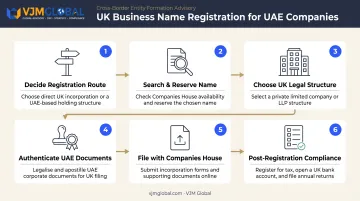
UAE companies typically clear UK name registration in six steps, from choosing a route through to post-filing compliance. Work through them in order so UAE document legalisation does not stall your Companies House filing.
Step 1: Decide Your Registration Route
Before touching a Companies House form, work out what you actually need. There are three practical paths:
- Form a new UK private limited company under the desired name, giving you a standalone UK legal entity
- Register a UK establishment (branch) of the existing UAE company, extending the parent's legal identity into the UK
- Trade under an unregistered business name, attached to a UK entity you already control, subject to disclosure rules
The right choice hinges on one question: does your UAE company want a fully separate UK entity, or simply a UK extension of what already exists in Dubai, Abu Dhabi, or Sharjah?
Step 2: Search and Reserve Your Proposed Name
Run your proposed name through the Companies House company name availability checker. The checker is a live search that flags direct conflicts before you file; it does not reserve the name.
There's a second, separate check most UAE applicants skip: the UK trademark register. Company registration and trademark protection run on completely different systems, so a clear company name search tells you nothing about brand exclusivity. Search the UK trademark register by keyword, owner, or phrase before you commit to a name.
Step 3: Choose the UK Legal Structure
Once the name clears both checks, decide on the legal vehicle:
| Structure | Best for | Key requirement |
|---|---|---|
| UK Ltd | Standalone credibility, UK banking, liability separation | Director, registered office, SIC code, PSC details |
| UK establishment (branch) | Keeping one unified group identity | Must register within one month of opening |
| LLP (limited liability partnership) | Professional services with UAE partners | Minimum two members, UK registered office |
A branch isn't a separate legal entity. The UAE parent still signs contracts and carries the liability, which matters if your UK operation is anything beyond a sales presence.
Step 4: Prepare and Authenticate Corporate Documents from the UAE
This is usually the slowest part of the whole process, and it trips up more UAE applicants than any UK filing step. You'll need:
- Certificate of incorporation and memorandum and articles of association (MOA/AOA) from the UAE parent
- Board resolution approving the UK registration
- Power of Attorney for a UK-based representative or agent
Here's the part people miss: the UK's Foreign, Commonwealth & Development Office (FCDO) legalisation service only apostilles documents issued in the UK.
A UAE-issued certificate of incorporation cannot go through the UK apostille process at all. It must be notarised and legalised in the UAE first, typically through the UAE Ministry of Foreign Affairs, before it's usable at Companies House or a UK bank.
Step 5: File the Application with Companies House
Online filing is the fast route - most straightforward applications are processed within 24 hours. Paper filings and overseas company registrations take considerably longer, sometimes up to ten working days.
Your application needs:
- A UK registered office address (a real address in the same jurisdiction as the company, not a UAE address)
- A Standard Industrial Classification (SIC) code describing your business activity
- Director and persons with significant control (PSC) details, including for UAE-resident individuals - there's no residency exemption
Step 6: Complete Post-Registration Compliance
Registration isn't the finish line. Once your name is live, you'll need a UK business bank account to actually trade. Traditional banks can take weeks to onboard a company with non-UK-resident directors; e-money institution (EMI) and fintech providers are generally faster for UAE-based founders to get moving with.
Beyond banking, three obligations kick in immediately:
- Register for Corporation Tax within three months of starting your accounting period
- Register for VAT if turnover crosses the £90,000 threshold
- Display your name at your premises, on correspondence, and on your website
Documents & Requirements UAE Companies Need Before Registering
Gather these before you start the clock on registration, not after:
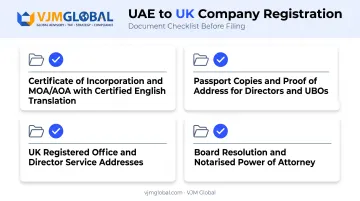
- Certificate of Incorporation and MOA/AOA (Memorandum and Articles of Association) of the UAE parent, often required with a certified English translation
- Passport copies and proof of address for every director, shareholder, and Ultimate Beneficial Owner
- UK registered office address, plus a separate service address for each director, required even if all trading happens in the UAE
- Board resolution approving the UK registration, plus a notarised Power of Attorney if someone other than a director will sign on the company's behalf
Build in time for UAE attestation. The Ministry of Foreign Affairs attestation process through approved couriers generally takes several business days depending on location. Documents still need to reach Companies House or a UK bank's compliance desk after that.
Applicants who start document authentication in parallel with name searches, rather than after, save themselves weeks.
UK Naming Rules and Common Mistakes UAE Companies Should Avoid
The "same as" rule trips up more applicants than anything else. Companies House automatically checks this at filing, and it disregards minor differences: punctuation, "Ltd" versus "Limited," or common words. "Gulf Trading Co Ltd" and "Gulf Trading Company Limited" register as the same name.
"Too like" is a different, slower trap. A name can clear the initial filing and still get challenged later. If an existing company complains and Companies House agrees the names are confusingly similar, you can be ordered to rebrand after you've already printed stationery and built a website.
Sensitive words need permission first. Words like "Chartered," "Royal," "British," or "Group" require written approval from the relevant body before Companies House will accept them. Budget extra time if your brand includes one.
A registered company name is not a trademark. As Companies House itself clarifies, incorporating a company stops someone else registering the identical company name; it does nothing to stop a competitor trading under a similar brand. If protecting the brand matters, register a UK trademark separately.
Filing rules are only half the risk. These naming mistakes come up repeatedly with UAE clients:
- Assuming a trading name carries the same legal weight as a registered company name. It doesn't. Trading names have no central registry and rely on passing-off law if challenged.
- Importing a Gulf trade name without a UK availability check. Names that are unique in Dubai often collide with UK entities under "same as" or "too like" rules.
- Branding before approvals clear. Stationery, domains, and sites built too early get expensive if a sensitive-word refusal or "too like" objection forces a change.
Business Name vs UK Limited Company vs Branch: Choosing the Right Route
| Route | Cost & speed | Legal protection | Best fit |
|---|---|---|---|
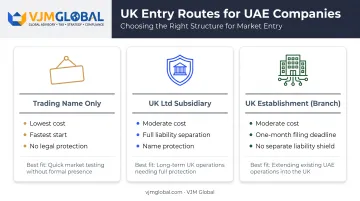
| Trading name only | Lowest cost, fastest to start | None; relies on passing-off law | Testing the UK market before committing |
| UK Ltd subsidiary | Moderate cost, 24-hour online filing | Full liability separation, name protection | Building UK credibility and banking access |
| UK establishment (branch) | Moderate cost, one-month filing deadline | No separate shield; UAE parent carries liability | Keeping one unified group identity |
A trading name suits a UAE company dipping a toe in, with no real appetite for a permanent UK footprint yet. It's cheap and fast, but offers zero liability shield and no formal name protection.
A UK Ltd subsidiary makes sense once you want a UK bank account, UK contracts in a UK entity's name, and a clean line between UAE and UK liability. It's the route most UAE companies land on once they're past the testing phase.
A branch keeps your UAE legal identity intact while trading under the same name in the UK. That helps when group structure, financing, or investor reporting depends on staying unified rather than fragmented.
If you're not sure which fits, VJM Global can run UK company or branch registration with UAE-side compliance in one engagement. The team maps the structure to your tax position and operating plan, not just filing convenience.
Conclusion
A smooth UK business name registration for a UAE company comes down to three things:
- Picking the right route for your actual goals
- Getting UAE corporate documents authenticated early
- Respecting UK naming rules before you fall in love with a brand
Most delays have nothing to do with Companies House itself. The online system is genuinely fast. They come from document authentication gaps and naming conflicts that could have been caught in week one.
Specialist cross-border advisors such as VJM Global support UAE companies through the whole process, from the initial name search through UK Corporation Tax and VAT registration.
Frequently Asked Questions
How can I check if a business name is registered in the UK?
You can't check a "business name" the way you would in the UAE—there's no separate registry for it. Only registered company names can be checked via the Companies House availability search; trading names rely on trademark and passing-off checks instead.
Can a UAE company register a UK company name without visiting the UK?
Yes. The entire process runs remotely through Companies House online filing, supported by a formation agent, a UK registered office, and standard identity verification.
Does a UAE company need a UK bank account to register a business name?
No. Registration does not require a bank account. You will need one to trade, and EMI or fintech providers are often faster for UAE-based directors than traditional banks.
Will registering a UK company name make my UAE company liable for UK tax?
No, incorporation alone doesn't trigger UK tax residency. Liability depends on where management and control genuinely sit, and the UK-UAE Double Tax Treaty helps resolve disputes if residency becomes contested.
What's the difference between a UK trading name and a registered company name?
A registered company name is filed with Companies House and formally protected against identical or very similar registrations. A trading name has no central registry and is protected only through trademark rights or passing-off law.
How long does it take a UAE company to register a business name in the UK?
A straightforward online Companies House filing usually processes within 24 hours. It takes longer if UAE-issued documents still need notarisation and legalisation first—often the real bottleneck.