Introduction
Business ties between the UAE and UK run deep, and more UAE-based founders are registering UK private limited companies without ever booking a flight.
The process looks deceptively simple on the Companies House website: fill in a form, pay a fee, get a certificate.
But many founders struggle with what comes after the click-to-submit moment. Structure choice, documentation accuracy, tax residency planning and banking readiness all determine whether the company functions once it's live.
This guide walks through the exact steps, requirements, costs, common mistakes and alternative structures so UAE founders can get it right the first time.
Key Takeaways
- UK Ltd registration is fully remote via Companies House, with no residency requirement.
- Online filing costs £100 and completes within 24 hours, though total setup costs more.
- Incorporation alone doesn't guarantee simple taxation; management location and treaty rules matter.
- Banking, VAT and Corporation Tax registrations are separate steps needing early planning.
- Professional support for cross-border documentation and PSC filings reduces delays
Step-by-Step Process to Register a Private Limited Company in the UK from the UAE
The entire process runs online, no visit to the UK required, and Companies House typically processes digital filings within 24 hours.
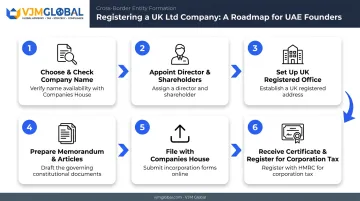
Step 1: Choose and Check Your Company Name
Your company name must end in "Limited" or "Ltd" and can't duplicate, or closely resemble, an existing registered name. Certain words are restricted or require special permission, particularly anything implying a government connection or regulated activity.
- Check availability using the Companies House WebCheck tool before you get attached to a name
- Run a trademark search separately : a name can pass Companies House checks and still infringe someone's registered trademark, forcing a costly rebrand later
Step 2: Appoint a Director and Identify Shareholders
There's no requirement for directors to live in the UK. The minimum age is 16, and a private Ltd doesn't need a company secretary.
For UAE-based directors and shareholders, you'll typically need:
- A valid passport
- Emirates ID
- Proof of UAE residential address
One thing that's changed recently: identity verification became a legal requirement from 18 November 2025 under the Economic Crime and Corporate Transparency Act reforms. New directors receive a personal verification code at incorporation; existing directors verify at their next confirmation statement, and PSCs verify separately.
Step 3: Set Up a UK Registered Office Address
Every UK Ltd needs a physical, appropriate UK address as its registered office. Royal Mail PO Boxes don't qualify.
Most UAE founders use a registered office or virtual address provider rather than sourcing a UK address themselves. The address becomes public record, so it needs to be a compliant, ongoing arrangement, not a one-off favour from a UK contact.
Step 4: Prepare the Memorandum and Articles of Association
Companies House generates the memorandum automatically during online filing. For articles, you choose between:
- Model articles: the standard, default set that works fine for most straightforward Ltds
- Bespoke articles: needed if you want non-standard share rights, director powers or transfer restrictions
You'll also file a statement of capital (share numbers, value, and class) and identify any Person with Significant Control — generally anyone holding more than 25% of shares or voting rights.
Step 5: File the Incorporation Application with Companies House
The Web Incorporation Service costs £100 and usually registers a company within 24 hours. You'll need to submit:
- Officer details (directors and any PSCs)
- Share allocation and class structure
- Registered office address
- A SIC code describing your business activity
Step 6: Receive the Certificate of Incorporation and Register for Corporation Tax
The certificate confirms your company legally exists and provides its company number. From here, you must register for Corporation Tax with HMRC within three months of the company starting to trade, not three months from incorporation date. This is a subtle but important distinction.
HMRC then issues a 10-digit Unique Taxpayer Reference (UTR), usually by post within about 15 days, sent to your registered office address. You'll need this for every future filing.
Documents and Requirements Checklist for UAE Applicants
Thorough preparation before you file cuts down the delays that trip up most cross-border applicants.
- Personal identification — valid passport or Emirates ID, plus proof of UAE residential address, for every director, shareholder and PSC
- Registered office documentation — confirmation from a compliant UK address provider
- Share capital details — number of shares, nominal value, and share class (ordinary shares are the standard choice for UAE-owned Ltds)
- PSC declaration — required for anyone holding more than 25% of shares or voting rights, or otherwise exercising significant control
Getting these details right before filing avoids the gaps that trigger Companies House queries later.
VJM Global helps UAE-based founders prepare this exact documentation: structuring share allocations, drafting supporting paperwork, and filing PSC declarations correctly the first time.
Cost, Tax Residency, and Banking Considerations
Cost of Incorporation and Ongoing Compliance
The Companies House fee itself is modest, but it's only one line item in your total setup cost.
| Item | Cost |
|---|---|
| Online incorporation | £100 |
| Paper incorporation | £124 |
| Confirmation statement (online) | £50 per year |
| Confirmation statement (paper) | £110 per year |
| Registered office/virtual address | Varies by provider |
| Formation agent support | Varies by scope |
| Annual accounts preparation | Varies by complexity |
Beyond Companies House, budget for a registered office service, formation agent or accountant support, and annual accounting and confirmation statement filings. These ongoing costs typically outweigh the initial filing fee within the first year.
UK Tax Residency vs. Incorporation
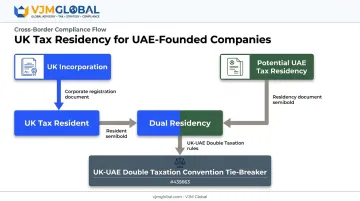
Here's a point many guides get wrong: incorporating in the UK doesn't leave your tax residency undecided: a UK-incorporated company is automatically UK tax resident under domestic law, regardless of where the directors sit. The central management and control (CMC) test is an additional rule that mainly catches foreign-incorporated companies that are effectively run from the UK.
For UAE founders, this means your new Ltd will be UK tax resident from day one. The practical questions that follow are:
- Whether your company also becomes tax resident in the UAE under local rules, creating dual residency
- How profits and dividends flow between the UK entity and any UAE operations
- Whether a permanent establishment exists in the UAE that changes where profits are taxed
The UK-UAE Double Taxation Convention, in force since December 2016, provides relief mechanisms for exactly this scenario. But dual-resident companies need the tax authorities of both countries to agree on a tie-breaker. It's not automatic, so documenting where decisions genuinely get made still matters for that process.
Opening a UK Business Bank Account
Traditional UK banks apply thorough due diligence on non-resident directors, covering identity checks, source-of-funds questions, and beneficial ownership verification, all of which take time. Fintech and e-money institution (EMI) providers often move faster on onboarding, though it's worth understanding the distinction: an EMI safeguards the funds you deposit but doesn't lend against them the way a bank can.
On VAT, the registration threshold sits at £90,000, effective since April 2024. Serving only non-UK clients doesn't automatically exempt you. VAT obligations depend on place-of-supply rules, which vary for B2B versus B2C services. Get this classified correctly before assuming you're outside scope.
Beyond VAT and banking logistics, structuring intercompany documentation between a UAE operation and a new UK entity is exactly where things get complicated fast. VJM Global has supported over 250 UK businesses with this kind of cross-border compliance work, helping keep tax and documentation positions defensible rather than assumed.
Private Limited Company vs. Other UK Business Structures
A Ltd suits most UAE founders, but it isn't automatically the right fit for everyone.
| Structure | Best for | Key requirement |
|---|---|---|
| Private Limited Company | Most UAE-founded SMEs and startups | £100 filing, one director minimum |
| Public Limited Company (PLC) | Businesses planning a public listing or institutional fundraising | £50,000 minimum share capital, mandatory audit |
| Limited Liability Partnership (LLP) | Professional/consulting service providers wanting partnership-style profit sharing | Minimum two members |
| Branch of a UAE company | Short-term UK market testing | No separate legal identity; parent exposed to UK liabilities |
Beyond the table, three structures deserve a closer look:
- PLC makes sense only for institutional capital or a public listing goal; the £50,000 capital requirement and mandatory audit rule it out for most SMEs.
- LLP fits UAE consultancy or professional service founders who want profits allocated between members rather than distributed as corporate dividends.
- Branch structures set up fastest for testing the UK market, but carry no separate legal identity from the UAE parent, so liabilities flow straight back home.
Common Mistakes UAE Founders Make When Registering
- Skipping the trademark check — passing the Companies House name search doesn't mean you're clear of trademark conflicts, and rebranding after launch is expensive
- Failing to document management decisions: treaty relief claims require evidence of where board decisions are actually made, not just where the company is incorporated
- Underestimating bank onboarding timelines: non-resident director due diligence takes longer than founders expect, and leaving it until after incorporation stalls invoicing
- Using a residential address or PO Box: Companies House rejects PO Boxes outright, and a residential address becomes permanently public
Frequently Asked Questions
Can I set up a UK private limited company if I live in the UAE?
Yes. Registration is fully remote through Companies House, and there's no UK residency requirement for directors or shareholders.
How much does it cost to set up a private limited company in the UK?
The Companies House online filing fee is £100. Add typical costs for a registered office provider, formation support, and annual accounting or confirmation statement filings on top.
Is a UK private limited company the same as an LLC or corporation?
It's the closest UK equivalent to an LLC or corporation, but the UK doesn't use the "LLC" designation. A Ltd has its own distinct legal features around shares, directors and filing obligations.
Do I need to visit the UK to register or open a bank account?
Registration is entirely online. Some traditional banks may request additional verification for non-resident directors when opening an account, though this rarely requires travel.
Does registering a UK company give me the right to live or work there?
No. Company ownership doesn't grant UK residency rights. You'd need a separate visa application if you intend to live or work in the UK.
How long does it take to register a private limited company from the UAE?
Companies House typically processes online filings within 24 hours. Factor in extra time beforehand for gathering documents and afterward for banking setup.