Introduction
Picture a Dubai mainland LLC owner typing "how to register a UK LLC" into Google. Every search result tells them the same thing: that structure doesn't exist in Britain.
This trips up more UAE entrepreneurs than you'd think. The term "LLC" is so embedded in Gulf business culture that many founders assume it's a universal legal label. It isn't.
The UK equivalent is the Private Limited Company (Ltd), registered under the Companies Act 2006 with Companies House. A UAE LLC and a UK Ltd share the same core idea of limiting owners' financial exposure, but they're built on completely different legal foundations.
This guide breaks down what a UK Ltd actually is, how it compares to a UAE mainland LLC, why UAE businesses set one up, and what registering and running one involves from outside the UK.
Key Takeaways
- The UK's closest match to a UAE LLC is a Private Limited Company (Ltd); "LLC" carries no legal status under UK law
- UAE nationals and UAE entities can own and direct a UK Ltd fully, with no residency requirement
- Online Companies House registration usually completes within 24 hours, often faster than a UAE mainland LLC setup
- The UK-UAE Double Taxation Agreement helps prevent double taxation, but you still need to check UAE management-and-control rules
- Confirmation Statements, annual accounts, and Corporation Tax returns are mandatory regardless of where the owner lives
What Is the UK Equivalent of a UAE LLC?
Search GOV.UK's official list of business structures and you'll find sole trader, limited company, business partnership, and overseas company. LLC doesn't appear anywhere on it. That's because "LLC" is a legal concept borrowed from US and UAE company law, not a registrable structure under the UK system.
Under Section 3 of the Companies Act 2006, a company limited by shares (what most people mean by "Ltd") caps each member's liability at the amount unpaid on their shares. If a shareholder has paid for their shares in full, they typically owe nothing further if the company runs into trouble.
Same Name, Different Instrument
Here's where it gets confusing for UAE readers: a UAE mainland "LLC" is licensed by the relevant Department of Economic Development and governed by UAE Federal Decree-Law No. 32 of 2021. It's a distinct legal instrument from a US-style LLC and from a UK Ltd, even though all three share overlapping naming conventions.
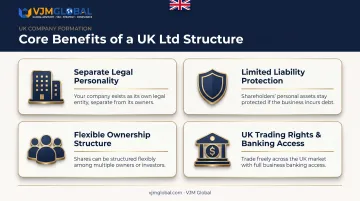
A UK Ltd is the practical equivalent because it offers:
- Gives the company its own legal personality, so it holds assets and signs contracts
- Protects shareholders' personal assets beyond their share investment
- Allows flexible ownership, from one shareholder to dozens
- Provides full UK trading rights and, in most cases, easier access to UK banking
This structure isn't a niche choice. Private limited companies made up over 95% of all corporate bodies on the Companies House register as of March 2026, according to Companies House's own statistical release. It's the default structure for a reason: it's simple, well understood, and widely trusted by banks and clients alike.
Why This Matters Specifically for UAE Business Owners
UAE entrepreneurs often type "UK LLC" into search bars simply because LLC is the familiar mainland structure back home. That habit is understandable, but it is also the most common misstep before UK company formation begins. Correct the terminology first and the filing path, documents, and banking setup become much clearer.
UAE LLC vs UK Private Limited Company: Key Differences
Both structures exist to limit shareholder liability. Beyond that shared purpose, they diverge sharply on ownership rules, tax treatment, governance, and how much information becomes public.
Ownership and Foreign Investment Rules
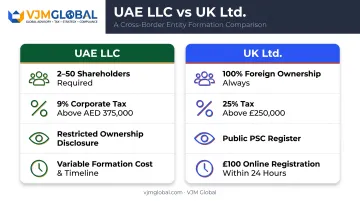
UAE mainland LLCs typically require 2 to 50 shareholders. Since Federal Decree-Law No. 26 of 2020 took effect, full foreign ownership is permitted in most sectors. "Strategic impact" activities like banking, telecoms, and defence may still require UAE national participation or board conditions set by the relevant regulator.
UK Ltd companies work differently:
- No residency requirement for directors or shareholders
- 100% foreign ownership permitted, always, in every sector
- A single person can be both the sole director and sole shareholder
Liability, Governance, and Public Disclosure
A UAE LLC allows a delegated or appointed manager to run day-to-day operations. Ownership details aren't published in the same searchable way: under UAE Cabinet Resolution No. 109 of 2023, beneficial ownership information generally can't be disclosed without written approval.
UK Ltd companies operate under a statutory director framework plus the Person of Significant Control (PSC) regime. Anyone holding more than 25% of shares or voting rights must be identified and filed with Companies House, where it's publicly searchable. That transparency cuts both ways. It builds trust with UK banks and investors, but it also means less privacy than a UAE LLC structure offers.
Taxation Treatment
| UAE Corporate Tax | UK Corporation Tax | |
|---|---|---|
| Lower band | 0% up to AED 375,000 | 19% up to £50,000 profit |
| Upper band | 9% above AED 375,000 | 25% above £250,000 |
| Free Zone treatment | 0% on Qualifying Income for Qualifying Free Zone Persons | No equivalent zero-rate regime |
| Marginal relief | None | Applies between £50,000 and £250,000 |
Free Zone entities don't get a separate tax-free allowance on non-qualifying income. That income is taxed at 9%, like mainland profits above the threshold.
Formation Cost, Capital, and Timeline
| UAE Mainland LLC | UK Ltd | |
|---|---|---|
| Minimum capital | No fixed statutory minimum (Cabinet may set one by decision) | No minimum capital requirement |
| Formation cost | Varies by activity; components can run into several thousand AED | From £100 (online) |
| Timeline | Digital platforms advertise setup in as little as 15 minutes for eligible activities; regulated activities take longer | Usually 24 hours online |
Both jurisdictions have made digital registration genuinely fast. The UK's advantage is consistency: the £100 online fee and 24-hour turnaround apply almost regardless of business activity, whereas UAE mainland timelines and costs shift depending on the licence and emirate.
Why UAE Businesses Register a UK Ltd
For many UAE-based founders, a UK entity isn't a replacement for their existing LLC. It's an addition that opens doors a UAE-only entity can't.
Credibility with international clients and banks. A UK-registered company carries recognised weight in Europe and the wider English-speaking business world. Clients, banks, and investors often trust a UK Ltd's paper trail—filed accounts and PSC register—more readily than an offshore or Gulf-only entity when they decide who to contract with.
A working tax treaty. The UK-UAE Double Taxation Agreement, in force since December 2016, helps prevent the same profits being taxed twice across both jurisdictions. That said, the treaty doesn't eliminate UK Corporation Tax on the UK entity's own profits. It only prevents double-counting.
Common scenarios that push UAE founders toward a UK Ltd:
- Selling products or services directly into UK or EU markets
- Opening a UK subsidiary under an existing UAE LLC parent company
- Meeting a UK investor's or contract counterparty's requirement for a local entity
How to Register a UK Private Limited Company from the UAE
The good news: none of this requires setting foot in the UK.
Core requirements before you start:
- A unique company name ending in "Limited" or "Ltd"
- A physical UK registered office address (PO Boxes and virtual-only addresses aren't accepted)
- At least one director aged 16 or over
- At least one shareholder
- A defined share structure
Founders without a UK address typically use a registered office or formation agent service to satisfy that requirement. VJM Global has supported 250+ UK businesses, including founders operating entirely remotely, with entity formation and ongoing compliance.
Step-by-Step Registration Process
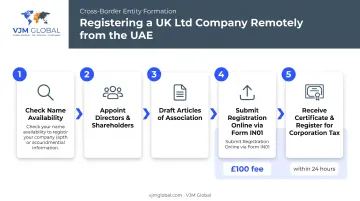
- Check name availability through the Companies House register to confirm your chosen name isn't already taken
- Appoint directors and shareholders, and identify anyone who qualifies as a Person of Significant Control (25%+ ownership or voting rights)
- Draft the Memorandum and Articles of Association — Companies House's model articles work fine for most straightforward companies
- Submit your registration online, through formation software, or by post (form IN01)
Costs and timelines vary by route:
| Route | Cost | Typical Timeline |
|---|---|---|
| Online | £100 | Within 24 hours |
| Software (same-day) | £156 | Same day, if submitted before 3pm |
| Postal (form IN01) | £124 | 8-10 days |
Once Companies House approves the filing, you receive a certificate of incorporation and can trade as a UK limited company.
Register for Corporation Tax with HMRC within 3 months of starting business activity. If taxable turnover exceeds £90,000, VAT registration becomes compulsory too.
Documents to prepare in advance:
- Passport copies for all directors and shareholders
- Proof of residential address for each director and shareholder
- Any NOC-equivalent clearance from an existing UAE sponsor, if applicable to your current visa or licence status
Prepare these before you start so identity checks don't stall the application mid-process.
Tax and Compliance Considerations for UAE-Owned UK Companies
Incorporation is just the beginning. A UK Ltd carries ongoing obligations that don't pause because the owner lives in Dubai or Abu Dhabi.
Mandatory annual filings:
- Confirmation Statement — filed at least once every 12 months, even for dormant companies
- Annual accounts — due within 9 months of your financial year-end (21 months for first accounts)
- Corporation Tax return (CT600) — due within 12 months of the accounting period, with payment due 9 months and 1 day after period-end
There's a UAE-side wrinkle worth flagging early. If your UK company is effectively managed and controlled from the UAE, the UAE Federal Tax Authority may treat it as a UAE tax resident for Corporate Tax purposes. That usually means key decisions are made there, through UAE-based board meetings or UAE-resident directors.
That's not automatic, but it's a real risk that depends on how the company is structured and run day to day. Getting this wrong can mean unexpected tax exposure in both jurisdictions rather than the clean, treaty-protected setup most founders expect.
VJM Global handles UK filings, coordinates UAE-side compliance, and helps structure management arrangements so UAE-owned UK entities aren't caught out by residency rules they didn't know applied.
Frequently Asked Questions
What is the UK equivalent of an LLC for businesses from the UAE?
The UK's closest equivalent is the Private Limited Company (Ltd), registered with Companies House under the Companies Act 2006. A UAE LLC and a UK Ltd both limit owner liability, but they are formed under different statutes and regulators.
Which is better for a UAE business: LLC or UK Private Limited (Ltd)?
It depends on where you operate and sell. Keep your UAE LLC for Gulf operations and banking, and add a UK Ltd specifically when you have real UK or EU clients, investor requirements, or a credibility need.
Can a UAE company own a UK Private Limited Company?
Yes. A UAE-incorporated company can be a shareholder of a UK Ltd, with no residency or nationality restriction on ownership, as long as the UK company maintains a valid UK registered office address.
Does the UK have a tax treaty with the UAE?
Yes, the UK-UAE Double Taxation Agreement has been in force since December 2016. It helps prevent double taxation on the same income, though UK Corporation Tax on the entity's UK profits still applies regardless.
How long does it take to register a UK Ltd from the UAE?
Standard online registration with Companies House typically completes within 24 hours once all details are correctly submitted. Same-day and postal options are also available at different price points.
Do I need to visit the UK to register a company as a UAE resident?
No. The entire process can be completed remotely from the UAE. The only physical requirement is a valid UK registered office address, which a formation agent or registered address service can provide.