Companies House makes the mechanics of registration genuinely simple. But UAE-based founders run into layers that most generic guides skip entirely: tax residency questions, the UK-UAE Double Tax Treaty, banking access from abroad, and document requirements that differ from what a UK resident would need.
This guide covers who's eligible, the exact online steps, real costs in pounds, the documents you'll need to gather in the UAE, and the tax and banking pitfalls that catch remote founders off guard.
Key Takeaways
- UAE residents of any nationality can register a UK Ltd company fully online, usually approved within 24-48 hours
- Companies House filing fees stay low; total setup cost rises once you add a registered office and formation agent
- UK incorporation does not automatically create UK tax residence; where management decisions happen matters more
- Non-UK resident directors and PSCs must complete identity verification before the application can proceed
- Corporation Tax, confirmation statements and annual accounts apply the same way wherever you live
How to Register a Company Online in the UK from the UAE: Step-by-Step
The entire process happens through Companies House's online portal or a formation agent's platform. No paper forms, no courier packages, no UK visit required.
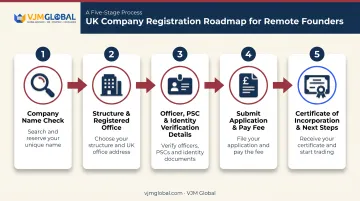
Step 1: Choose and Check Your Company Name
Run your proposed name through the free Companies House name-availability checker before doing anything else. Your name must:
- End in "Ltd" or "Limited"
- Avoid restricted words (such as "Royal," "Bank," or "Chartered") without special permission
- Not be identical or too similar to an existing registered company
If you're already running a free zone entity in the UAE, check that your new UK name doesn't clash with or dilute your existing trade name. Consistent branding across both jurisdictions makes life easier for clients and banks alike.
Step 2: Decide Your Structure and Arrange a UK Registered Office
A Private Limited Company (Ltd) is the standard structure for UAE founders who want a UK entity for invoicing, operations, or payment processing. It's straightforward to run, limits personal liability, and is well understood by UK clients and banks.
Every UK company needs a registered office address in the jurisdiction where it's incorporated. A PO Box alone won't cut it.
Since most UAE residents don't have a personal UK address, this is typically arranged through a formation agent or accountant, who provides a compliant address as part of their package.
Confirm your registered office before you start the application. Trying to submit without one is one of the most common reasons remote applications stall.
Step 3: Gather Officer, Shareholder and PSC Details and Founding Documents
For each officer, you'll need to provide:
- Full legal name and date of birth
- Nationality and occupation
- Residential address (kept private) and a service address (publicly listed)
One UAE-based person can legally hold every role simultaneously: director, shareholder, and person with significant control (PSC). There's no requirement to bring in additional UK-based people.
Since 18 November 2025, identity verification has been a legal requirement under the Economic Crime and Corporate Transparency Act for every proposed director and relevant PSC, including those based overseas.
You can complete this directly via GOV.UK One Login using a biometric passport from any country, or through an authorised formation agent if the direct route doesn't suit your documents. Once verified, you receive a personal code that gets entered into the incorporation filing.
The Memorandum and Articles of Association are generated automatically during the online process using standard templates, so there's nothing to draft from scratch unless you want bespoke share rights.
Step 4: Submit the Application to Companies House and Pay the Fee
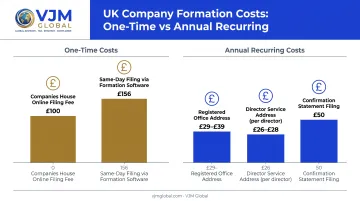
You can submit directly through the GOV.UK portal or via a formation agent's platform, which often pre-fills fields and flags errors before submission. The standard online filing fee is £100. A same-day option exists at £156, but it's only available through compatible third-party software, not the standard web form.
Most online applications are approved within 24 hours. If you spot an error after submitting, correcting it typically requires a separate filing rather than an edit to the original application. Double-check names, addresses and share allocations before you hit submit.
Step 5: Receive Your Certificate of Incorporation and Handle Immediate Next Steps
On approval, you receive:
- A certificate of incorporation confirming your company number
- An authentication code for future online filings
Your company can start trading immediately. From here, three things need attention fast:
- Register for Corporation Tax with HMRC within three months of starting to trade
- Open a business bank account (more on the realistic options below)
- Set up your accounting system so you're tracking income and expenses from day one
What You Need Before You Start: Requirements, Documents and Costs
Gathering the right paperwork in advance prevents most of the delays that overseas applicants run into. Here's what actually matters.
Eligibility for UAE Residents
There's no nationality or residency restriction on UK directors, shareholders, or Persons with Significant Control (PSCs). A single UAE-based founder, regardless of passport, can fulfil all three roles on their own. This applies equally to Emirati nationals, Indian expats, and any other resident of the UAE.
Documents Needed From the UAE
Expect to provide:
- A clear passport copy (biometric passports are accepted for the direct identity verification route)
- Proof of UAE residential address, such as a recent utility bill or an Emirates ID-linked document
- Certified English translations for any document not originally in English
Formation agents typically want address evidence dated within the last three months. If electronic checks fail, some may also request a tax-residence certificate as a backup.
Registered Office and Service Address Options
Since you likely don't have a personal UK address, most UAE founders use a formation agent or accountant's address for both the registered office and the director's service address. Based on current market pricing:
- Registered office address: roughly £29-£39 per year
- Director service address: roughly £26-£28 per director, per year
These are separate services and both are usually needed unless your provider bundles them together.
Cost Breakdown
| Item | Typical Cost |
|---|---|
| Companies House online filing fee (one-time) | £100 |
| Same-day filing via formation software (one-time) | £156 |
| Registered office address (annual) | £29-£39 |
| Director service address (annual) | £26-£28 |
| Confirmation statement filing (annual) | £50 |
Formation agents often bundle the filing fee, registered office and service address into a single package. Exact pricing depends on the provider and on extras such as mail forwarding and compliance reminders.
Get a quote matched to your requirements rather than assuming a flat rate.
Tax Residency, the UK-UAE Double Tax Treaty and Banking for Non-Residents
This is the section most guides gloss over, and it's where UAE-based founders make expensive assumptions.
Incorporation Doesn't Decide Your Tax Residency
Registering in the UK does not automatically make your company UK tax resident. HMRC applies a central management and control test: tax residency follows wherever the real strategic decisions are actually made, not where the paperwork is filed. If board decisions, major contracts and strategic direction happen from your UAE office, that carries real weight.
The Double Tax Treaty's Role
The UK-UAE Double Tax Treaty exists to prevent the same profits being taxed twice. If your company could be considered resident in both countries, the treaty's tie-breaker provisions determine which jurisdiction gets primary taxing rights. This matters directly for:
- Profit allocation between the UK entity and your UAE base
- Dividend withholding treatment
- Intercompany arrangements and cross-border fees
Permanent Establishment Risk
Even if your company is managed from the UAE, substantial UK activity can create a permanent establishment and trigger UK tax exposure you did not intend.
Activities that tip the balance include:
- A fixed UK office
- A dependent agent regularly concluding contracts on your behalf
- Ongoing UK-based operations
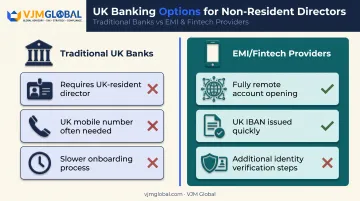
Comparing Banking Routes
Tax residency and PE risk also shape which banking route is realistic for a non-resident founder.
| Route | Best for | Trade-off |
|---|---|---|
| Traditional UK banks | Founders with existing UK ties | Often need a UK-resident director or UK trading address; slower onboarding |
| EMI/fintech providers | Remote, fully UAE-based founders | Faster online account opening with a UK IBAN; additional verification can add several working days |
Traditional banks like Lloyds generally require a UK-resident applicant with a UK mobile number, which rules out an all-UAE-director company from that route entirely. EMI providers tend to be more realistic for founders operating purely from Dubai or Abu Dhabi, though eligibility is still case-by-case and documentation requests vary.
Once banking, residency and PE boundaries are clear, intercompany fees, IP licensing and cross-border filings are easier to get right first time. VJM Global has supported over 250 UK businesses and maintains chartered accountants and compliance specialists across the UAE and UK, so UK filings and UAE-side obligations line up rather than pull against each other.
Common Mistakes UAE Founders Make When Registering a UK Company Online
A handful of errors show up repeatedly among remote applicants:
- Assuming incorporation settles tax questions. Registering the company doesn't document where central management and control genuinely sits. That record needs to exist separately, and it matters if HMRC ever asks.
- Starting the application before securing a registered office. Without a confirmed UK address and director service address in hand, submission simply won't go through.
- Underestimating identity verification. Directors and PSCs who leave this step until the last minute often find their application delayed or rejected outright.
- Going it alone on cross-border compliance. UK filings and UAE obligations don't align on their own. VJM Global's cross-border entity formation and tax team coordinates both sides from the start, so founders aren't left reconciling mismatches later.
Frequently Asked Questions
Can a non-UK resident register a UK limited company?
Yes. There's no residency or nationality restriction. A UAE-based founder can be sole director, shareholder, and Person with Significant Control (PSC), provided identity verification is completed and a UK registered office is appointed.
Can I register my company online in the UK?
Yes, the entire process runs through Companies House online. Submission typically takes around 10 minutes, with approval usually arriving within 24-48 hours and no UK visit needed.
How much will it cost to register a company in the UK?
The Companies House online filing fee is £100. Add £29-£39 for a registered office, £26-£28 per director for a service address, and any formation agent package fees on top.
Do I need to visit the UK to register my company from the UAE?
No. From name checking through to receiving your certificate of incorporation, the full registration process can be completed remotely.
Will my UK company be taxed in the UK if I run it from the UAE?
It depends on where central management and control genuinely sits, not on where the company is incorporated. The UK-UAE Double Tax Treaty's tie-breaker rules step in if both countries could claim residency.
Can I open a UK business bank account from the UAE without visiting?
Many Electronic Money Institution (EMI) and fintech providers allow fully remote account opening for non-resident directors. Traditional UK banks usually require stronger UK ties, such as a UK-resident director, making them harder to access from abroad.