Introduction
UAE companies are moving into the UK at a steady pace. Trade between the two countries hit £25.2 billion in the four quarters to Q1 2026, and UAE investors held £7.0 billion in UK assets by the end of 2024.
For any UAE business making that move, the first real decision isn't marketing or hiring. It's structure: branch or subsidiary?
Get it wrong and you could face unlimited liability, double taxation, or months of stalled banking approvals. Get it right and you save real time and money on entry.
This guide focuses on how UAE's 9% corporate tax regime, free zone status, and the UK-UAE tax treaty change the calculation for UAE-headquartered businesses. We'll compare both structures directly and give you decision criteria that apply to your situation.
Key Takeaways
- A branch extends the UAE parent's liability into the UK; a subsidiary ring-fences it
- Online UK Ltd incorporation usually completes within 24 hours; branch registration has no set Companies House timeline
- UK-UAE treaty relief usually means no UK withholding tax on ordinary dividends to a UAE parent
- UAE’s 9% corporate tax can create double taxation without treaty and foreign tax credit planning
- Risk tolerance and UK investment horizon decide the right structure, not a fixed rulebook
Branch vs Subsidiary: Quick Comparison for UAE Companies
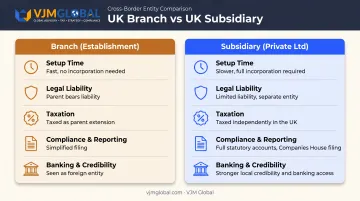
Here's how the two structures stack up on the factors that matter most to a UAE parent company.
| Factor | UK Branch (Establishment) | UK Subsidiary (Private Ltd) |
|---|---|---|
| Setup time | Form OS IN01 after the UAE company opens a UK establishment; no official Companies House timeline | Usually incorporated online within 24 hours (£100) |
| Legal liability | No separate legal personality; UAE parent (mainland or free zone) fully liable for UK debts and claims | Separate body corporate; liability limited to unpaid share capital |
| Taxation | Corporation Tax on UK-sourced profits attributable to the branch only | UK-resident company taxed on worldwide profits, with DTA relief available |
| Compliance & reporting | Parent-company accounts (translated if required) plus a UK trading statement; no separate UK audit | Standalone UK annual accounts and confirmation statement; audit above £15m turnover, £7.5m assets, or 50 employees |
| Banking & credibility | Closer scrutiny common — contracting party is a foreign entity | Standalone UK legal entity; often simpler for banks and buyers to onboard |
Both routes require UK banks to run the same core customer and beneficial-owner checks. No official data shows one structure clears KYC faster than the other.
What differs is exposure: a UK establishment is still the UAE company in law, so due diligence often traces straight back to the Dubai, Abu Dhabi, or free zone parent.
What is a UK Branch (Establishment)?
A UK branch isn't actually a separate company. Companies House calls it a UK establishment, a registered place of business for an overseas company that keeps trading under its original UAE legal identity. You register it using form OS IN01, currently £124, once the UAE company has started operating in the UK.
For a UAE trading house, logistics operator or oil and gas services firm, this route means operating under an existing brand, supplier contracts and banking relationships. You avoid building a new UK legal identity from scratch.
The trade-off is liability. A branch has no separate legal personality. Any UK contract dispute, unpaid invoice or legal claim reaches the UAE parent's balance sheet directly, whether that parent sits in Dubai mainland or a free zone like JAFZA or DMCC.
Corporation Tax only applies to profits from UK activity attributable to the branch. Under UAE foreign-source income rules, a UAE resident company can elect to exempt profits from a qualifying foreign permanent establishment. That election is available if the PE faces foreign tax of at least 9%, though this needs case-by-case modelling rather than a blanket assumption.
Use Cases of a UK Branch for UAE Companies
A branch typically fits UAE companies testing UK demand before committing serious capital:
- Construction and EPC contractors bidding on a specific short-term UK project
- Trading and import-export companies testing a new UK distribution route
- Consultancy firms serving one or two UK clients with no long-term hiring plan
These sectors favour branches because contracts are project-based and the parent's track record already carries weight with clients. If your UAE company only needs a UK presence for 12 to 18 months, a full subsidiary can add compliance overhead you won't use.
What is a UK Subsidiary?
A UK subsidiary is a private limited company incorporated in England and Wales (or Scotland or Northern Ireland), owned by the UAE parent but governed entirely by UK company law. It's a separate legal person from day one.
That separation is the whole point. If the UK subsidiary can't pay a supplier or loses a lawsuit, the UAE parent's exposure is capped at what it put in as shares.
The structure also helps commercially. UK banks, suppliers and public-sector procurement teams generally prefer a UK-registered counterparty over a foreign branch. A UK-resident company can access the UK's tax treaty network and R&D incentives directly.
Setting one up is straightforward on paper:
- One director minimum, aged 16 or over, who doesn't need to live in the UK
- A UK registered office address is mandatory (a virtual office can satisfy this)
- Share capital can be any value — £1 is a common nominal figure, not a legal minimum
- Online incorporation costs £100, and most companies register within 24 hours
The compliance load is heavier than a branch. A subsidiary files its own annual accounts and confirmation statement every year, separate from anything the UAE parent files at home.
Statutory audit becomes mandatory once the company exceeds two of three thresholds (effective from 6 April 2025):
- £15m turnover
- £7.5m in balance sheet assets
- 50 employees
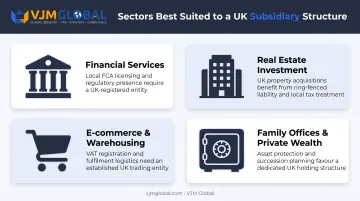
Use Cases of a UK Subsidiary for UAE Companies
Subsidiaries make sense once a UAE company commits to the UK long-term:
- Financial services firms needing UK regulatory standing
- Real estate investment vehicles holding UK property directly
- E-commerce businesses hiring UK staff or warehousing stock locally
- Family offices and private wealth structures ring-fencing UK assets from the wider group
Any UAE business planning to hire UK employees, sign multi-year contracts, or bid on UK government tenders will often find a subsidiary is the baseline requirement. Many procurement processes and larger clients specify a locally incorporated supplier before they'll issue a contract at all.
Branch vs Subsidiary: Which Is Better for UAE Companies?
There's no universal answer, but the right decision usually comes down to how the tax treaty, UAE's own tax rules, and your growth timeline line up.
How the Tax Treaty and UAE's 9% Rate Interact
Under Article 7 of the UK-UAE Double Taxation Convention, a UAE enterprise's profits stay taxable only in the UAE unless it operates through a UK permanent establishment. In that case, the UK taxes only the profit attributable to that PE. A branch is, by definition, that PE.
Dividends work differently for subsidiaries. The treaty generally exempts ordinary cross-border dividends from source-state withholding tax (the 15% figure sometimes quoted only applies to specific real-estate investment vehicles, not standard company dividends). That means a UAE parent repatriating profits from a UK subsidiary usually avoids UK withholding tax on the way out.
On the UAE side, corporate tax runs at 9% above AED 375,000. A UAE company can elect to exempt profits from a qualifying foreign PE, including a UK branch, if that PE faces foreign tax of at least 9%—a threshold the UK's main rate above £250,000 clearly meets.
Subsidiary dividends flowing back to a UAE parent may also qualify for a participation exemption if ownership, holding period and tax-rate tests are met. None of this is automatic; it depends on structuring and documentation, not the entity type alone.
Banking, Substance and Practical Timing
UK banks apply the same core know-your-customer standard to both structures: identifying the customer, verifying beneficial owners, and understanding the account's purpose. UAE free zone parents sometimes face extra questions here, simply because free zone ownership layers can be harder for a UK bank to trace than a UAE mainland structure. This applies whether you're opening an account for a branch or a subsidiary.
If you're planning to relocate senior staff to run the new UK operation, the UK Expansion Worker route under the Global Business Mobility visa category is worth flagging early. Eligibility and sponsor licensing requirements differ depending on whether the UK presence already exists.
As a starting point:
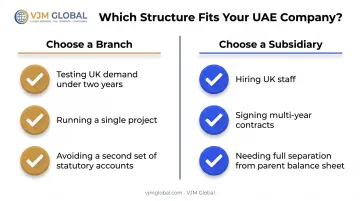
- Choose a branch if you're testing UK demand for under two years, running a single project, or want to avoid a second set of statutory accounts
- Choose a subsidiary if you're hiring UK staff, signing multi-year contracts, or need a UK entity that stands fully apart from the parent's balance sheet
A pattern we see often: a UAE trading company opens a UK branch to serve one or two clients. Then a larger UK buyer requires a locally incorporated, UK-registered supplier before signing, a common condition among public-sector and enterprise buyers. That single requirement is often what pushes a company from a branch to a subsidiary, well before tax planning even enters the conversation.
Getting this decision wrong is expensive to unwind later. Converting a branch into a subsidiary mid-contract means re-negotiating agreements under a new legal entity. VJM Global's UK and UAE teams work through entity formation, Companies House registration and cross-border tax structuring together, so a UAE company's branch or subsidiary decision reflects its actual tax position and growth plans rather than a generic template.
Conclusion
Neither structure is inherently better for UAE companies entering the UK.
A branch keeps setup simple and fast when the UK is still a test market. The trade-off is clear: the parent's balance sheet stands behind every UK obligation.
A subsidiary costs more in ongoing filings and audit exposure, but it ring-fences risk. It also tends to win more contracts with UK buyers who require local incorporation.
The right call depends on three factors:
- How long you plan to stay in the UK
- How much parent-level risk you can absorb
- How the UK-UAE treaty and UAE's 9% corporate tax rate affect your numbers
Get cross-border tax and entity advice before you register, not after. Early advice prevents a costly correction later. VJM Global's UK and UAE service teams can walk through both routes against your company's actual structure.
Frequently Asked Questions
What is the difference between a branch and a subsidiary in the UK?
A branch is a UK extension of the UAE parent with no separate legal status, so the parent carries full liability for UK debts. A subsidiary is a UK-incorporated company with its own legal identity and limited liability.
What is the difference between a UK branch and a UK establishment?
"UK establishment" is the formal Companies House term for what's commonly called a branch: a registered UK place of business for a foreign company that hasn't incorporated a separate UK entity.
Does the UK-UAE tax treaty affect the branch vs subsidiary choice?
Yes. The treaty prevents double taxation on the same profits for both structures, but subsidiaries generally get more favourable dividend treatment, since ordinary cross-border dividends are typically exempt from UK withholding tax.
Can a UAE free zone company open a branch or subsidiary in the UK?
Yes. Both UAE free zone and mainland companies can register either structure. Free zone parents may face additional banking due diligence when opening a UK account, though registration itself doesn't differ by parent type.
How long does it take to set up a UK subsidiary from the UAE?
Online incorporation usually completes within 24 hours through Companies House. Opening a UK bank account for the new entity typically takes longer, sometimes several months, due to standard KYC checks on UAE-owned entities.
Do I need a UK bank account for a branch or subsidiary owned by a UAE company?
Both structures generally need a UK bank account to trade locally and pay suppliers or staff. Appointing a UK-resident director can sometimes speed up account approval, though it isn't a formal requirement.